

Content marketing is defined as the practice of creating and distributing valuable, relevant, and consistent content to attract a clearly defined audience and drive profitable customer action. Unlike advertising, which interrupts people to push a message, content marketing earns attention by solving real problems first. The Content Marketing Institute recognizes it as one of the most cost-effective growth channels available to small businesses. For Canadian owner-operators competing against larger brands, understanding how content marketing works is not optional. It is the foundation of a sustainable online presence.
What is content marketing and how does it work?
Content marketing works by matching what your business knows to what your customers are actively searching for. A plumber in Hamilton who publishes a guide on “why your water heater makes a popping sound” is not just sharing information. That plumber is intercepting a customer at the exact moment they have a problem and positioning their business as the trusted solution.

The mechanism follows a clear sequence. You identify the questions your customers ask before they buy. You create content that answers those questions thoroughly. You publish that content where your customers look, whether that is Google, a Google Business Profile, an email newsletter, or LinkedIn. Over time, each piece of content compounds, building authority and pulling in traffic without additional ad spend.
For small businesses, the most effective starting point is local SEO combined with a well-structured website. Website architecture with content pillars is critical for search engine ranking and demonstrating expertise. Without that structure, even well-written content may never rank. Content pillars are simply the three to five core topics your business owns. A bookkeeping firm might build pillars around tax preparation, cash flow management, and payroll. Every blog post, FAQ, and service page connects back to one of those pillars.
- Identify your customer’s top five questions. Talk to your sales team or review your inbox. Real questions beat keyword guesses every time.
- Map content to the buyer’s journey. Awareness content (blog posts, guides) pulls people in. Consideration content (case studies, comparisons) moves them forward. Decision content (testimonials, pricing pages) closes them.
- Publish on a consistent schedule. One strong post per week beats three posts in one week followed by two months of silence.
- Distribute actively. Multi-channel distribution through email, LinkedIn, forums, and direct outreach is what separates content that gets read from content that sits unnoticed.
- Measure and adjust. Track which content drives traffic, inquiries, and sales. Cut what does not work and double down on what does.
Pro Tip: Set up Google Search Console on day one. It shows you exactly which search queries bring people to your site, which is the fastest way to find content gaps worth filling.
What are the measurable benefits of content marketing?
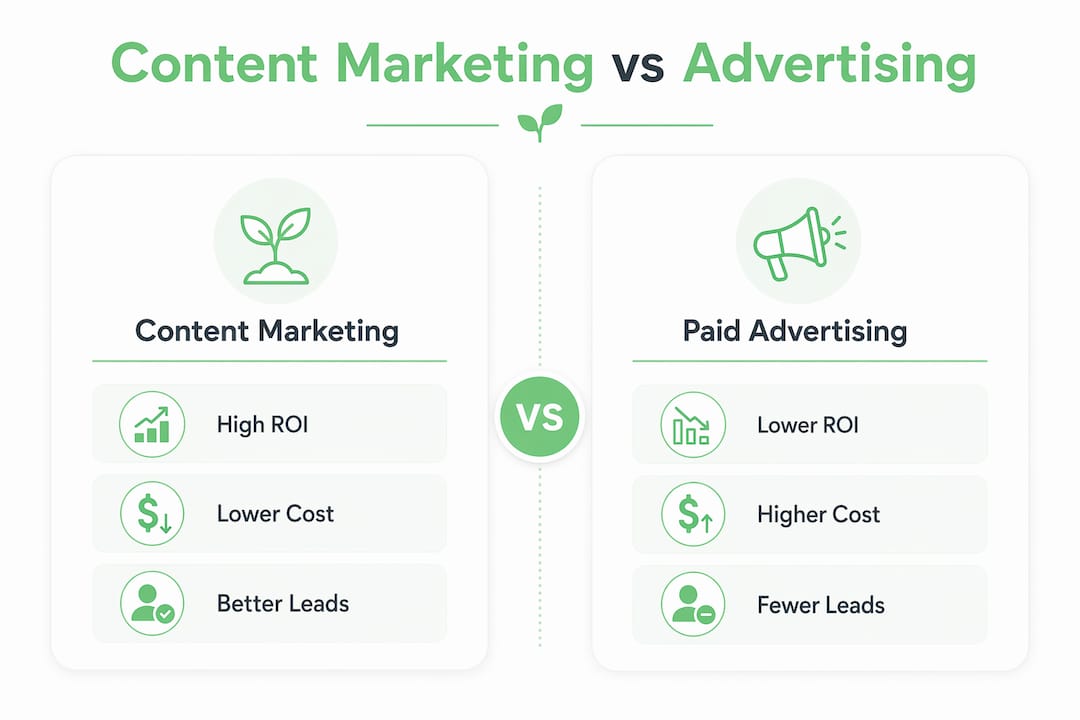
Content marketing delivers an average ROI of $7.65 per $1 spent, compared to $1.80 per $1 for paid advertising. That gap is significant for small businesses with tight budgets. Paid ads stop the moment you stop paying. Content keeps working.
The cost advantage is equally clear. Content marketing costs 62% less than outbound marketing while generating three times more leads. For a small business spending $1,000 a month on marketing, that difference compounds into a measurable competitive edge within 12 months.
| Metric | Content marketing | Paid advertising |
|---|---|---|
| Average ROI per $1 spent | $7.65 | $1.80 |
| Cost vs. outbound marketing | 62% lower | Baseline |
| Lead generation volume | 3x more | Baseline |
| Results after budget stops | Continues | Stops immediately |
Measurement is where most small businesses leave money on the table. Only 41% of marketers actively measure content marketing ROI. Yet those who do measure are 3.1 times more likely to receive budget increases. Tracking your results is not just good practice. It is the single fastest way to justify and grow your marketing investment.
Marketing ROI measurement remains the top challenge for marketers in 2026, particularly with multiple channels and AI-driven consumer journeys making attribution harder. The businesses that solve this problem first gain a clear advantage over competitors who are still guessing.
What common mistakes do small businesses make in content marketing?
Most small businesses do not fail at content marketing because they lack talent. They fail because they repeat the same avoidable mistakes.
- Writing for the business, not the customer. The biggest mistake is focusing content on what the business prefers rather than what customers search for. A restaurant owner who writes about their family history is not answering “best gluten-free brunch in Ottawa.” Address customer questions first, always.
- Publishing inconsistently. Inconsistent publishing prevents traction with search engines. Google rewards sites that publish regularly. One strong post per week builds authority far more effectively than sporadic bursts.
- Skipping distribution. Publishing a blog post and waiting for traffic is not a strategy. Publishing without structured distribution is ineffective. You need to actively push content to email lists, social channels, and relevant online communities.
- Promoting instead of educating. Content that reads like an ad gets ignored. Content that teaches, explains, or solves a problem gets shared, bookmarked, and linked to. The ratio should be roughly 80% educational to 20% promotional.
- Ignoring content alignment with business goals. Content must align with business goals and solve customer problems to drive revenue growth. Publishing content that gets traffic but never converts to inquiries or sales is a waste of resources.
Pro Tip: Before publishing any piece of content, ask one question: “Would my ideal customer find this genuinely useful?” If the honest answer is no, rewrite it or scrap it.
How to create an effective content marketing strategy
A content marketing strategy is a written plan that connects your content to specific business outcomes. Without one, you are publishing randomly and hoping for results.
Step 1: Define your content pillars
Content pillars organize your messaging into three to five distinct themes, each serving a different business goal. A trades company might use pillars like “emergency repairs,” “seasonal maintenance,” and “home improvement tips.” Every piece of content you create should belong to one pillar. This structure signals expertise to search engines and keeps your audience engaged with consistent, relevant material.
Step 2: Build a publishing calendar
A publishing calendar does not need to be complicated. A simple spreadsheet with topic, format, publish date, and distribution channel is enough. The goal is consistency. Consistency and discipline in publishing build long-term authority and success. Commit to a frequency you can maintain for 12 months, not just four weeks.
Want this working in your business — without doing it yourself?
Start a Project →Step 3: Create content that supports sales goals
Every piece of content should connect to a business outcome. A blog post about “how to choose a commercial cleaning service” is not just informational. It is a pre-sales tool that filters and qualifies leads before they ever contact you. Map each content piece to a stage in your sales process and track whether it moves people forward.
Step 4: Track performance and adjust
Top-performing content programs use dual tracking on Google Search Console and AI visibility platforms to prove revenue impact. Google Search Console shows organic search performance. AI visibility platforms show whether your content appears in tools like ChatGPT or Perplexity, which is an increasingly important discovery channel. Review your data monthly and cut content that consistently underperforms.
| Strategy element | What to track | Why it matters |
|---|---|---|
| Content pillars | Organic traffic per pillar | Shows which topics drive the most authority |
| Publishing calendar | Posts published vs. planned | Measures consistency and team accountability |
| Sales alignment | Leads from content pages | Connects content effort to revenue |
| Distribution | Referral traffic by channel | Reveals which platforms send qualified visitors |
| Performance review | Conversions per post | Identifies your highest-value content |
Key Takeaways
Content marketing outperforms paid advertising on ROI, cost, and lead volume, but only when it is built on customer questions, consistent publishing, and clear business goals.
| Point | Details |
|---|---|
| Content marketing definition | It is the practice of creating valuable content to attract and convert a defined audience. |
| ROI advantage | Content marketing returns $7.65 per $1 spent, compared to $1.80 for paid ads. |
| Measurement gap | Only 41% of marketers measure ROI, yet those who do are 3.1x more likely to get budget increases. |
| Biggest mistake | Writing for the business instead of answering real customer questions kills engagement and ROI. |
| Strategy foundation | Content pillars, a consistent calendar, and sales-aligned content are the three non-negotiable building blocks. |
What I’ve learned after years of watching small businesses get content marketing wrong
The most common thing I see is a business owner who publishes a handful of blog posts, waits three months, sees no results, and concludes that content marketing does not work. What actually happened is that they published content about themselves instead of their customers, had no distribution plan, and had no content pillars holding the site together. The content was invisible to Google and irrelevant to buyers.
The second thing I see is businesses treating content marketing as a short-term campaign. It is not. It is infrastructure. A well-structured website with strong content pillars is an asset that appreciates over time. A paid ad campaign is an expense that disappears the moment the budget runs out.
The insight that changes everything for most small businesses is this: your content should answer the questions your sales team hears every day. Not the questions you wish customers would ask. The actual questions. “How much does it cost?” “How long does it take?” “What happens if something goes wrong?” Answering those questions in writing, publicly, builds more trust than any brochure ever will.
One more thing worth saying plainly: content marketing in 2026 is not just about ranking on Google. AI tools like ChatGPT and Perplexity are now major discovery channels. If your content is not structured and authoritative enough to be cited by AI, you are already behind. The businesses that win will be the ones that optimize for both.
— Cristo
How Cloudsprout helps small businesses build content that works
Small businesses across Ontario come to Cloudsprout when they are tired of publishing content that goes nowhere. Cloudsprout handles content marketing, local SEO, website architecture, and distribution under one roof, with no outsourcing and no lock-in contracts. Every client starts with a full digital audit so you know exactly where you stand before any work begins.

If your content is not generating leads, the problem is almost always structural. Cloudsprout’s team identifies the gaps, builds the content pillars, and creates a publishing plan tied directly to your sales goals. Month-to-month pricing means you stay because the results are there, not because a contract forces you to.
FAQ
What is the content marketing definition in simple terms?
Content marketing is the practice of creating useful content, such as blog posts, videos, and guides, to attract potential customers and build trust before they buy.
How is content marketing different from advertising?
Advertising pays to interrupt people with a message. Content marketing earns attention by solving problems first, which builds longer-lasting trust and costs significantly less over time.
What are the best examples of content marketing for small businesses?
Strong examples include a local electrician publishing safety guides, a bakery sharing recipe videos, or an accountant writing tax-tip blog posts. Each piece answers a real customer question and drives organic traffic.
How long does content marketing take to show results?
Content marketing typically takes three to six months to show measurable organic traffic growth. Consistency and proper site structure accelerate results significantly.
Does content marketing work for Canadian small businesses specifically?
Local SEO and Google Business Profile are the top digital channels for Canadian small and mid-sized businesses. Content marketing that targets local search terms and customer questions delivers strong results in Canadian markets.
Recommended
Less reading. More growing.
We build the systems these articles describe — websites, AI follow-up, reviews, automation — and run them for you.
Keep reading