

Social media marketing is defined as using social media platforms to connect with audiences, build brand visibility, generate leads, and grow revenue. With 5.17 billion people active on social media globally, representing 63.7% of the world’s population, the opportunity for small businesses is enormous. The industry term for this practice is “social media marketing,” though you’ll also hear it called “social marketing” or “social strategy” in agency circles. For small business owners, understanding what social media marketing actually does, not just what it is, separates those who grow from those who post into the void.
What roles does social media marketing play in modern business growth?
Social media marketing does far more than run ads. It functions as a brand amplifier, a customer service desk, a market research tool, and a sales channel, all at once. Understanding each role helps small business owners allocate time and budget where it counts.

Building brand trust and accountability
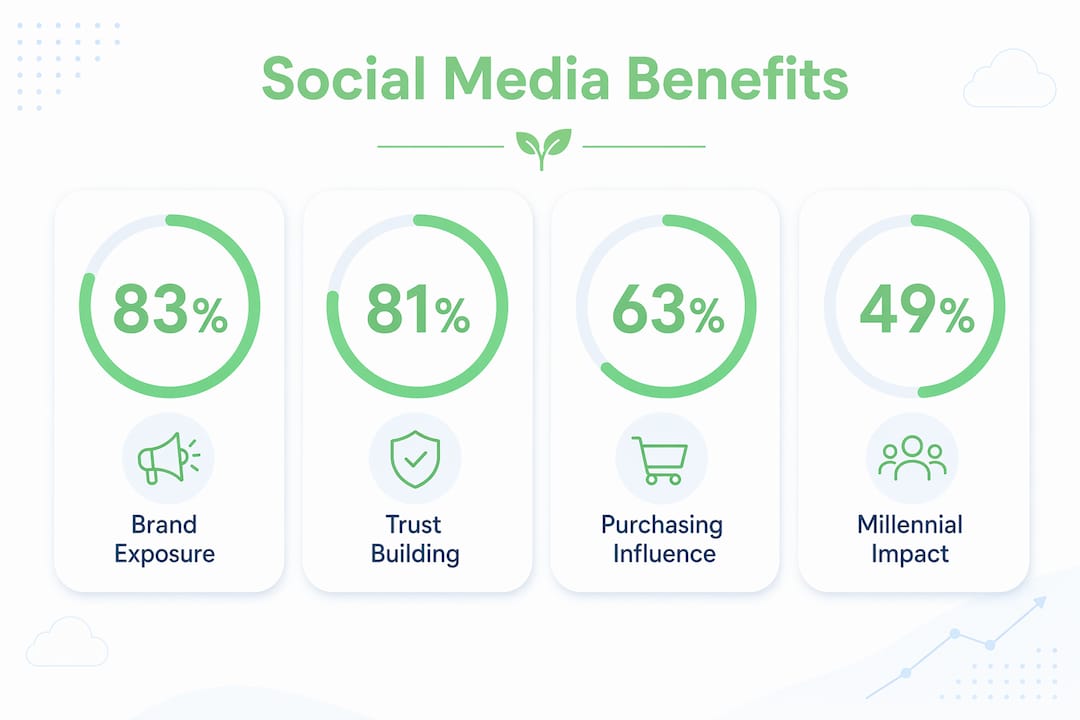
81% of consumers believe an active social media presence increases brand trust and accountability. That number matters because trust is the primary reason a first-time customer chooses a local plumber over a national chain. When your business posts consistently, responds to comments, and shows the people behind the work, you signal reliability. Silence on social media, by contrast, raises doubt.
Influencing purchasing decisions
Social media directly shapes what people buy. 63% of Gen Z and 49% of millennials report that social media ads or influencer recommendations influence their purchasing decisions. These two groups now represent the majority of consumer spending. A small business that ignores social media is effectively invisible to its fastest-growing customer segments.
Real-time customer service and crisis response
Social media acts as a real-time crisis management tool by monitoring sentiment and addressing customer concerns proactively. A negative review handled publicly and professionally often builds more trust than a perfect record. Customers watch how businesses respond under pressure. That response, or the absence of one, becomes part of your brand story.
Social listening and competitive intelligence
Social media marketing is a two-way dialogue. It gathers customer feedback and market intelligence that shapes the entire business strategy, not just the content calendar.
Social listening gives companies a competitive edge and directly influences product innovation. Small businesses that monitor conversations about their industry, their competitors, and their own brand gain insights that no survey can replicate. You learn what customers actually want, in their own words, before you spend money building it.
How do strategic approaches enhance the effectiveness of social media marketing?
A documented social media marketing strategy aligns activities with broader business goals. Without that document, social media becomes a series of disconnected posts with no measurable outcome. The businesses that see real returns treat social media as a system, not a hobby.
Setting SMART goals for social media
SMART goals (Specific, Measurable, Achievable, Relevant, and Time-bound) give your social media efforts a clear direction. “Get more followers” is not a goal. “Grow Instagram followers by 500 in 90 days by posting three times per week and responding to every comment within 24 hours” is a SMART goal. The difference is accountability. You either hit the number or you learn why you didn’t.
Choosing the right platforms
Small businesses should prioritize one or two platforms where their core audience is active. A restaurant owner in Ontario gets far more traction on Instagram and Facebook than on LinkedIn. A B2B bookkeeper gets the opposite result. Platform selection is not about personal preference. It is about where your customers already spend their time.
Building a content calendar
A content calendar removes the daily panic of “what do I post today?” It also creates consistency, which algorithms reward. The steps for building one are straightforward:
- Define your content pillars (education, promotion, community, behind the scenes).
- Map out posting frequency per platform based on your capacity.
- Schedule content at least two weeks in advance using a scheduling tool.
- Block time weekly to review comments and respond to messages.
- Review performance monthly and adjust based on what the data shows.
Pro Tip: Batch your content creation. Write captions, select images, and schedule one month of posts in a single two-hour session. This protects your consistency even during your busiest weeks.
Avoiding the “post and ghost” trap
Inconsistent engagement reduces reach because algorithms prioritize content that sparks genuine interaction. Posting without responding to comments, ignoring direct messages, and disappearing for weeks at a time all signal to the algorithm that your content is not worth amplifying. Engagement is not optional. It is the mechanism that makes organic reach work.
What are the demonstrable benefits of social media marketing for small businesses?
The benefits of social media are well documented and directly relevant to small business growth. Marketers worldwide report that social media marketing delivers increased exposure (83%), increased website traffic (71%), and lead generation (62%) as its top three outcomes. Each of those outcomes maps directly to a business goal.
| Benefit | What it means for your business |
|---|---|
| Increased brand exposure (83%) | More people recognize your name before they need your service |
| More website traffic (71%) | Social posts drive qualified visitors to your site |
| Lead generation (62%) | Followers convert to inquiries and sales |
| Community building | Repeat customers who advocate for your brand |
Beyond the numbers, active social media presence builds the kind of community that sustains a small business through slow seasons. Customers who feel connected to a brand spend more and refer more often. That loyalty is worth more than any single ad campaign.
Want this working in your business — without doing it yourself?
Start a Project →The impact of social media strategies also extends to long-term reputation. A business with 500 engaged followers and a track record of helpful, honest content outperforms a business with 5,000 passive followers every time. Engagement quality drives revenue. Follower count is just a vanity metric.
Pro Tip: Link every social media profile directly to a specific landing page on your website, not just your homepage. A targeted page converts visitors at a higher rate because it matches the intent of the post that sent them there.
How can small businesses effectively implement social media marketing strategies?
Implementation is where most small businesses stall. The strategy sounds clear, but the execution gets messy without a repeatable process. These are the practices that separate businesses that grow through social media from those that spin their wheels.
- Start with audience research. Know the age, location, interests, and problems of your ideal customer before you create a single post. Platform analytics and customer conversations give you this data for free.
- Create authentic content. Show real work, real people, and real results. Stock photos and generic captions do not build trust. A photo of your team finishing a job site or a short video explaining a common customer question outperforms polished corporate content.
- Use analytics to refine your approach. Check which posts drive the most profile visits, link clicks, and saves. Double down on those formats and topics. Cut what gets ignored.
- Balance paid and organic. Organic content builds community. Paid social advertising accelerates reach. Small businesses that align marketing investments with financial goals get better returns from both channels because they know exactly what each dollar needs to produce.
- Stay focused. Trying to maintain a presence on every platform dilutes your effort and burns out your team. Quality of interactions surpasses quantity across platforms for growth.
Social media has evolved from a supportive channel to an integral part of the customer journey, touching every stage from awareness to purchase to retention. Small businesses that treat it as a core function, not an afterthought, build compounding advantages over time. Every post, reply, and story adds to a body of content that works for your brand around the clock.
Key Takeaways
Social media marketing drives measurable business growth when small businesses treat it as a system built on clear goals, consistent engagement, and platform focus.
| Point | Details |
|---|---|
| Define your role first | Social media serves brand building, customer service, lead generation, and market research simultaneously. |
| Trust drives conversions | 81% of consumers link an active social presence to brand trust, which directly influences purchase decisions. |
| Platform focus beats platform volume | Prioritize one or two platforms where your audience is active to avoid diluted effort and burnout. |
| Engagement is not optional | Algorithms reduce reach for accounts that post without responding; consistent interaction is the mechanism for organic growth. |
| Measure what matters | Track exposure, traffic, and leads, not follower count, to connect social media activity to real business outcomes. |
What I’ve learned watching small businesses win and lose on social media
The biggest mistake I see small business owners make is treating social media as a broadcasting tool. They post their promotions, their hours, their announcements, and then wonder why nobody engages. Social media built on one-way broadcasting produces silence. The businesses I’ve watched grow consistently are the ones that ask questions, respond to every comment, and share content that serves the reader before it serves the brand.
The second pattern I’ve noticed is platform overextension. An owner-operator running a trades business cannot maintain a quality presence on Instagram, Facebook, TikTok, LinkedIn, and X simultaneously. Something always gets neglected. The accounts that neglect engagement pay for it in reach. The smarter move is to own two platforms completely rather than exist on five platforms poorly.
What surprises most small business owners is how much intelligence lives inside their social media analytics. The data tells you what your customers care about, when they are online, and what content makes them act. Most businesses collect that data and never look at it. Pairing social media insights with a broader digital marketing strategy is what separates businesses that grow from those that plateau.
Social media marketing is not a shortcut. It is a long-term investment in visibility, trust, and customer relationships. The businesses that commit to it with a clear strategy and genuine engagement are the ones still standing five years later.
— Cristo
How Cloudsprout helps small businesses get social media right
Small business owners in Ontario and across Canada often know they need a stronger social media presence but lack the time or systems to execute consistently. Cloudsprout builds and manages integrated social media marketing programs for owner-operators in trades, food service, professional services, and e-commerce.

Every engagement starts with a free digital audit that identifies where your current social presence is losing ground. From there, Cloudsprout’s in-house team handles content creation, community management, paid social, and analytics reporting under one roof. No outsourcing, no lock-in contracts, and direct access to the people doing the work. If your website development and social media are not working together to convert visitors into customers, that audit will show you exactly why.
FAQ
What is the role of social media marketing for small businesses?
Social media marketing connects small businesses with their target customers, builds brand trust, generates leads, and drives website traffic. It also functions as a real-time customer service channel and a source of market intelligence.
How does social media drive engagement and sales?
Consistent, authentic content combined with active responses to comments and messages builds community loyalty. 63% of Gen Z and 49% of millennials report that social media directly influences their purchasing decisions.
Why use social media for marketing instead of other channels?
Social media reaches 5.17 billion people globally and delivers measurable benefits including increased exposure, website traffic, and lead generation at a lower cost than most traditional advertising channels.
How many platforms should a small business use?
Small businesses should focus on one or two platforms where their core audience is most active. Spreading effort across too many platforms reduces content quality and engagement, which limits organic reach.
What makes a social media marketing strategy effective?
A documented strategy built on SMART goals, consistent content scheduling, active engagement, and regular analytics review produces the best results. Businesses that align their marketing with clear financial goals also see stronger returns on their social media investment.
Recommended
Less reading. More growing.
We build the systems these articles describe — websites, AI follow-up, reviews, automation — and run them for you.
Keep reading