TL;DR:
- Owner-operators should set one measurable 90-day business goal and follow the 2 Plus 1 channel rule.
- Focusing on two acquisition channels and one owned retention channel enhances strategy effectiveness and sustainability.
The single best approach for owner-operators is this: pick one measurable 90-day business goal, then apply the 2 Plus 1 channel rule — two acquisition channels where your audience already spends time, plus one retention channel you own outright. That’s it. Everything else flows from those two decisions.
Here’s what that looks like in practice:
- One 90-day goal: “Book 10 new HVAC tune-up appointments via Instagram DM by September 30.”
- Two acquisition channels: Instagram Reels + Google Business Profile posts.
- One retention channel: Email list (you own it; no algorithm can switch it off).
- Why it works: As Buffer notes, “random acts of content lead to random results.” One goal per quarter forces focus.
- Coming up: a channel scoring table, a 12-week calendar template, and real industry mini-plans for trades, food service, and more.
Table of Contents
- What types of social media strategies work for owner-operators?
- How do you choose the right channel mix?
- How do you build a practical 90-day social media plan?
- Which KPIs actually tell you if it’s working?
- What tools help owner-operators manage social media efficiently?
- What does social media actually cost in time and money?
- Industry mini-plans: 90-day examples by business type
- Cloudsprout can run your 90-day plan for you
- Key Takeaways
- Why most owner-operators are one decision away from a working strategy
- Useful sources
- FAQ
What types of social media strategies work for owner-operators?
Seven strategy types show up repeatedly across small-business social media. Each one fits a different business model, budget, and sales cycle.
- Organic content strategy: Regular posts, Reels, or Stories built around your expertise. Best fit: service businesses with a strong local reputation and time to create content consistently.
- Paid acquisition strategy: Facebook/Instagram ads, Google Ads, or TikTok Spark Ads targeting cold or warm audiences. Best fit: e-commerce or any owner ready to spend $300–$500/month to accelerate lead flow.
- Community-building strategy: Facebook Groups, LinkedIn engagement, or neighborhood apps like Nextdoor. Best fit: local service businesses (plumbers, salons, clinics) where word-of-mouth already drives referrals.
- Influencer and partnership strategy: Collaborating with local micro-influencers or complementary businesses. Best fit: food service, retail, or fitness studios where a single post from a trusted local voice can fill a week’s bookings.
- Retention and support strategy: Email sequences, SMS reminders, and DM-based customer service. Best fit: any owner who already has a customer list and wants repeat business without paying for new eyeballs every time.
- Shoppable and product-led strategy: Instagram Shopping, TikTok Shop, or Pinterest product pins. Best fit: e-commerce owners with a product catalog and decent photography.
- Event and promo-driven strategy: Seasonal campaigns, limited-time offers, or launch countdowns. Best fit: restaurants, non-profits, and retailers who have natural calendar hooks (back-to-school, tax season, holiday menus).
Pro Tip: Most owner-operators fall into the “post-and-ghost” trap — they publish a burst of content, get busy, and go silent for three weeks. Batch two weeks of posts in a single afternoon every other Sunday. Scheduled content keeps your feed alive even when a job runs long or a shipment is late.
How do you choose the right channel mix?
The 2 Plus 1 rule stops the platform-hopping that kills most small-business social efforts. Here’s how to score your options before committing.
Decision steps:
- Map your audience: Where do your actual buyers spend 20+ minutes a day?
- Audit your time: Can you realistically produce video, or is static image + caption more sustainable?
- Name your goal type: Awareness, leads, or direct bookings? Each favors different platforms.
- Score each channel below, then pick your top two acquisition scores plus your strongest retention option.
| Channel | Audience fit (local/B2B/consumer) | Weekly effort | Avg. monthly cost (DIY) | Speed to first result |
|---|---|---|---|---|
| Facebook/Meta | Local, community | Medium | $300–$500 ads | 2–4 weeks |
| Visual, 18–product/food/trades | Medium-high | $300–$500 ads | 2–6 weeks | |
| B2B, professional services | Medium | Organic | 4–8 weeks | |
| TikTok | 18–discovery, education | High (video) | $300–$500 ads | 1–3 weeks |
| YouTube | All ages, tutorials, trust-building | Very high | Organic | 12 weeks |
| Warm list, all ages | Low | Some cost monthly | 1–2 weeks | |
| SMS | Warm list, local, appointment-based | Very low | $10–$50/month | Days |
Forbes Advisor’s platform research confirms the pattern: Facebook and Meta for local and service businesses, Instagram for visual retail and food, LinkedIn for B2B and professional services.

Pro Tip: If you’re running any paid ads, start with retargeting warm visitors — people who already visited your website or watched 50% of a video. Cold audiences burn budget fast. Warm retargeting typically costs less per lead and converts faster, especially in the first 30 days.
How do you build a practical 90-day social media plan?
Hootsuite’s cyclical strategy framework — set goals, define audience, choose pillars, pick platforms, build a calendar, analyze, refine — maps cleanly onto a 90-day sprint. Here’s how to run it.
Step-by-step setup:
- Write one SMART goal: specific, measurable, time-bound. (“Generate 15 quote requests from Facebook by Day 90.”)
- Choose three content pillars: education, proof, and personality. A plumber might post “how-to fix a dripping tap” (education), a before/after photo (proof), and a funny job-site moment (personality).
- Assign channel roles: acquisition channels get your new content; your retention channel (email or SMS) gets repurposed highlights and offers.
- Set your cadence: Apaya’s small-business guide recommends 3–5 posts per week per platform, or a minimum of 2 per week if resources are tight.
- Block two content-batching sessions per month. Shoot or write everything in one go, then schedule it.
Sample 12-week calendar:
| Month | Week | Focus | Post types |
|---|---|---|---|
| Month 1 | 1–2 | Establish presence | Intro post, FAQ answer, behind-the-scenes |
| Month 1 | 3–4 | Build proof | Before/after, customer result, service reveal |
| Month 2 | 5–6 | Drive awareness | Educational Reel, tip carousel, seasonal hook |
| Month 2 | 7–8 | Generate leads | Offer post, deadline reminder, DM CTA |
| Month 3 | 10 | Deepen trust | Story highlight, FAQ follow-up, local shoutout |
| Month 3 | 12 | Review and scale | Best-performer repost, email recap, 90-day recap post |
30/60/90 checkpoint questions: At Day 30, ask: “Which post got the most saves or DMs?” At Day 60: “Is my retention channel growing?” At Day 90: “Did I hit the goal? What single change would most improve Month 4?”
For a ready-made content planning framework, Cloudsprout’s content marketing checklist walks through pillar selection in detail.
Which KPIs actually tell you if it’s working?
Many marketers now prioritize performance-based KPIs like conversion rates and CTR over vanity metrics, according to Hootsuite’s 2026 survey. Follower count and likes feel good. They rarely pay the rent.
Track these instead: conversions (form fills, calls, bookings), CTR on ads and link posts, cost per lead (CPL), repeat purchase rate, and email open rate.
| Metric | What it tells you | Check it |
|---|---|---|
| Conversion rate | Are viewers becoming leads or buyers? | Weekly |
| CTR (ads + organic links) | Is the creative or copy compelling enough to click? | Weekly |
| Cost per lead (CPL) | Is paid spend efficient? | Weekly (ads only) |
| Email open rate | Is your retention channel healthy? | Per send |
| Repeat purchase / rebook rate | Are customers coming back? | Monthly |
Weekly report template (takes 10 minutes):
Write down your top metric, one insight (“Tuesday Reels outperform Monday by 2x”), and one action (“Shift posting to Tuesday, test a new hook format”).
Simple A/B tests to run without heavy tooling: swap one headline word in an ad, test a question-style caption versus a statement-style caption, or try a photo versus a Reel for the same offer. Run each test for 7–14 days before drawing conclusions.
What tools help owner-operators manage social media efficiently?
| Job | Tool options | Why it helps |
|---|---|---|
| Scheduling | Buffer, Later, Meta Business Suite | Batch and queue posts; saves 3–5 hours/week |
| Creative templates | Canva, Adobe Express | Consistent branded graphics without a designer |
| Basic analytics | Native platform insights, Google Analytics | Free; covers reach, CTR, and traffic source |
| Ad management | Meta Ads Manager, Google Ads | Self-serve; start with $5–$10/day |
| Email/retention | Mailchimp, Kit (formerly ConvertKit) | Free tiers available; automation-ready |
| Social inbox | Meta Business Suite, Hootsuite free | Centralizes DMs and comments across pages |
For owners who want to run social media without an agency, Buffer and Meta Business Suite together cover scheduling, basic analytics, and ad management at zero monthly cost.
What does social media actually cost in time and money?
| Approach | Weekly time | Monthly cost | Best for |
|---|---|---|---|
| DIY (owner does everything) | 5–10 hours | Tools available at zero cost | Tight budget, high personal brand value |
| Hybrid (tools + occasional freelancer) | 2–4 hours | $300–$500 | Owners who want consistency without full handoff |
| Fully outsourced | Under 1 hour | — | Owners whose time is worth more than the agency fee |
Outsourcing decision checklist:
Want this working in your business — without doing it yourself?
Start a Project →- Is social media generating leads you can trace? If not, fix the strategy before paying an agency.
- Is your hourly rate higher than what a freelancer charges for the same task?
- Do you have a content library (photos, videos, past work) an agency can actually use?
- Can you review and approve content in under 30 minutes per week?
If you answered yes to three or four of those, outsourcing likely pays for itself. If you answered no to most, spend another 60 days building your content library first.
Industry mini-plans: 90-day examples by business type
-
Trades (plumber, electrician, roofer): Goal: several booked estimates in a 90-day period. Acquisition: Instagram Reels (before/after footage shot on a phone) + Google Business Profile posts. Retention: Email with seasonal maintenance reminders. Day-30 checkpoint: 3 estimates booked. Day-60: 6–7. Day-90: 10+. Leads typically appear within the first two weeks if Reels show a recognizable local problem (e.g., “frozen pipe fix in under 20 minutes”).
-
Food service (restaurant, café, food truck): Goal: new Instagram followers converted to first-time visits. Acquisition: Instagram Reels (daily special, kitchen prep, staff moment) + Facebook Events. Retention: SMS list with weekly “secret menu” text. Expect foot traffic uptick around Day 21–30 when Reels start gaining local reach.
-
Professional services (accountant, lawyer, consultant): Goal: several discovery calls booked via LinkedIn in a 90-day time frame. Acquisition: LinkedIn posts (one insight per week, one client-result story per week) + blog SEO. Retention: Email newsletter with one useful tip per send. LinkedIn is the industry standard for B2B professional services. Calls usually start appearing around Day 45–60.
-
Non-profit: Goal: new email subscribers and a moderate amount in online donations over a 90-day period. Acquisition: Facebook (community groups + event posts) + Instagram Stories with donation sticker. Retention: Email with impact updates and donor recognition. Donation conversions typically pick up in Weeks 8–12 once trust is established.
-
E-commerce: Goal: a number of first-time purchases from social traffic within 90 days. Acquisition: TikTok product demos + Instagram Shopping posts. Retention: Email abandoned-cart sequence (3 emails over 5 days). Expect first purchases within Days 7–14 if the product solves a visible problem and the video shows it working.
Cloudsprout can run your 90-day plan for you
Running a 90-day social strategy while managing a business is doable. Running it well, consistently, without dropping client work, is where most owner-operators stall.
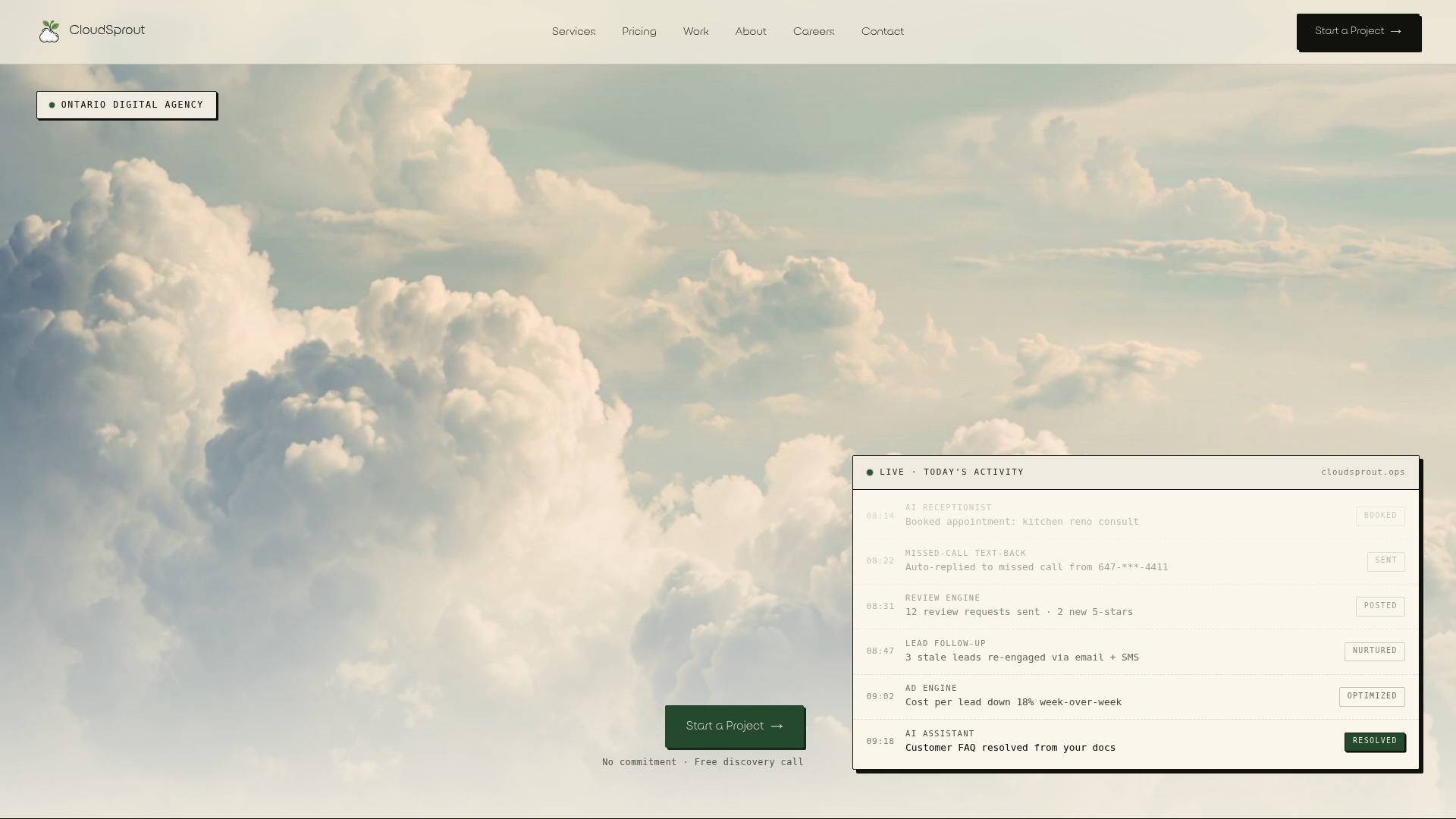
Cloudsprout handles the whole system in-house: social strategy, content production, ads setup, email retention builds, and small-business SEO — no outsourcing, no revolving freelancers. You get direct access to the team doing the work, month-to-month pricing, and no lock-in contracts. New clients start with a Free Social Week — a no-risk way to see exactly what a managed 90-day plan looks like before committing to anything.
Book your Free Social Week or grab a free SEO audit at cloudsprout.ca to get started today.
Key Takeaways
Owner-operators who pick one measurable 90-day goal and apply the 2 Plus 1 channel rule consistently outperform those who post randomly across every platform.
| Point | Details |
|---|---|
| One goal per 90 days | Write one SMART business goal before choosing any platform or content type. |
| 2 Plus 1 channel rule | Pick two acquisition channels and one retention channel you own (email or SMS). |
| Post 3–5 times per week | Aim for 3–5 posts per platform per week; 2 per week is the minimum to maintain momentum. |
| Track performance KPIs | Measure conversions, CTR, and cost per lead — not follower count or likes. |
| Cloudsprout free trial | Cloudsprout’s Free Social Week lets owner-operators test a fully managed 90-day plan at zero risk. |
Why most owner-operators are one decision away from a working strategy
The conventional advice tells you to “be on every platform” and “post consistently.” That’s not wrong, exactly. It’s just incomplete in a way that quietly wastes months of effort.
What actually separates owner-operators who get leads from social media from those who don’t is almost never the platform they chose. It’s whether they made a single, specific commitment before they posted anything. One goal. One audience. One retention channel they control.
The surprising part? The best-performing content I see from small businesses is almost always the stuff that looks unpolished: a phone video of a job in progress, a photo of a real mistake and how it got fixed, a 45-second clip of someone explaining why they do things a certain way. That kind of content is something a big brand can’t replicate. You can shoot it between jobs, and it builds the kind of trust that a $5,000 ad campaign often can’t buy.
If you want to protect and grow that trust once you’ve built it, pairing your social presence with solid reputation management practices is worth the time. Reviews, responses, and how you handle public feedback all feed directly into whether a new follower becomes a paying customer.
Start with the 2 Plus 1 rule. Set one 90-day goal. Batch your first two weeks of content this weekend. That’s the whole plan.
Useful sources
- Buffer: Social Media Marketing Strategy — The source for the “random acts of content” principle and the case for one measurable goal per quarter. Backs the BLUF and 90-day planning sections.
- Buffer: Complete Guide to Social Media Marketing — Platform-focus guidance and the principle of going deep on two channels rather than thin across many. Supports the channel selection framework.
- Hootsuite: 2026 Social Media Marketing Strategy — The 7-step cyclical strategy that underpins the 90-day plan structure and checkpoint prompts.
- Hootsuite: 2026 Survey Summary — Source for the 69% performance KPI statistic used in the measurement section.
- Swallowtail Social: How to Create a Social Media Strategy — Primary source for the 2 Plus 1 channel rule recommendation for small businesses.
- Forbes Advisor: Social Media Marketing Guide — Platform-fit guidance by industry (Facebook for local, LinkedIn for B2B) used in the channel table and industry examples.
- Apaya: AI Social Media for Small Businesses — Source for the 3–5 posts per week cadence recommendation used in the 90-day calendar.
- AMA: 8 Steps to Build a Successful Social Media Strategy — Authoritative framework for audience definition, platform selection, and competitive positioning.
- Cloudsprout: Social Media Marketing for Ontario Small Businesses — Localized guidance for Ontario owner-operators; supports the regional examples throughout.
FAQ
What is the 2 Plus 1 rule for social media?
The 2 Plus 1 rule means choosing two acquisition channels (where new customers find you) and one retention channel you own, like email or SMS. It prevents platform overload and keeps your strategy sustainable.
How often should an owner-operator post on social media?
Aim for 3–5 posts per week per platform, or a minimum of 2 per week if time is limited. Consistency matters more than volume.
Which social media platform is best for small local businesses?
Facebook and Instagram give local service businesses the strongest combination of community reach, reviews, and direct messaging. LinkedIn is the better choice for B2B or professional services.
What KPIs should owner-operators track?
According to Hootsuite’s 2026 survey, 69% of marketers track performance-based KPIs like conversions, click-through rate (CTR), cost per lead, and email open rate. Follower count and likes are not reliable indicators of business results.
How can Cloudsprout help with a 90-day social media plan?
Cloudsprout builds and runs the full 90-day plan in-house, including content, ads, and email retention, with no lock-in contracts. New clients can start with a Free Social Week to test the service before committing.
Recommended
Less reading. More growing.
We build the systems these articles describe — websites, AI follow-up, reviews, automation — and run them for you.
Keep reading