Yes, and most small businesses start smaller than they expect. The realistic first move is not a full chatbot rollout. It’s a narrow pilot that answers your most repeated questions, using your own knowledge base as the source of truth. Done right, that alone can deflect a meaningful share of routine tickets within weeks, not months.
Before you touch any software, do this:
- Pull your last 90 days of support tickets and tag the top 10 recurring topics.
- Check whether you have a single, current knowledge base article for each one (most SMBs don’t).
- Pick one channel, usually chat, for a 30 to 60 day pilot.
Pro Tip: Watch one number first: AI resolution rate (the percentage of conversations the AI closes without a human touching them). Everything else, cost savings, CSAT, handle time, follows from that.
The rest of this guide walks through the use cases worth automating, the exact pilot steps, what to connect, how to measure it, and where SMBs get burned.
Key Takeaways
A narrow, KB-driven pilot on one channel is the fastest and safest way for an SMB to prove AI customer support works before scaling it further.
| Point | Details |
|---|---|
| Start with ticket data | Pull 90 days of tickets and automate only your top 1 to 3 recurring request types first. |
| Fix the knowledge base first | A stale or inconsistent knowledge base produces confident wrong answers no matter how good the AI is. |
| Watch resolution rate first | Track AI resolution rate weekly during the pilot before worrying about cost savings or CSAT. |
| Build in escalation rules | Set clear human handoff triggers for money, complaints, and cancellations before launch. |
| Consider Cloudsprout for the pilot | Cloudsprout runs a diagnostic, 30-day pilot, KPI report, and scale plan in-house with month-to-month terms. |
Table of Contents
- How to Automate Customer Support With AI: Where to Start
- What Are the Steps to Pilot AI Customer Support?
- What Systems Does AI Customer Support Need to Connect To?
- How Do You Measure Whether AI Support Is Working?
- What Are the Risks of Automating Customer Support?
- How Cloudsprout Runs an AI Support Pilot
- The Real Bottleneck Isn’t the AI
- Ready to Pilot AI Support Without the Guesswork
- Sources
- FAQ
How to Automate Customer Support With AI: Where to Start
Not every support task is worth automating, and treating them all the same is how pilots stall. The tasks with the best return share one trait: they’re repetitive, low-risk, and answerable from information you already have.
High-value automation targets for SMBs:
- FAQ and policy questions (hours, returns, shipping costs, warranty terms)
- Order status and tracking lookups
- Ticket triage and routing to the right team or priority level
- Appointment scheduling and rescheduling
- Conversation summaries for agents picking up a handoff
- After-hours intake so nothing sits untouched overnight
The business case is straightforward. A chat agent doesn’t clock out, so you get coverage outside your posted hours without hiring a night shift. Zendesk’s research on AI use cases points to reduced average handle time as the more immediate win, since agents stop retyping the same answer to “where’s my order” fifteen times a day.
Picture a five-person e-commerce shop. Before automation, a single owner answers every email personally, often the same three questions on repeat: shipping timelines, return policy, and sizing. After connecting a chat widget to the knowledge base, those three questions get answered instantly, day or night, and the owner’s inbox shrinks to the messages that actually need a human, damaged items, custom orders, complaints. That’s the pattern that shows up again and again: automation doesn’t replace the owner, it removes the repetitive third of the workload.

Intercom’s documentation on conversational AI describes agents that hold context across a conversation and pull from a company’s own knowledge source rather than generic training data, which is the difference between a bot that sounds helpful and one that’s actually right. Gartner has gone further, predicting that agentic AI will autonomously resolve a large share of common customer-service issues over the next several years. That’s a long-term trajectory, not a week-one benchmark, but it tells you where the ceiling is heading.
For a deeper look at chatbot-specific setups, Cloudsprout’s guide to AI chatbots for small businesses walks through templates for the FAQ and order-status use cases above.
What Are the Steps to Pilot AI Customer Support?
A pilot fails for one of two reasons: the scope is too broad, or the knowledge base underneath it is thin. Here’s the sequence that avoids both.
- Map ticket types and volumes. Export the last quarter of tickets and sort by topic. You’re looking for the two or three categories that make up the bulk of volume, usually FAQs, order status, and basic troubleshooting.
- Pick your top 1 to 3 automatable requests. Resist the urge to automate everything at once. A narrow pilot with clean data beats a broad one with gaps.
- Build or fix your single source-of-truth knowledge base. If your return policy lives in three slightly different versions across your website, a PDF, and an employee’s head, fix that first. AI answers are only as good as what you feed it, and a stale knowledge base produces confident wrong answers.
- Write approved answers for your top questions. Don’t let the AI improvise on policy. Draft the exact wording you want it to give for refunds, warranties, and pricing, then let it use that language.
- Decide channel scope. Start with chat on your website or Facebook page. Add email routing once chat is stable. Voice automation is the hardest to get right and should come last, if at all, for most SMBs.
- Set escalation rules up front. Define what triggers a handoff to a human: certain keywords (“cancel,” “lawyer,” “refund over $200”), repeated failed attempts, or a customer explicitly asking for a person.
- Design the pilot with guardrails. Run it on a defined sample, say, 20% of chat traffic, with a human reviewing a sample of transcripts daily for the first two weeks and weekly after that.
- Iterate the prompts and rules. Expect to rewrite answers in week one based on what the AI actually gets wrong, not what you assumed it would get wrong.
- Expand once KPIs hold steady. Add a channel or widen the traffic sample only after your resolution rate and CSAT stay consistent for at least two full weeks.
Zapier’s guide to AI in customer service frames this the same way: start narrow, prove it on a small slice of volume, then scale the parts that work. That sequencing matters more than which specific tool you pick.
Pro Tip: Keep a running “miss list” during the pilot, every question the AI got wrong or escalated incorrectly. That list becomes your training data for round two, and it’s more useful than any dashboard metric.
What Systems Does AI Customer Support Need to Connect To?
The automation is only as useful as what it can see. Before you pick a tool, map what it needs to touch:
- Helpdesk software (where tickets live and get assigned)
- CRM (customer history, order records, past interactions)
- Knowledge base (your policies, FAQs, product details)
- Order or shipment tracking systems (for status lookups)
- Call recordings or transcripts, if you’re automating any voice support
You have three basic ways to connect these. Native connectors, built directly into your helpdesk or CRM platform, are the easiest for a non-technical owner and usually the right starting point. Middleware tools like Zapier sit between systems that don’t talk to each other natively, useful if your order system and your helpdesk are from different vendors and neither has a direct plug for the other. Direct API integration gives you the most control but requires either in-house technical skill or a developer, which is usually overkill for a first pilot.
Whichever path you choose, keep basic data stewardship in place: track where each AI answer’s source information came from (provenance), log every automated conversation for review, and limit what customer data the AI can access to only what it needs for that request. A checklist for connecting intake, routing, and follow-up workflows is covered in Cloudsprout’s marketing automation tools checklist.
Pro Tip: If your helpdesk and CRM are already from the same vendor family (say, both from one platform’s ecosystem), check for a native integration before reaching for middleware. It’s one less thing to break.
How Do You Measure Whether AI Support Is Working?
Four numbers tell you almost everything you need to know. AI resolution rate is the share of conversations the AI closes without any human involvement. Deflection rate measures how many tickets never reach a human agent’s queue at all. CSAT (customer satisfaction score) tells you whether people are actually happy with the automated answer, not just whether it technically closed the ticket. Mean time to resolution (MTTR) shows whether response speed actually improved.
The ROI math is simple enough to do on a napkin: take your average cost per agent-hour, multiply by hours saved per week from deflected tickets, then add in the value of backlog reduction (fewer tickets sitting unanswered means fewer lost customers). Project that from your pilot’s actual numbers rather than a vendor’s marketing claim.
Want this working in your business. Without doing it yourself?
Start a Project →Reasonable benchmarks for a first pilot:
- Weeks 1 to 2: expect a rough, imperfect resolution rate as you fix wrong answers.
- Weeks 3 to 6: resolution rate should stabilize once your knowledge base and escalation rules settle.
- By week 8: CSAT for automated conversations should be within range of your human-agent CSAT, not dramatically lower.
Zendesk’s best-practices research recommends tracking these metrics weekly during a pilot rather than waiting for a monthly report, since problems compound fast when a wrong answer keeps going out unnoticed.
What Are the Risks of Automating Customer Support?
The most common failure isn’t a rude bot. It’s a confident, wrong one. AI models can hallucinate answers that sound plausible but aren’t grounded in your actual policy, and a system without proper account controls can occasionally take the wrong action on the wrong customer record. Tone mismatch is the quieter risk: an AI trained on generic data can sound stiff or oddly cheerful in situations that call for an apology.
Governance controls worth putting in place before launch:
- Human-in-the-loop review for any conversation involving money, cancellations, or complaints.
- Canned fallback responses (“Let me get a person to help with that”) for anything outside the AI’s approved scope.
- Business-rule filters that block certain actions entirely (refunds over a set dollar amount, account deletions, address changes).
- Clear escalation thresholds, defined by keyword, sentiment, or repeated failed attempts.
Grounding matters here. Vendors design AI agents around techniques that tie responses back to a company’s own verified knowledge rather than letting the model improvise, which is exactly the kind of control an SMB should demand from any tool it picks. Test for tone before launch too. Run sample angry-customer and confused-customer scenarios through the bot and read the replies out loud. If they sound tone-deaf on a text screen, they’ll sound worse to a frustrated customer.
Pro Tip: Give your AI a scripted, plainly worded way to say “I’m not sure, let me connect you with someone.” A bot that admits it doesn’t know is far less damaging than one that guesses.
How Cloudsprout Runs an AI Support Pilot
Cloudsprout works with owner-operated businesses across trades, food service, professional services, and e-commerce, the same group that usually has no in-house IT team to run this kind of project alone. That focus shapes the process: no jargon, no long contracts, and a pilot built to prove itself before you commit further.
The path looks like this: a diagnostic review of your current tickets and knowledge base, a 30-day pilot on one or two channels, a KPI report showing resolution rate and time saved, then a scale plan if the numbers hold up.
A pilot that can’t show its own numbers isn’t a pilot, it’s a guess with a subscription fee attached.
What gets delivered along the way:
- A knowledge base audit and gap list
- Integration setup with your existing helpdesk or CRM
- Test scripts covering common and edge-case conversations
- A KPI dashboard tracking resolution rate, deflection, and CSAT
- A rollout plan for scaling past the pilot
Full detail on the evaluate-pilot-scale sequence lives in Cloudsprout’s AI support agents playbook.
The Real Bottleneck Isn’t the AI
Most advice on this topic focuses on picking the right tool, and that’s the wrong first question. The AI models available to SMBs today are good enough for FAQ answers, order lookups, and triage. What breaks pilots is almost always the knowledge base underneath: outdated policies, three conflicting versions of the same answer, no clear owner for keeping it current.
Full automation is rarer than the marketing suggests, too. It’s the sensible one.
If you take one thing from this, prioritize the boring work first: clean up your policy documentation, write down the answers you actually want given, and only then start comparing tools. A great AI agent pointed at a messy knowledge base will just be confidently wrong faster than a person would have been.
Ready to Pilot AI Support Without the Guesswork
Cloudsprout gives you a full digital audit before you spend a dollar, so you know exactly what your ticket volume, knowledge base gaps, and integration options look like before committing to anything.
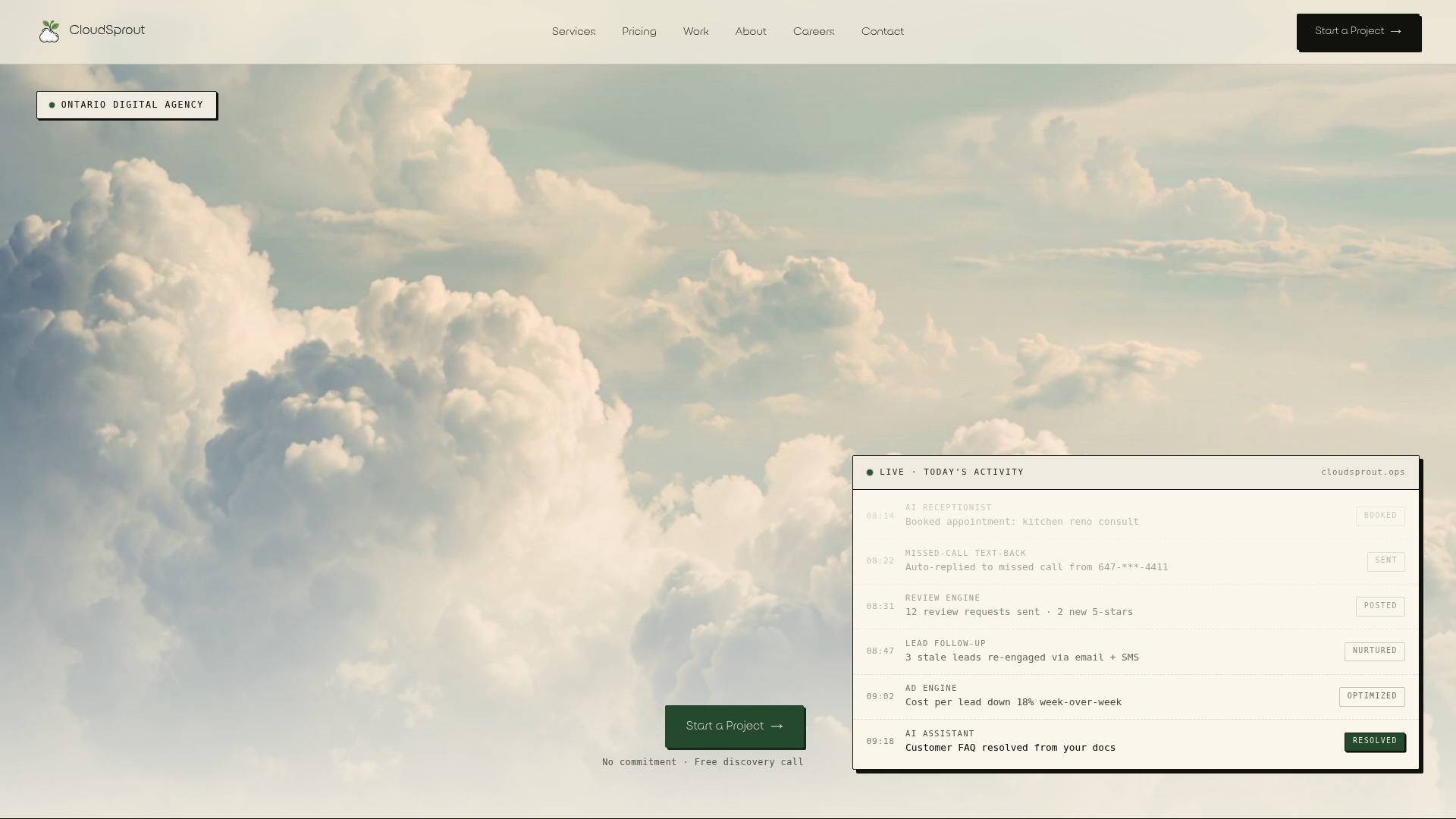
Unlike a typical agency retainer that locks you into a long contract for services you can’t easily evaluate, Cloudsprout runs everything in-house, no outsourced developers, no black-box pricing, and month-to-month terms you can walk away from if the results aren’t there. For a business trying to automate support without hiring a technical team, that direct access matters: you talk to the person actually building your pilot, not an account manager relaying messages.
If website integration or a customer-facing portal is part of your support setup, Cloudsprout’s website development services can connect that front end to the same knowledge base your AI pilot uses. Start with the free digital audit to see where your support operation stands before you commit to a pilot.
Sources
- Gartner press release: agentic AI prediction
- AI in customer service: Benefits, uses + best practices — Zendesk
- AI in customer service: A complete guide — Zapier
- Conversational AI platform for customer service — Intercom
FAQ
How Do I Automate Customer Support With AI?
Start by mapping your top recurring ticket types, then connect a chat-based AI agent to a verified knowledge base and pilot it on one channel for 30 to 60 days before expanding.
How Is AI Used in Customer Support?
AI handles FAQ answers, order status lookups, ticket triage, and conversation summaries, while routing anything involving money, complaints, or edge cases to a human agent.
What Is Automated Customer Support?
Automated customer support uses AI to answer routine customer questions and complete simple tasks without a human agent, typically pulling answers from a company’s knowledge base and escalating anything it can’t confidently handle.
Can AI Handle Customer Service Phone Calls?
Yes, but voice automation is harder to get right than chat, and most SMBs should pilot chat and email first before attempting voice support.
Recommended
Less reading. More growing.
We build the systems these articles describe. Websites, AI follow-up, reviews, automation. And run them for you.
Keep reading