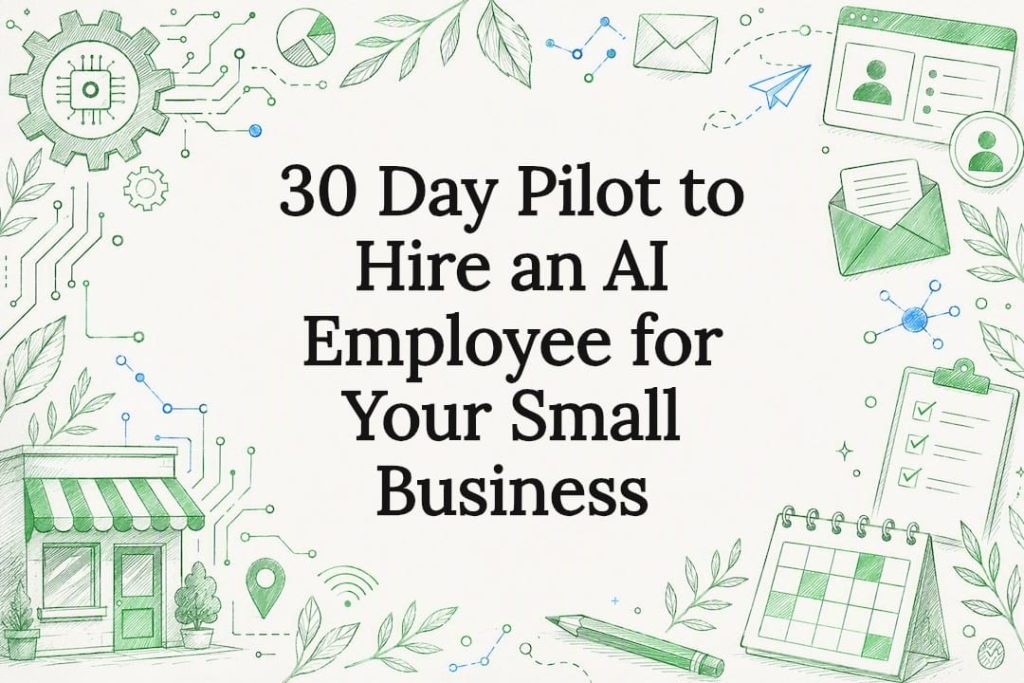
Yes, if you have one recurring digital task eating your week, hire a single AI employee and run it in draft mode for 30 days before trusting it with anything else. The upside is real time back on tasks like inbox triage or lead follow up, but the risk is skipping the pilot and handing over access before you’ve measured accuracy. Pick one task, name a human owner, and start small.
TL;DR:
- AI employees should be tested in draft mode for at least 30 days on a single recurring digital task before granting broader access or trust.
- Tasks suitable for initial AI automation include support triage, inbox management, lead qualification, CRM data enrichment, and KPI reporting, especially when processes are documented.
- Key performance metrics to monitor during pilots are approve-without-edit rate, tasks deflected, hours saved weekly, and cost per task, to gauge reliability and efficiency gains.
- A well-defined role contract, including scope, triggers, allowed actions, accountability, and rollback plan, is essential before implementing AI automation to prevent errors and control costs.
- Use strict permission scoping, audit trails, and predefined cost caps to prevent AI from becoming a liability or exposing sensitive data.
Table of Contents
- What Is an AI Employee for Small Business (and How It Differs From a Chatbot)
- Which Jobs Should You Hand to an AI Employee First?
- What Results Should You Actually Expect?
- How Do You Decide to Hire and Run Your First AI Employee?
- What Does the Implementation Checklist Look Like Day to Day?
- How Do You Keep an AI Employee From Becoming a Liability?
- How Cloudsprout Pilots AI Employees for Owner-Operators
- Why the “Set It and Forget It” Pitch Is the Wrong Way to Think About This
- Ready to Run Your First AI Employee Pilot?
- Sources
- FAQ
What Is an AI Employee for Small Business (and How It Differs From a Chatbot)
An AI employee is not a chatbot with a better name. A chatbot answers a single prompt and forgets you the moment the window closes. A copilot sits next to you and suggests text while you do the work. An AI employee is different: it’s an agentic system assigned a recurring role, one that remembers context across days or weeks, watches for specific triggers, and takes permitted actions on its own, inside boundaries you set.

Rule-based automation is a third category worth separating out. A Zapier-style workflow does exactly the same deterministic steps every time, with no judgment involved. An AI employee, by contrast, evaluates a situation and decides what to do within its scope. Anthropic’s Slack-integrated Claude Tag illustrates the shift: it acts as a visible team member inside a channel, handling multi-step tasks and even flagging code changes for approval before merging, rather than just answering a single question.
Before you call something an “AI employee,” run it through a five-part test:
- Role: Does it own a defined job, not just a task?
- Continuity: Does it retain context between sessions?
- Triggers: Does it act on specific events (a new lead, a support ticket) without being prompted each time?
- Agency: Can it take real actions, like sending an email or updating a CRM record, not just draft suggestions?
- Accountability: Is there a named human who reviews its output and owns the outcome?
If a tool fails two or more of these, it’s a chatbot wearing a costume, and the 5-part test is worth applying to any vendor pitch before you sign anything.
Which Jobs Should You Hand to an AI Employee First?
Some tasks are almost custom-built for this. Others are a trap. The good ones share four traits: they happen often, they live entirely on a screen, you can check whether the output was right, and a mistake is easy to undo.
- Support triage and draft replies. Incoming tickets get sorted by urgency, and the AI drafts a first response using your knowledge base. A human approves or edits before it sends. Salesforce’s rundown of employee agents points to this exact pattern already running inside small sales teams.
- Inbox and calendar triage. The AI flags priority emails, drafts scheduling replies, and blocks time for follow-ups, leaving your actual replies for you to send.
- Lead qualification and booking. A new inquiry comes in, the AI asks the two or three questions that matter, and books a call only if the answers clear your bar.
- CRM enrichment. Every new contact gets cleaned, tagged, and cross-referenced against past interactions automatically, instead of sitting half-filled for a month.
- KPI reporting. Every Monday morning, a short dashboard summary lands in your inbox instead of you pulling numbers from three different tools.
- Weekly research briefs. The AI scans competitor pricing or industry news and sends a one-page summary before your Tuesday check-in.
Pro Tip: Start with whichever task on this list already has a written process, even a messy one in a shared doc. An AI employee learns your rules faster when the rules already exist somewhere on paper.
What Results Should You Actually Expect?
Time savings are the headline benefit, and they’re real for volume work: an AI employee that handles the first draft of every support reply frees hours you’d otherwise spend typing the same three answers all week. Consistency is the quieter win. A tired employee on a Friday afternoon writes shorter, sloppier replies than they do Monday morning. An AI employee doesn’t have a bad day.
Gartner forecasts that agentic AI will autonomously resolve 80% of common customer service issues without human intervention by 2029. That’s a five-year-out projection, not a promise for your first month, but it signals where the ceiling is heading for support-style roles.
Where AI employees still struggle: anything requiring genuine judgment calls, like deciding whether to fire a vendor, negotiating a lease, or handling a customer who’s genuinely irate rather than just confused. Physical work is obviously off the table too. Vendors themselves generally frame the honest goal as offloading repetitive administrative load so the humans on your team can spend their energy on empathy and complex strategy, not replacing that judgment outright.
Track four numbers from day one:
- Approve-without-edit rate: the percentage of drafts you send as-is, with zero changes.
- Tickets or tasks deflected: how many never needed your direct attention at all.
- Hours saved per week: measured against what the task used to take you or a staff member.
- Cost per ticket or lead: what the AI actually costs divided by volume handled.
How Do You Decide to Hire and Run Your First AI Employee?
Run every candidate task through this checklist before committing to anything:
- Is it recurring? A one-off project isn’t worth building a role around.
- Is it entirely digital? Physical steps break the loop.
- Can you measure whether it was done correctly? If you can’t tell right from wrong, you can’t grade it.
- Is it reversible? A draft you can edit is safe. A refund you can’t claw back isn’t.
- Is the process already documented somewhere, even informally?
If a task clears four of five, it’s a strong pilot candidate. Once you’ve picked one, write it up as a short role contract before you touch any software:
- Scope: the exact job, in one sentence.
- Triggers: what starts the AI’s work (a new email, a form submission, a schedule).
- Allowed actions: what it can do without asking (draft, tag, summarize) versus what needs sign-off (send, refund, delete).
- Non-goals: what it should never touch, spelled out explicitly.
- Acceptance criteria: what “done correctly” looks like.
- Accountable human: one named person, not “the team.”
Then move through four stages over roughly 30 days: sandbox testing on old data with no live exposure, then draft mode where every output waits for your approval, then semi-autonomous where low-risk actions go through automatically and only edge cases get flagged, then full autonomy once your approve-without-edit rate holds steady above whatever threshold you set, often somewhere in the 85 to 95 percent range depending on the task’s stakes. Graduating a role before that number stabilizes is how small businesses end up with an AI that confidently sends the wrong pricing to a client.
On cost, don’t compare headline monthly prices across vendors. Billing shapes vary: some charge through a credit wallet that drains per action, some pool credits per seat, others bill per completed task. Model your expected volume against the vendor’s actual billing unit, cost per ticket or per task resolved, rather than the sticker price on their homepage.
What Does the Implementation Checklist Look Like Day to Day?
Before you flip anything on, map the workflow you’re automating step by step, including the parts nobody’s written down yet. Build a short context pack: your tone guidelines, your FAQ answers, your pricing rules, whatever the AI needs to sound like you instead of a generic assistant. Decide up front whether it gets read-only access first or write access from day one; read-only is almost always the safer starting point. Test against sandbox copies of your data, never live customer records, during the first phase.
Deployment follows the same four-stage arc from the pilot framework: observe, draft, semi-autonomous, autonomous. Every stage should log what the AI did, when, and why, so you have an audit trail if something goes sideways later. Automation guides covering marketing and workflow tools for small teams generally stress this same point: logging isn’t optional, it’s how you catch drift before it becomes a problem.
Your monitoring plan needs four pieces:
Want this working in your business. Without doing it yourself?
Start a Project →- A short list of KPIs you check weekly, not daily (daily checking usually means the pilot isn’t ready yet).
- A clear exception route: what happens when the AI hits something outside its scope.
- A monthly review where you decide to expand, hold, or shut down the role.
- Defined rollback triggers and a hard cost cap, so a runaway loop can’t rack up a surprise bill.
Pro Tip: Set your cost cap lower than you think you need. It’s far easier to raise a ceiling after a good first month than to explain a surprise invoice to your bookkeeper.
On integrations, most small business pilots connect through email, a CRM, a helpdesk, or a calendar, usually just one or two of these to start. Give the AI the minimum access it needs to do the job, not blanket admin rights across every tool you own. Reviewing how CRM and ERP projects handle data enrichment is a useful gut check for what “minimum necessary access” actually looks like in practice.

How Do You Keep an AI Employee From Becoming a Liability?
Permission scoping is the single most important guardrail, and it’s the one businesses skip most often. Access tokens should live in your integration layer, not inside the model itself. If an AI employee’s only way to send an email is through a scoped API connection with a defined permission set, a bad output can be a bad draft. If that same AI has a live token sitting in its prompt, a bad output can become a bad action nobody caught until the damage was done.
Every role needs a named human owner, not a department. That person approves anything involving money, contracts, or public-facing commitments before it goes out. Escalation should be automatic and boring: if the AI hits a situation outside its scope, it stops and flags a person, it doesn’t guess.
Keep these guardrails on your checklist:
- Full audit trail of every action taken, timestamped and reviewable.
- A hard token or spending cap that can’t be exceeded without manual override.
- Periodic sampling of outputs for bias or accuracy drift, even after graduation.
- A written, one-page policy any employee can read in five minutes.
This isn’t paranoia. Broader enterprise security reporting has repeatedly found that gaps in access controls and governance are a common contributor to data exposure, and a small business handing an AI system live customer data without scoped permissions is exposed to the same risk on a smaller scale.
How Cloudsprout Pilots AI Employees for Owner-Operators
Cloudsprout builds everything in-house, no outsourcing, which matters here because an AI employee touches your email, your CRM, and your customer data. We don’t hand that off to a subcontractor. Every engagement starts with a free digital audit so we can see what’s actually recurring in your workflow before recommending anything. From there, a pilot runs on the same 30-day, draft-mode structure outlined above, scoped to Ontario and Canadian small businesses in trades, food service, professional services, and e-commerce. Come to a pilot call with one task already in mind; that alone puts you ahead of most owners who start the conversation without one.
Why the “Set It and Forget It” Pitch Is the Wrong Way to Think About This
Most of the marketing around AI employees sells autonomy as the finish line. That’s backwards. The businesses that get real value treat autonomy as something you earn through measured approval rates, not something you buy on day one. The conventional advice, “just plug it into your CRM and let it run”, skips the part that actually determines whether this works: a scoped role contract and a human who reviews output until the numbers prove it’s ready.
What the evidence actually supports is narrower and less exciting than the pitch decks suggest: pick one recurring task, measure the approve-without-edit rate, and only expand scope once that number holds. Owners who skip the sandbox and draft stages because they’re impatient are the ones who end up with a horror story about a wrong refund or a tone-deaf email blast. Prioritize the boring stuff first, permission scoping, a named accountable person, a rollback plan, before you touch anything about model choice or feature lists. The model matters less than most vendors want you to believe.
— Cristo
Ready to Run Your First AI Employee Pilot?
Most agencies will sell you a licensed AI tool and walk away once it’s installed. Cloudsprout builds and pilots the actual role with you, in-house, with no outsourced code and no long-term contract locking you in if it doesn’t deliver.
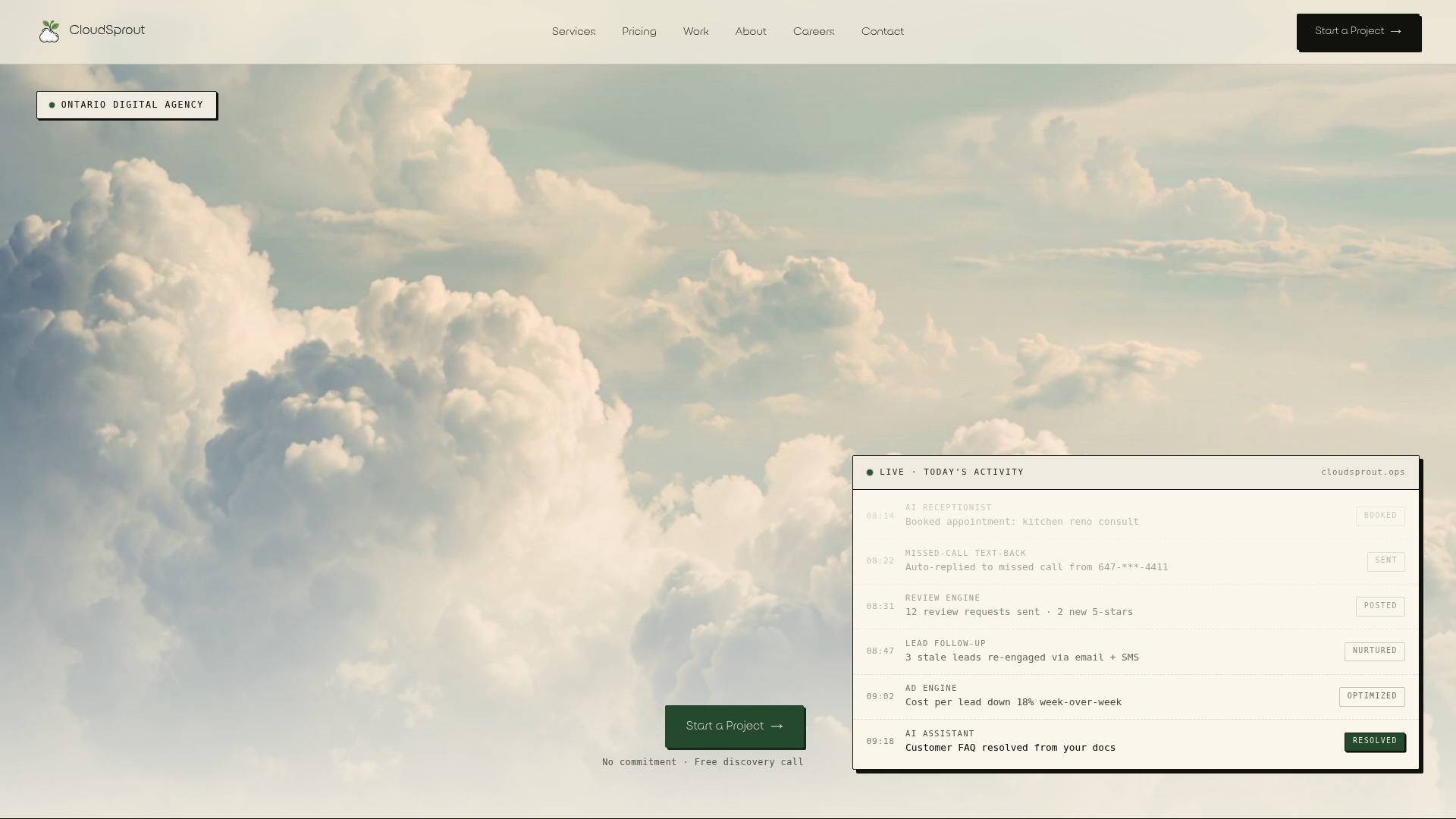
Every engagement starts the same way: a free digital audit where we map your recurring tasks and flag the one or two best candidates for a 30-day pilot. From there, pricing runs month to month, scaled to what the pilot actually needs, no surprise invoices from a billing shape you didn’t understand going in. If you want to see what a custom build looks like before committing to a pilot, our website development team can walk through how AI employee integrations connect to the tools you already run.
Before you reach out, write down one task: how often it happens, what “done right” looks like, and who on your team currently owns it. That single page is often the difference between a pilot that graduates in 30 days and one that stalls out in the sandbox stage.
Sources
These sources back the specific figures, frameworks, and pricing patterns cited above, including CellCog’s five-part test, eesel AI’s billing breakdown, and Salesforce’s use-case roundup. For a closer look at agent-driven administrative workflows outside the small business context, the Rivetline blog covers similar automation patterns worth comparing.
- What Is an AI Employee? The 5-Part Test for a Standing AI Worker — CellCog
- What is an AI employee? Roles, access, oversight, and cost | eesel AI
- 8 Ways Employee Agents Are Helping Small Businesses — Salesforce (2026-03-24)
FAQ
What’s the Best AI Assistant for a Small Business Owner?
There isn’t one universal answer since it depends on the task, but the best starting point is whichever tool integrates cleanly with the system you already use daily, like your CRM or helpdesk, rather than the one with the flashiest feature list.
How Do People Try to Make Money Using AI?
Most legitimate approaches involve using AI to cut the time spent on existing recurring work, like drafting replies or qualifying leads, so a business can take on more volume with the same staff, not through any guaranteed income scheme.
What Is the 30% Rule for AI?
There’s no single agreed-upon “30% rule” in the research on AI employees; if you’ve seen this term used as a specific benchmark, treat it skeptically and rely instead on measured metrics like your approve-without-edit rate.
Can I Hire AI Employees for My Business?
Yes. Small businesses already use employee agents for tasks like sales prep, email drafting, and CRM data cleanup, typically starting with one scoped role and a 30-day pilot before expanding.
How Long Should a Pilot Run Before I Trust an AI Employee With More Access?
Most pilot frameworks recommend roughly 30 days moving through sandbox, draft, and semi-autonomous stages, graduating to full autonomy only once the approve-without-edit rate holds steady at your chosen threshold.
Recommended
Less reading. More growing.
We build the systems these articles describe. Websites, AI follow-up, reviews, automation. And run them for you.
Keep reading