

Multi-location SEO is defined as the practice of optimizing each physical business location independently so it ranks well in local search results. This is not a scaled-up version of standard SEO. It is a distinct discipline with its own architecture, content rules, and management demands. 80% of US consumers search for local businesses weekly, and 32% do so daily. That volume means every location you operate is either capturing customers or losing them to a competitor who shows up first. Understanding multi-location SEO is the first step toward fixing that.
What is multi-location SEO and how does it work?
Multi-location SEO, also called local SEO for multiple locations, is the targeted optimization process that gives each of your physical sites its own search presence. A single-location business needs one Google Business Profile, one location page, and one set of local citations. A business with five, ten, or fifty locations needs all of that multiplied, managed consistently, and kept from competing against itself.
The core components are location pages, Google Business Profile (GBP) management, citation consistency, review generation, and structured data markup. Each component must be executed per location, not once at the brand level. Effective multi-location SEO is a compound effect of local content uniqueness, review velocity, citation accuracy, and technical SEO scaffolding. Miss one layer and the whole structure underperforms.

The industry term for this discipline is “multi-location local SEO,” and it sits at the intersection of technical SEO and local search marketing. Digital marketers who treat it as just “more of the same” consistently underdeliver for clients with distributed footprints.
How does multi-location SEO differ from single-location SEO?
Single-location SEO is a straight line. Multi-location SEO is a network, and networks break in ways straight lines do not.
The most common failure point is internal keyword competition. When two of your locations target the same search query, Google must choose one to rank. Neither page gets full authority. The result is both locations ranking lower than a single well-optimized competitor page would. This is called keyword cannibalization, and it is endemic in businesses that copy location pages without changing the content.
Other key differences include:
- Duplicate content risk. Swapping only the city name across identical page templates triggers thin-content penalties from Google.
- GBP management complexity. Each location needs its own verified profile, its own category selection, its own photo set, and its own review stream.
- Citation sprawl. Inconsistent name, address, and phone number (NAP) data across directories erodes trust signals for every affected location.
- Internal linking strategy. A hub-and-spoke internal link structure connecting a main locations page to individual city pages distributes authority correctly. Random linking does not.
- AI overview capture. In 2026, AI-driven search engines favor businesses with strong, verified entity signals across distributed locations. This is a new ranking layer that single-location SEO rarely needs to address at scale.
Pro Tip: Before building any new location pages, audit your existing ones for duplicate paragraphs. A free tool like Copyscape or a manual side-by-side comparison will reveal how much templated content you are already carrying.
What are best practices for creating and managing location pages?
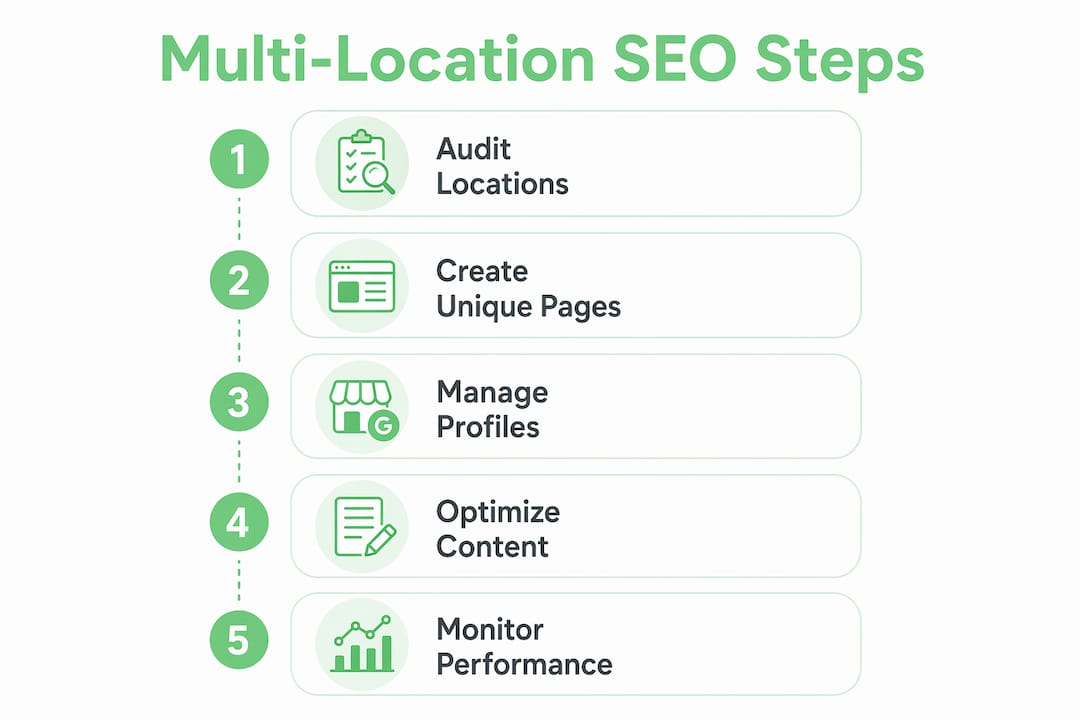
Location pages are the foundation of any multi-location SEO strategy. A weak page ranks nowhere. A strong page ranks in the map pack, the organic results, and increasingly in AI-generated search overviews.
URL structure
Use a subdirectory structure like /locations/city-name/ rather than subdomains or separate domains. Subdirectories consolidate domain authority into one root, make analytics cleaner, and simplify internal linking. Subdomains split authority as if they were separate websites.
Content requirements per page
Each location page must contain content that could not be copy-pasted onto any other location page. That means:
- Unique introductory copy referencing the specific neighborhood, nearby landmarks, or local service area.
- Location-specific photos of the actual storefront, staff, or service area.
- Accurate operating hours that match the GBP exactly.
- Local testimonials from customers in that area, not generic brand reviews.
- A Google Map embed tied to that location’s GBP listing.
Structured data markup
LocalBusiness schema with a unique @id and a sameAs property linking to the verified GBP URL is the technical standard for multi-location pages. Include verified geo-coordinates in the schema. This tells search engines and AI systems exactly what entity each page represents and where it operates.
| Element | Requirement |
|---|---|
| URL structure | /locations/city-name/ subdirectory format |
| Schema markup | LocalBusiness with unique @id, geo-coordinates, and GBP sameAs link |
| Unique content | Neighborhood references, local photos, location-specific testimonials |
| NAP consistency | Matches GBP name, address, and phone number exactly |
| Internal linking | Linked from a central /locations/ hub page |
Pro Tip: Do not launch a location page until it has at least 400 words of genuinely unique content. Google’s quality guidelines treat thin location pages as low-value, and a penalty on one page can drag down the entire domain.
How to effectively manage Google Business Profiles for multiple locations
Each Google Business Profile is a standalone ranking asset. Treating them as a batch job rather than individual properties is the single most common mistake in multi-location management.
Verification is the starting point. Every location must be individually verified through Google’s process, whether by postcard, phone, or video. Unverified profiles do not rank in the map pack. After verification, each profile needs its own primary and secondary category selections, a complete business description written for that location, and a photo set updated at least monthly.
Reviews are the most critical local ranking factor and must be managed per location with steady, genuine customer feedback. A location with 200 reviews outranks an identical location with 20, all else being equal. Build automated review request workflows triggered by completed service or purchase at each site.
Key management practices include:
- Citation consistency. Your business name, address, and phone number must match exactly across Google, Yelp, Apple Maps, Bing Places, and major data aggregators like Foursquare and Data Axle.
- Q&A monitoring. Google allows anyone to answer questions on your GBP. Monitor and answer questions yourself before misinformation spreads.
- Post frequency. Weekly Google Posts on each profile signal active management and keep the listing fresh in Google’s eyes.
- Review responses. Responding to every review, positive or negative, within 48 hours improves local prominence scores.
Pro Tip: Use a listing management platform to push NAP updates across directories simultaneously. Manual updates across dozens of directories for multiple locations is not a sustainable process.
What content strategy should multi-location businesses adopt?
Corporate content should focus on broad authority-building topics, while local pages must target geo-specific content to avoid internal keyword cannibalization. This is a governance problem as much as a content problem.
Want this running in your business without doing it yourself?
Book a Free Consultation →The split works like this. Your main website blog publishes content about industry topics, company news, and broad service explanations. Each location page targets searches with geographic modifiers, such as “plumber in Hamilton” or “tax accountant near Barrie.” When both levels target the same query, they compete. When they stay in their lanes, they reinforce each other.
“Content volume alone is insufficient. Alignment between corporate and local content roles is the critical driver of growth for multi-location brands. Without a clear ownership map, teams create duplicate content that dilutes authority and causes ranking conflicts across the entire domain.”
Practical governance steps include:
- Keyword mapping by location. Assign specific geo-modified keywords to specific location pages. Document ownership so no two pages target the same primary term.
- Local content formats. Use location-specific blog posts about community events, local partnerships, or neighborhood spotlights. This content cannot be duplicated elsewhere.
- Content calendar coordination. Align corporate publishing with local publishing so they support rather than undercut each other.
- AI-assisted gap analysis. Use AI writing and research tools to identify which local queries your location pages are not yet targeting. The gaps are often significant.
Effective website copy at the location level is not about word count. It is about specificity. A page that mentions the intersection your shop sits on, the parking lot behind the building, and the neighborhood association you sponsor will always outperform a page that just swaps a city name into a template.
How is multi-location SEO evolving with AI-driven search in 2026?
The goal of multi-location SEO has shifted. The old goal was to rank on page one. The new goal is to become the business that AI recommends.
AI-driven search engines recommend businesses based on verified data, consistent reviews, and strong location pages rather than keyword rankings alone. Google’s AI overviews, Perplexity, and similar tools pull from structured, trustworthy sources. A business with accurate schema, consistent citations, and a strong review profile gets cited. A business with outdated NAP data and thin pages does not.
The signals that matter most for AI visibility in 2026:
- Entity clarity. Your business must be recognizable as a distinct, verified entity at each location. Schema markup and GBP verification are the primary tools for this.
- Third-party corroboration. Mentions in local news, chamber of commerce directories, and industry associations tell AI systems your locations are real and trusted.
- Review recency and volume. AI systems weight recent reviews heavily. A location with 10 reviews from last month outperforms one with 100 reviews from three years ago.
- Data accuracy at scale. Operational governance ensures consistency, quality, and measurement across distributed sites. Inaccurate data at any location creates entity confusion for AI systems.
- Structured content. FAQ sections, service lists, and clearly labeled operating hours on location pages give AI systems extractable, citable information.
Technical SEO fundamentals like page speed, mobile usability, and crawlability remain table stakes. AI visibility layers on top of them, not instead of them.
Key Takeaways
Multi-location SEO succeeds when each location is treated as an independent ranking asset with unique content, verified profiles, and consistent data across every directory and platform.
| Point | Details |
|---|---|
| Define the discipline correctly | Multi-location SEO optimizes each physical location independently, not as a batch of identical pages. |
| Prevent internal competition | Map keywords to specific location pages so no two pages target the same geo-modified query. |
| Build unique location pages | Each page needs original copy, local photos, accurate NAP, and LocalBusiness schema with geo-coordinates. |
| Manage GBPs individually | Verify, optimize, and generate reviews for each profile separately to maximize map pack visibility. |
| Prepare for AI search | Verified entity signals, consistent citations, and structured data determine which locations AI recommends. |
What I have learned managing multi-location SEO at scale
The businesses that struggle most with multi-location SEO share one trait: they scaled before they governed. They launched ten location pages before deciding who owns the content, who updates the GBPs, and how NAP changes get communicated across directories. The technical problems are always fixable. The organizational ones take much longer.
My strongest recommendation is to prioritize locations before you spread effort evenly. Prioritize by revenue potential, competitive intensity, and current digital footprint gaps. A location in a low-competition market with an incomplete GBP will respond faster than a flagship location in a saturated market. Start where the return is clearest, build the playbook there, then replicate it.
The review problem also gets underestimated. Most businesses collect reviews passively. Multi-location businesses need active, automated systems that request reviews at the moment of highest customer satisfaction, per location, every day. One location with strong review velocity will outrank three locations with better content but stale profiles.
AI search is not a future concern. It is a present one. The businesses building entity clarity and citation accuracy now will have a compounding advantage over the next two years. The ones waiting to “see how AI search develops” are already behind.
— Cristo
How Cloudsprout supports multi-location businesses online
Cloudsprout works with small and mid-sized businesses across Ontario that need more than a single-page website to compete locally. For businesses operating across multiple locations, that means scalable website development built on proper subdirectory architecture, location-specific content, and LocalBusiness schema from day one.
Cloudsprout’s SEO services include Google Business Profile optimization, citation management, and review generation workflows tailored to each location. Every engagement starts with a full digital audit at no cost, so you know exactly where each location stands before any work begins. No lock-in contracts. No outsourcing. Direct access to the team doing the work. If you operate more than one location and your local search presence does not reflect that, Cloudsprout is worth a conversation.
FAQ
What is multi-location SEO?
Multi-location SEO is the practice of optimizing each physical business location independently so it ranks in local search results. It involves unique location pages, individual Google Business Profiles, and consistent citation data per site.
How many Google Business Profiles do I need?
Each physical location requires its own verified Google Business Profile. A business with five locations needs five separate, individually optimized profiles to rank in local map pack results.
What causes internal keyword competition in multi-location SEO?
Internal keyword competition occurs when two location pages target the same search query. Keyword cannibalization splits ranking authority between the pages, causing both to rank lower than a single well-optimized page would.
How does AI search affect local business visibility?
AI search engines recommend businesses based on verified entity data, consistent citations, and strong review profiles rather than keyword rankings alone. Accurate structured data and active GBP management are now direct inputs to AI visibility.
What is the best URL structure for multiple location pages?
The subdirectory format /locations/city-name/ is the preferred structure. It consolidates domain authority, simplifies analytics, and makes internal linking more effective than subdomains or separate domains.
Recommended
Less reading. More growing.
We build the systems these articles describe. Websites, AI follow-up, reviews, automation. And run them for you.
Keep reading