

Customer reviews are a direct ranking signal in Google’s local search algorithm, placing them among the top three factors that determine where your business appears in local results. 87% of consumers read online reviews for local businesses before making a decision. That number tells you something critical: reviews do not just influence rankings, they shape whether anyone clicks on your listing at all. Understanding how reviews affect local SEO means understanding two separate but connected forces. Reviews change where you rank, and they change whether customers choose you once they find you. Both matter equally for a small or mid-sized business competing in a local market.
How do reviews affect local SEO rankings?
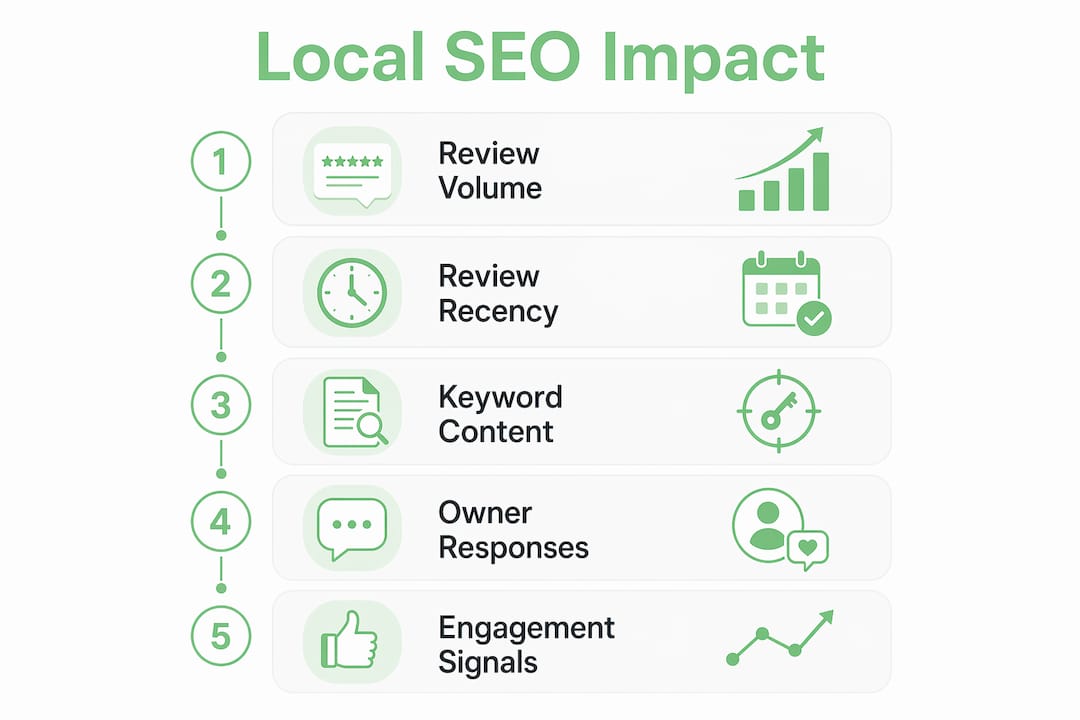
Google’s local ranking algorithm weighs three broad factors: relevance, distance, and prominence. Reviews feed directly into prominence. A business with a high volume of recent, detailed reviews signals to Google that it is active, trusted, and worth showing to searchers.
The specific review signals Google reads include:
- Review quantity. Businesses with over 200 reviews rank significantly better in the Local Pack top three. Volume tells Google your business has a real, established customer base.
- Review recency. Google treats fresh reviews as a freshness signal. A business that collected 50 reviews two years ago and stopped is less prominent than one collecting five reviews per month consistently.
- Keyword content. Google extracts service-specific keywords from customer review text. A review mentioning “water heater replacement in Barrie” does more for your local relevance than a generic “great service” comment.
- Star rating. Rating matters for consumer trust, but it carries less ranking weight than volume and recency. A business with a 4.3 average and high volume outranks a 5.0 rating with only a handful of reviews.
- Response rate. Responding to reviews signals an active, engaged business profile. Google reads that activity as a positive prominence indicator.
- Review velocity. Consistent, steady accumulation of reviews is far more valuable than a sudden burst. A burst-and-stop strategy can trigger Google’s spam filters and actually harm your rankings.
Pro Tip: Ask customers for reviews immediately after a positive interaction, while the experience is fresh. A same-day or next-day request produces more detailed, keyword-rich responses than a follow-up sent weeks later.
How do reviews influence click-through rates and customer decisions?

Rankings get you in front of searchers. Reviews determine whether those searchers click on your listing or scroll past it. The impact of reviews on local SEO extends well beyond the algorithm.
86% of consumers check Google specifically when looking for reviews. Google is the dominant trust platform across all age groups, which means your Google Business Profile is often the first impression you make.
Here is how review signals shape customer behavior at the search results page:
- Higher review counts increase clicks. Moving from 10 to 100 reviews produces roughly a 20% lift in click-through rate. Each set of 10 new reviews adds nearly a 3% conversion lift to your Google Business Profile.
- Star ratings filter decisions fast. Ratings below 4.0 stars deter the majority of local customers before they ever visit your website. Most searchers make a judgment in seconds based on the star display alone.
- Recency builds trust. A business with 150 reviews but the most recent one from 18 months ago looks stagnant. Customers interpret review gaps as a sign that something changed, and not for the better.
- Photos in reviews increase engagement. Visual content submitted by customers adds credibility that text alone cannot match. It shows real people had real experiences.
- Negative reviews, when addressed, have limited ranking damage. A professionally handled negative review can actually demonstrate responsiveness. Ignoring negative reviews, however, sends negative signals to both Google and potential customers.
The practical takeaway is straightforward. A business with 80 reviews at 4.4 stars, with recent activity and owner responses, will consistently outperform a competitor with 20 reviews at 4.8 stars and no engagement.
What strategies help small businesses manage reviews for local SEO?
The importance of online reviews for SEO is clear. The harder question is how to generate them consistently without crossing into practices that violate Google’s guidelines.
Effective review generation follows a few core principles:
- Ask every time, not occasionally. Build review requests into your standard process after every completed job, appointment, or purchase. Consistency produces the steady velocity Google rewards.
- Use service-specific prompts. Instead of asking “Can you leave us a review?”, try “Would you mind mentioning the furnace installation you had done?” That prompt produces keyword-rich content Google can actually use for local relevance.
- Focus on Google Business Profile first. 86% of consumers use Google as their primary review source. Other platforms matter, but Google is where your local SEO ranking lives.
- Never incentivize reviews. Offering discounts, gifts, or any reward for a review violates Google’s policies. It also produces reviews that read as inauthentic, which customers notice.
- Avoid bulk review campaigns. Sending 40 review requests in one week after months of silence looks unnatural. Google’s algorithm flags sudden spikes, and rapid spikes followed by inactivity can damage your local rankings.
A practical local SEO and review strategy treats review generation the same way you treat any other business process: scheduled, tracked, and consistent. The owner-operated business SEO checklist from Cloudsprout covers this as part of a broader local visibility framework.
Pro Tip: Create a short, direct link to your Google review page and save it as a text message template. Send it to customers the same day you complete their service. A frictionless process gets far more responses than a multi-step email.
How do review responses improve local search performance?
Responding to reviews is not just good customer service. It is an active SEO tactic that most small businesses underuse.
Review responses create fresh, keyword-rich content that Google indexes alongside the review itself. When you respond to a review mentioning “roof repair in Hamilton” and your response references the same service and location, you reinforce your relevance for that local query. Your response acts as dense entity content, helping Google better understand and categorize what your business actually does.
The data on response length is specific. Top-ranking businesses respond with an average of 140 words per review. That is not a coincidence. Detailed responses give Google more indexable content and signal genuine engagement.
Want this running in your business without doing it yourself?
Book a Free Consultation →Review replies also indirectly boost SEO by generating engagement signals that indicate an active, relevant business profile. A 100% response rate is a genuine competitive advantage in most local markets, because the majority of businesses respond to fewer than half their reviews.
Pro Tip: When responding to a positive review, thank the customer by name, reference the specific service they mentioned, and include your city or neighborhood. Three sentences done right outperform a generic “Thanks for your feedback!” every time.
Responding to negative reviews requires a different approach. Acknowledge the issue, avoid defensiveness, and offer to resolve it offline. Professionally handled negative reviews reduce their ranking impact and often reassure prospective customers more than a string of perfect reviews would.
Key Takeaways
Customer reviews improve local SEO by building prominence through volume, recency, keyword content, and active engagement, all of which Google’s algorithm reads as trust signals.
| Point | Details |
|---|---|
| Volume beats perfect ratings | A high review count at 4.3 stars outranks a 5.0 rating with few reviews in local search. |
| Recency is a freshness signal | Consistent monthly review acquisition outperforms a one-time burst followed by silence. |
| Keywords in reviews matter | Service-specific mentions in reviews improve local query relevance more than generic praise. |
| Responses are indexable content | Detailed, keyword-rich responses averaging 140 words correlate with higher Local Pack rankings. |
| Google is the priority platform | 86% of consumers use Google for reviews, making your Google Business Profile the top focus. |
Reviews are the one SEO signal your customers build for you
Most of the local SEO basics I work through with clients involve technical fixes, content gaps, or backlink issues. Reviews are different. They are the one ranking signal your customers generate on your behalf, and that makes them both powerful and unpredictable.
What I have seen consistently is that businesses treat review management as a one-time cleanup task. They respond to a few old reviews, ask a few customers for new ones, and then move on. Rankings improve briefly, then plateau. The businesses that sustain Local Pack positions treat reviews the same way they treat payroll: it happens on a schedule, every single week, without exception.
The other thing most articles miss is that user-generated content in reviews now serves as a verification layer for AI-powered search. When a customer writes in natural language about your specific service, that content carries more weight with AI-driven search systems than anything your marketing team writes about you. Your customers are describing your business in the exact words other customers use to search for it. That is organic SEO you cannot manufacture.
My honest advice: stop thinking of reviews as reputation management and start treating them as a content channel. The language your customers use in reviews tells you what they value, what they remember, and what they would tell a friend. That is your most honest keyword research, and it costs nothing to collect.
Reputation management and SEO should be integrated into the same workflow, not handled as separate tasks by separate people. When you read a review, you should be asking two questions: what does this tell me about my service, and what does this tell me about how customers describe what I do? Both answers make you better at the work and better at being found for it.
— Cristo
Cloudsprout can help you turn reviews into local search visibility
Building a review strategy that actually moves your local rankings takes more than asking customers for feedback. It requires a connected approach where your website, your Google Business Profile, and your content all reinforce the same local signals.
Cloudsprout works with small and mid-sized businesses across Ontario to build local SEO programs that include review strategy, Google Business Profile management, and the technical website foundation that makes all of it work. Every engagement starts with a full digital audit at no cost, so you know exactly where you stand before committing to anything. If you want a website built to support local search from the ground up, the team at Cloudsprout handles it all in-house with no outsourcing and no lock-in contracts.
FAQ
Do reviews directly improve local search rankings?
Yes. Reviews are among the top three factors in Google’s local ranking algorithm, influencing prominence through volume, recency, and engagement. Businesses with more reviews and active response patterns consistently rank higher in the Local Pack.
What type of review content helps local SEO the most?
Service-specific reviews that mention what was done and where outperform generic praise. Google extracts keywords from review text, so a customer mentioning “plumbing repair in Guelph” improves your relevance for that local query more than “great company” does.
How often should a business ask for reviews?
After every completed transaction or service interaction. Consistent, steady review acquisition signals freshness to Google and avoids the spam flags that come with sudden bulk requests.
Does responding to negative reviews help local SEO?
Yes. Professionally written responses to negative reviews reduce their ranking impact and signal business activity to Google. Ignoring negative reviews sends a negative engagement signal to both the algorithm and prospective customers.
Which review platform matters most for local SEO?
Google Business Profile is the top priority. 86% of consumers use Google as their primary review source, and Google reviews feed directly into local search rankings in a way that reviews on other platforms do not.
Recommended
Less reading. More growing.
We build the systems these articles describe. Websites, AI follow-up, reviews, automation. And run them for you.
Keep reading

One Page Voice Chart: 8 Brand Voice Examples Small Businesses Can Use