

SEO cost in Toronto can range from a limited monthly package to a multi-thousand-dollar growth program because agencies are not always selling the same work. A single-location service business, a competitive law firm, an ecommerce store, and a multi-location company require different research, content, technical work, authority building, and reporting.
For planning purposes, many Toronto small businesses will encounter monthly proposals between C$1,000 and C$5,000. Treat that as a comparison range, not a verified market average or a recommendation to spend that amount. Public packages exist below and above it, and the real question is what work, expertise, accountability, and measurement the price includes.
By CloudSprout Editorial Team · Pricing and sources reviewed September 25, 2026
Quick answer: Do not choose an SEO provider from the monthly price alone. Compare the starting condition of your site, target market, deliverables, responsible team, contract terms, measurement plan, and estimated break-even point. Get the complete scope in writing before signing.
How the pricing ranges in this guide were prepared
This guide compares publicly advertised Toronto and GTA agency packages reviewed on September 25, 2026 with broader industry survey data. Public package pages reviewed for this update advertised prices ranging from below C$300 per month to C$6,000 per month, demonstrating why one “average Toronto SEO price” can be misleading.
The ranges below are planning bands synthesized from those public examples. They are not a statistical survey of every Toronto agency, a quote for your business, or evidence that similarly priced packages contain equivalent work. Prices and packages can change, so verify each provider’s current page and written proposal.
Toronto SEO pricing: key takeaways
| Question | Practical answer |
|---|---|
| What budget will I commonly encounter? | C$1,000–C$5,000 per month is a useful proposal-comparison band for many Toronto small businesses, but it is not a guaranteed market average. |
| Why do quotes vary? | Competition, website condition, location count, content needs, technical complexity, authority work, and reporting scope change the required labour. |
| What matters more than the package name? | The written deliverables, priorities, responsible team, measurement plan, access, ownership, exclusions, and cancellation terms. |
| How should ROI be evaluated? | Calculate how many additional profitable customers are required to cover the SEO investment, then track qualified organic leads and closed sales. |
| What should make me cautious? | Guaranteed rankings, unexplained link building, unclear ownership, generic deliverable lists, and reports that exclude leads or revenue. |
What this Toronto SEO pricing guide covers
- Toronto SEO planning ranges
- What each budget level should include
- What determines the price
- Common SEO pricing models
- Setup fees, tools, and other hidden costs
- How to calculate a break-even SEO budget
- How long SEO should be given
- How to compare Toronto SEO proposals
- Contract, reporting, and ownership terms
- Current status of older digital grant programs
- CloudSprout’s published pricing
Toronto SEO pricing snapshot in Canadian dollars
Use these bands to organize proposals with similar scope. Do not assume a provider belongs in a category based only on price.
| Monthly planning band | Possible fit | Scope to confirm |
|---|---|---|
| Below C$1,000 | DIY support, maintenance, limited local SEO, a bundled small-business plan, or a narrow set of monthly tasks | Available hours, whether content and technical implementation are included, response time, and what is explicitly excluded |
| C$1,000–C$2,500 | A focused local business, smaller professional-services site, or priority service campaign | Technical fixes, local optimization, service-page work, content, measurement, and implementation capacity |
| C$2,500–C$5,000 | A competitive Toronto market, several priority services, stronger content production, or ongoing technical and authority work | Strategy time, content depth, digital PR or outreach, developer time, conversion tracking, and lead-quality reporting |
| C$5,000+ | Multi-location businesses, large ecommerce catalogues, national campaigns, migrations, or highly competitive industries | Dedicated specialists, cross-location governance, editorial production, technical monitoring, testing, dashboards, and stakeholder support |
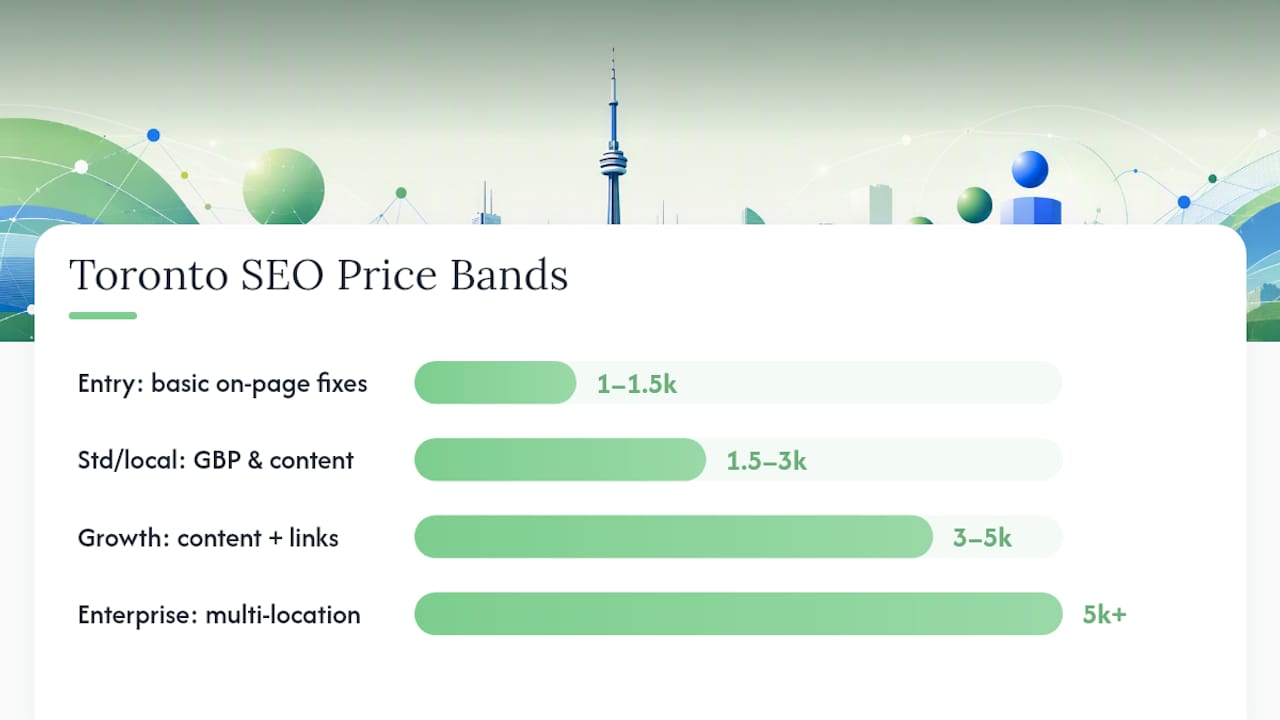
A low price is not automatically bad, and a high price is not proof of quality. A narrow package can be appropriate when the website already has strong foundations and the business needs only a specific service. A more expensive program may be justified when technical debt, content production, several locations, or competitive acquisition targets require more specialist time.
What should an SEO budget include?
Instead of comparing labels such as Starter, Growth, or Premium, convert every proposal into the same categories.
| Work area | Questions the proposal should answer |
|---|---|
| Research and strategy | Which services, locations, audiences, competitors, and search intents are priorities? Who decides what happens first? |
| Technical SEO | Does the fee cover only identifying problems, or also developer time to fix indexing, speed, structured data, templates, and internal linking? |
| On-page optimization | How many existing pages will be reviewed and improved? Does the agency write and publish the changes? |
| Content | What types of pages or articles will be produced? Who performs subject review, fact-checking, editing, image selection, and publishing? |
| Local SEO | Are Google Business Profile work, location pages, citation correction, reviews, and local reporting included where relevant? |
| Authority building | What outreach or digital PR will be performed? Are paid placements, sponsored links, or third-party fees disclosed? |
| Analytics and attribution | Will calls, forms, qualified leads, bookings, and sales be connected to organic search—not only rankings and traffic? |
| Communication | Who owns the account, how often will you meet, and how quickly are questions or urgent issues handled? |
If a proposal lists “monthly SEO” without quantities, responsibilities, priorities, or outputs, ask for clarification. Deliverable counts should not become the entire strategy, but they make the workload and exclusions easier to compare.
What determines SEO cost in Toronto?
Two businesses in the same city can receive very different quotes for legitimate reasons.
- Starting condition: indexing problems, slow templates, poor information architecture, thin pages, duplicate content, or an unfinished migration require foundational work.
- Competition and customer value: markets with many established competitors or high-value customers may require deeper research, stronger pages, and more authority development.
- Number of priorities: one service in one area is different from several services across Toronto, the GTA, Ontario, or Canada.
- Website size: an eight-page service website is not equivalent to an ecommerce catalogue with thousands of products and filtered URLs.
- Content requirements: original interviews, expert review, photography, design, video, and regulated-topic fact-checking add time and cost.
- Implementation responsibility: some providers advise only; others include writing, development, publishing, analytics, and quality assurance.
- Local presence: Google Business Profile management, review workflows, location pages, and citation maintenance can form a separate workstream.
- Reporting and attribution: connecting calls and sales to search requires more setup than sending a monthly ranking export.
- Speed and capacity: a compressed launch or high publishing volume requires more people and coordination.
Ask the provider to show which of these factors increased or reduced your quote. A useful estimate should be traceable to the work required rather than an unexplained package tier.
Common SEO pricing models and when they fit
Hourly consulting
Hourly pricing can work for advisory calls, troubleshooting, training, or a defined block of technical support. The Ahrefs survey of 439 SEO providers found that US$75–US$100 was the most common hourly range globally at the time of its survey. That is historical global data, not a current Toronto average, so compare it carefully with Canadian-dollar quotes, seniority, and included preparation.
Project-based SEO
A fixed project suits an audit, migration plan, content overhaul, analytics setup, or defined group of service pages. Confirm whether the project includes implementation and post-launch verification. An audit that only identifies problems is not equivalent to a project that also fixes and retests them.
Monthly retainer
A retainer fits work that needs continued measurement and iteration, such as technical maintenance, content publishing, local SEO, outreach, and conversion improvement. Confirm how priorities can change when data shows that the original plan is not working.
Performance-based pricing
Payment tied to leads or outcomes can look attractive, but the agreement must define attribution, lead quality, brand searches, existing demand, sales-team performance, tracking failures, and ownership of the assets created. Pay-per-ranking arrangements can encourage work that targets easy but commercially weak keywords.
Google states that no one can guarantee a number-one ranking. Be cautious when performance pricing is paired with ranking guarantees, secret methods, or unclear ownership.
SEO costs that may sit outside the monthly fee

- initial audits, onboarding, research, or strategy workshops;
- developer hours required to implement technical recommendations;
- new landing pages, copywriting, design, photography, or video;
- analytics, call tracking, consent management, or CRM integration;
- paid SEO tools, reporting software, or data providers;
- digital PR production or legitimate third-party publication costs;
- website hosting, maintenance, accessibility, or security work;
- translation and French-language localization;
- platform migration or emergency recovery work; and
- HST and currency conversion when a provider bills outside Canada.
Ask for the expected first-year total in Canadian dollars, including setup fees and optional work. A C$1,500 retainer with regular extras can cost more than a C$2,500 proposal that includes implementation and content.
Calculate how many customers are needed to break even
Traffic and rankings are useful diagnostic metrics, but they do not pay for the campaign. Build a simple model using gross profit rather than top-line revenue.
- Estimate gross profit per new customer. Multiply average customer revenue by the gross margin attributable to that work.
- Calculate required customers. Divide the monthly SEO cost by gross profit per new customer.
- Calculate required qualified leads. Divide the required customers by the sales close rate.
- Add the time horizon. Account for setup costs, the delay before organic work contributes leads, repeat purchases, and customer lifetime value where reliable.
Example: A business considering C$2,500 per month earns C$4,000 in average revenue from a new customer at a 40% gross margin. Gross profit per customer is C$1,600. The campaign therefore needs approximately two additional customers per month to cover C$2,500 before overhead. If the business closes 25% of qualified leads, it needs roughly eight additional qualified leads to produce those two customers.
Want this running in your business without doing it yourself?
Book a Free Consultation →This is a planning example, not a forecast. Replace every number with your own accounting and sales data. Also agree with the agency on how organic leads will be identified when customers use several channels before buying.
| Metric | Formula |
|---|---|
| Gross profit per customer | Average customer revenue × gross margin |
| Customers required to cover monthly SEO | Monthly SEO cost ÷ gross profit per customer |
| Qualified leads required | Required customers ÷ sales close rate |
| SEO customer acquisition cost | Total SEO cost ÷ new customers attributed to organic search |
How long should SEO take in Toronto?
There is no responsible universal ranking or lead timeline. Google says that some changes may be reflected within hours while others can take several months, and not every change produces a noticeable search result.
Evaluate the provider using controllable delivery checkpoints:
| Stage | Evidence you should receive |
|---|---|
| Baseline and discovery | Access confirmed, business goals documented, tracking tested, technical and content findings prioritized |
| Foundation | Critical crawl or indexing issues addressed, important pages mapped, local information corrected, measurement plan active |
| Publishing and improvement | Priority pages improved or launched, internal links updated, useful content published, relevant outreach documented |
| Learning and iteration | Search Console and lead data reviewed, weak assumptions changed, conversion issues tested, next priorities justified |
A provider should be able to explain what will happen during the first 30, 60, and 90 days without guaranteeing a position or exact traffic increase. Significant gains may take months, especially in competitive markets, but the work and measurement should not be invisible during that period.
How to compare Toronto SEO proposals

Score every proposal using the same questions:
- Which business outcome and customer actions will the strategy target?
- Which services, locations, pages, and search intents are in scope?
- What will be delivered during the first 30, 60, and 90 days?
- Does the provider identify issues only, or also implement and verify fixes?
- Who performs strategy, writing, editing, development, outreach, and reporting?
- How is AI used, and which human review and fact-checking steps apply?
- What link-building methods are used, and are paid placements disclosed?
- Which accounts, content, data, websites, and creative assets will you own?
- How will calls, forms, qualified leads, sales, and revenue be measured?
- What fees, limits, dependencies, and exclusions are not included in the monthly price?
- What are the cancellation, renewal, notice, and handoff terms?
- Can the provider show relevant work and explain what it did without exposing confidential client information?
Google recommends asking an SEO to explain intended actions and warns that secretive providers and guaranteed number-one claims deserve caution. Ultimately, the site owner remains responsible for work performed on the site.
Contracts, reporting, access, and ownership
Before signing, get these terms in writing:
- monthly fee, setup fee, taxes, tool costs, and approval process for extra work;
- minimum term, renewal method, cancellation notice, and early termination fees;
- deliverables, expected capacity, meeting schedule, and response times;
- ownership and administrator access for the domain, website, hosting, Search Console, Analytics, Business Profile, call tracking, CRM, and reporting;
- ownership and export rights for copy, images, research, dashboards, keyword lists, and historical data;
- use of subcontractors and who is accountable for their work;
- approval requirements for website changes, content, redirects, and link acquisition; and
- the handoff process when the engagement ends.
Monthly reporting should connect completed work with outcomes. At minimum, review search visibility, important landing pages, conversions, qualified leads, and known revenue. Rankings without location, device, or query context can be misleading, while traffic without conversion data cannot show whether the campaign is commercially useful.
Can grants reduce Toronto SEO costs?
Do not build the budget around old grant articles. The Government of Canada states that the Canada Digital Adoption Program concluded on March 31, 2025. Digital Main Street states that its Grow Your Business Online applications and the referenced Digital Transformation Grant portal are closed.
New programs can appear, but eligibility, eligible expenses, deadlines, and available funds can change. Confirm the current status directly with the administering government or program organization before treating funding as part of the project budget.
CloudSprout’s published pricing
CloudSprout publishes bundled website, systems, content, and growth plans in Canadian dollars. These are not pure SEO retainers and should not be compared directly with an SEO-only package.
As reviewed on September 25, 2026, the published pricing page lists:
- Sprout: C$300 per month, with a C$500–C$1,500 setup range;
- Grow: C$600 per month, with a C$1,500–C$3,500 setup range and light monthly SEO listed among the bundled services; and
- Scale: C$1,200 per month, with a C$3,500–C$7,500 setup range for a broader bundled system.
Because pricing and inclusions can change, review the current CloudSprout pricing page and request a written scope before purchasing.
If you are comparing Toronto SEO proposals, book a free 30-minute strategy call. Bring your website, business goals, and any competing quotes. CloudSprout can outline what it would prioritize, what the published plan includes, and what would be separately scoped. The consultation has no obligation.
Toronto SEO pricing questions
How much does SEO cost in Toronto?
C$1,000–C$5,000 per month is a useful planning range for comparing many small-business proposals, but it is not a verified market average. Public packages exist below and above that range. Compare the actual deliverables, expertise, implementation, reporting, and contract terms.
Is cheap SEO always bad?
No. A limited package may fit a small site with narrow needs. The risk appears when a low price is paired with vague deliverables, automated content without review, unexplained links, missing implementation, or unrealistic promises. Judge scope and methods rather than price alone.
Is a monthly retainer better than hourly SEO?
A retainer fits continued optimization, publishing, technical maintenance, and reporting. Hourly work can fit advice, training, or a limited technical task. A defined project may be better for an audit or migration. Choose the model that matches the work rather than assuming one is universally superior.
What should an SEO report include?
The report should connect completed work to Search Console data, important landing pages, calls or forms, qualified leads, and known sales. It should also explain problems, decisions, next actions, and any limits in the attribution data.
Can a Toronto SEO agency guarantee first place?
No provider controls Google’s rankings. Google explicitly warns that no one can guarantee a number-one ranking. Ask for a transparent strategy, realistic measurement, and proof of completed work instead.
Does CloudSprout publish its pricing?
Yes. CloudSprout publishes CAD prices for its bundled plans. The packages include combinations of websites, support, funnels, systems, content, and varying levels of SEO, so confirm the written scope that applies to your business.
Sources and pricing references
- Google Search Central: Do you need an SEO?
- Google Search Central: SEO Starter Guide
- Ahrefs: SEO pricing survey of 439 providers
- Canada Create: Public Toronto SEO package prices reviewed September 25, 2026
- SEO24: Public Toronto SEO package prices reviewed September 25, 2026
- MarketingFlow: Public GTA SEO package prices reviewed September 25, 2026
- CloudSprout: Published CAD pricing reviewed September 25, 2026
- Government of Canada: CDAP concluded March 31, 2025
- Digital Main Street: Ontario grant portal status
Recommended reading
Less reading. More growing.
We build the systems these articles describe. Websites, AI follow-up, reviews, automation. And run them for you.
Keep reading