
Post on Instagram 3 to 5 times a week, TikTok 2 to 5 times, Facebook 1 to 2 times a day, X 3 to 4 times a day, LinkedIn 2 to 5 times a week, Pinterest 15 to 25 pins a day, YouTube once a week plus 1 to 3 Shorts, and Google Business Profile once or twice a week. That is the starting range. Pick numbers you can actually sustain, run them for several weeks, and let your own engagement data (not a blog post) tell you whether to push harder or pull back.
TL;DR:
- Posting three to five times weekly on Instagram and two to five times on TikTok balances visibility and engagement without overwhelming your audience or content pool.
- Daily Facebook posts and three to four tweets per day help maintain presence, but should be adjusted based on engagement rate per post to avoid content fatigue.
- A high volume of pins on Pinterest, around 15 to 25 daily, builds a searchable catalog due to the platform’s long shelf life for content.
- Tracking engagement rate per post, not total interactions, reveals whether your posting frequency is effective or causing audience burnout.
- Starting with manageable schedules, such as three weekly posts on Instagram and Facebook plus one Google Business update, ensures sustainable growth for small teams or solo operators.
Table of Contents
- What Is the Right Social Media Posting Frequency for Each Platform?
- How Do You Find Your Own Sweet Spot for Posting Frequency?
- How Do You Match Posting Frequency to Your Team’s Real Capacity?
- What Tools Help You Keep a Consistent Posting Schedule?
- Which Metrics Tell You If Your Posting Frequency Is Actually Working?
- What’s a Realistic Starting Cadence If You’re Doing This Alone?
- Want This Handled Without Adding It to Your Own To-Do List?
- Sources
- FAQ
What Is the Right Social Media Posting Frequency for Each Platform?
Every platform has a different attention span, and that alone explains most of the disagreement you will find if you Google this question. A tweet has a shelf life measured in minutes. A Pinterest pin can still be driving clicks a year after you posted it. Match your cadence to how long each platform actually keeps your content alive, and the “how often” question gets a lot easier to answer.
Instagram: 3 to 5 feed posts per week, Stories daily
Instagram’s algorithm rewards accounts that show up consistently without flooding the feed. Buffer’s analysis of platform benchmarks puts the sweet spot at 3 to 5 posts a week, with a measured reach lift of 12 to 17% per post when accounts move up from 1 to 2 posts a week into that range. Reels still get algorithmic preference over static photos, so if you only have bandwidth for one format, make it video. Stories are a different budget entirely. Because they disappear in 24 hours, daily Stories cost almost nothing in planning time and keep you visible between feed posts.
TikTok: 2 to 5 videos per week
TikTok’s For You Page cares more about watch time on individual videos than about how often you post, which is why brands can win here without posting daily. Two to five short videos a week is enough to stay in rotation, and industry benchmark tracking on TikTok shows engagement rewards consistency more than volume. Trending audio and quick hooks in the first three seconds matter more than raw output.
Facebook: 1 to 2 posts per day
Facebook’s organic reach has been shrinking for years, so this platform rewards a slightly higher cadence than Instagram, especially for local businesses relying on community groups and local search. One to two posts a day, mixing photos, short video, and the occasional link, keeps you present without feeling like spam. Anything beyond that tends to just split your own audience’s attention across too many posts.
X (formerly Twitter): 3 to 4 posts per day
X moves fast. A post’s visibility window is short, so 3 to 4 posts a day is closer to a minimum than a maximum if you want consistent presence in followers’ timelines. This is the one platform where quantity genuinely functions as a strategy, provided the content itself stays sharp.
LinkedIn: 2 to 5 posts per week
LinkedIn behaves more like Instagram than X. Posting too often actually suppresses reach, because the algorithm favors fewer, higher-quality updates that generate real comments over quick likes. Two to five posts a week, focused on insight, case studies, or company news, outperforms a daily posting habit here.
Pinterest: 15 to 25 pins per day
This number looks wild next to the others, but Pinterest is a visual search engine, not a social feed. Pins have long shelf lives, often surfacing in search results months after publishing, so higher daily volume works because you are building a searchable catalog, not competing for a moment of attention. Batch-create pin graphics from existing blog posts, product photos, or infographics rather than creating everything from scratch.
YouTube: 1 long-form video per week, 1 to 3 Shorts
Long-form YouTube content rewards depth over frequency. One well-produced video a week beats three rushed ones. Shorts operate on a separate discovery system closer to TikTok’s, so posting 1 to 3 Shorts a week alongside your main video gives you two different growth engines from one channel.
Google Business Profile: 1 to 2 updates per week
Local businesses often ignore this one entirely, which is a mistake. Regular updates (a new photo, a promotion, a Google Post) signal to Google that the listing is active, which can influence local search and map rankings.
- Instagram: 3 to 5 posts/week
- TikTok: 2 to 5 posts/week
- Facebook: 1 to 2 posts/day
- X: 3 to 4 posts/day
- LinkedIn: 2 to 5 posts/week
- Pinterest: 15 to 25 pins/day
- YouTube: 1 video/week + 1 to 3 Shorts
- Google Business Profile: 1 to 2 updates/week
Buffer’s data: Accounts moving from 1 to 2 posts a week up into the 3 to 5 post range saw reach climb 12 to 17% per post, not because of raw volume but because consistency itself signals an active account to the algorithm.
A separate analysis of over 55,000 posts by PostPlanify found that accounts posting 3 to 5 times a week grew followers about 15.3% over roughly 90 days, compared with only 3.8% growth for accounts posting 1 to 2 times a week. That gap is the clearest evidence yet that showing up a little more often, not a lot more often, is where the real payoff sits.
How Do You Find Your Own Sweet Spot for Posting Frequency?
Benchmarks tell you where to start. Your own audience tells you where to land. Here’s a simple way to test it without overhauling your whole strategy overnight.
Want this running in your business without doing it yourself?
Book a Free Consultation →- Write a hypothesis before you touch your calendar. Something like: “Posting on Instagram 5 times a week instead of 3 will raise reach without dropping engagement rate per post.”
- Pick a control period and a test period of equal length. Run your current cadence for 4 to 6 weeks, then switch to the new cadence for another 4 to 6 weeks. Hootsuite recommends treating frequency changes as a hypothesis to test rather than a permanent decision.
- Run the test for a minimum of 6 to 12 weeks total. Anything shorter gets swamped by algorithm noise, holidays, or a single viral post skewing your numbers.
- Track reach, engagement rate, saves or shares, follower growth, and any downstream conversions like website clicks or leads, not just likes.
- Compare the two periods and apply a decision rule. If engagement rate per post holds steady or improves while reach climbs, scale up. If engagement rate per post drops as you post more, you have found your ceiling. Pull back to the last cadence where quality held.
Pro Tip: Watch engagement rate per post, not total engagement. Total engagement almost always rises when you post more often just because there are more posts to react to. Rate per post is the number that tells you whether each individual piece of content is actually working.
How Do You Match Posting Frequency to Your Team’s Real Capacity?
The best cadence on paper is worthless if nobody has time to execute it for more than three weeks. Build your schedule around a content mix, not just a number.
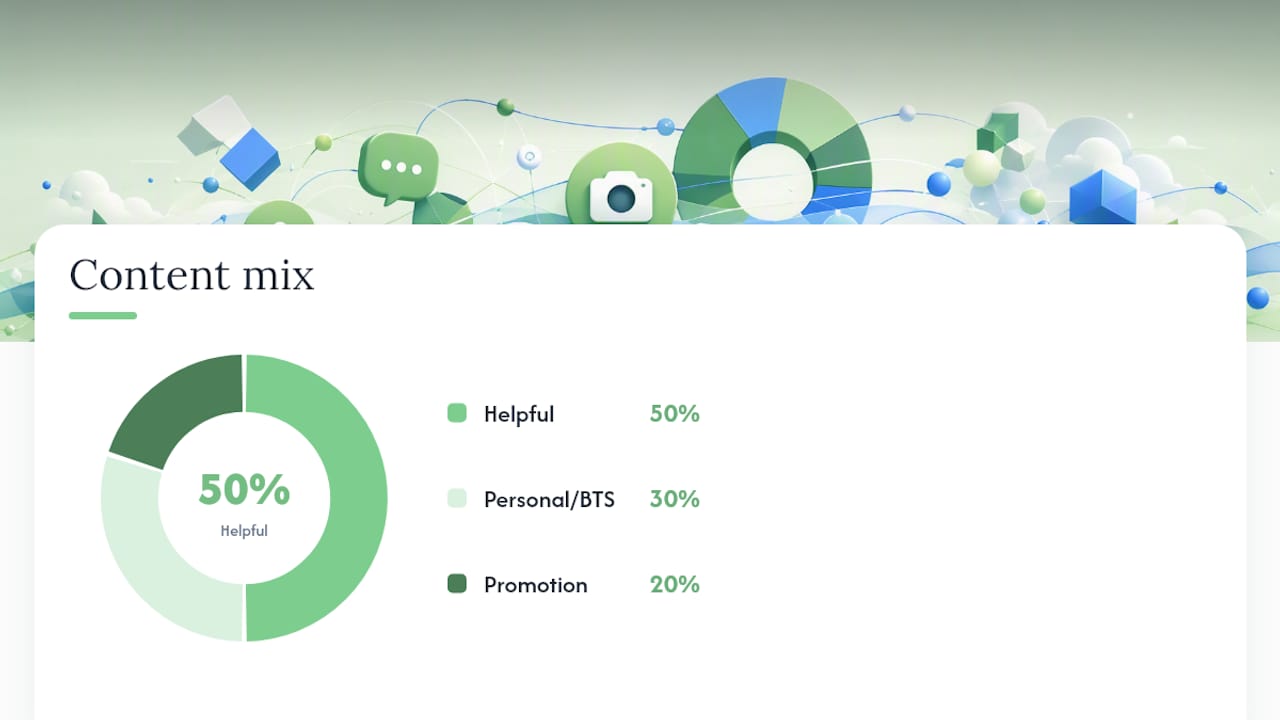
A version of the 5-3-2 rule works well here: for every 10 posts, 5 should be genuinely helpful content (tips, how-tos, answers to customer questions), 3 should be personal or behind-the-scenes, and 2 can be direct promotion. Hootsuite’s content-mix guidance backs this ratio as a way to avoid the all-promotion feed that makes followers unfollow.
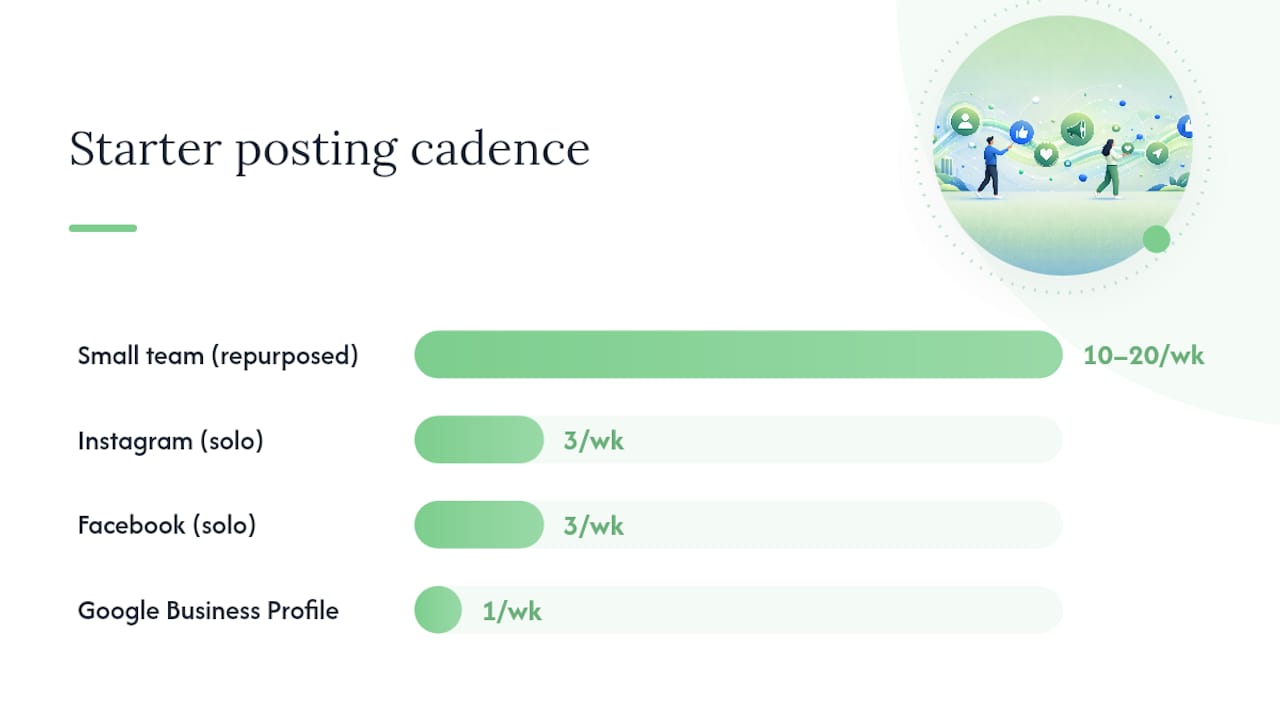
- Solo owner-operator: Aim for 6 to 8 posts a week total, spread across two platforms, not five.
- Small team (2 to 5 people): 10 to 20 posts a week across three platforms is realistic with one batching session.
- Small agency or dedicated marketer: Higher volume is possible, but only once repurposing systems are in place.
Batching is what makes any of this sustainable; using AI-assisted content ideas and calendar filling can help small teams scale cadence effectively. Shoot five short videos in one afternoon and you have raw footage for two weeks of TikTok and Instagram Reels. One blog post can become a LinkedIn article, three pin graphics, and a week of Instagram carousel slides. Trying to run five platforms at once, each with its own daily posting habit, is the single most common way small teams burn out and quietly abandon social media within two months. Maintaining two or three platforms well beats spreading thin across five.
Pro Tip: If you only have one afternoon a week for content, spend it filming raw video, not editing. Editing can happen in ten-minute gaps between other work; filming needs a dedicated block of uninterrupted time.
What Tools Help You Keep a Consistent Posting Schedule?
You need three things: something to design posts, something to schedule them, and something to check whether it’s working. Canva’s Content Planner covers the first two reasonably well for small teams, letting you design and schedule across platforms from one dashboard without juggling separate logins.
A simple weekly cycle looks like this:
- Monday: Ideation. Review last week’s top-performing post and plan the week’s five to eight pieces of content.
- Tuesday or Wednesday: Batch creation. Shoot video, write captions, design graphics in one sitting.
- Thursday: Schedule everything for the following week using your calendar tool.
- Ongoing: Monitor comments and messages daily. This part cannot be batched.
- Sunday: Quick report. Note reach, engagement rate, and any standout posts.
A content calendar template built around a 30/60/90 structure makes this cycle repeatable instead of something you rebuild from scratch every month.
Which Metrics Tell You If Your Posting Frequency Is Actually Working?
Reach and follower count are the numbers everyone checks first, but they are the least useful for deciding whether to change frequency. Engagement rate per post, saves, and shares tell you whether the content itself is landing, separate from how often you’re posting.
Watch for content fatigue: a steady drop in engagement rate per post over several weeks, or a rise in unfollows and negative comments, usually means you’ve crossed from “consistent” into “annoying.” HubSpot’s survey data found 64% of marketers post less than daily, which suggests most professionals have already learned this the hard way.
- Primary: Engagement rate per post, saves, shares
- Secondary: Reach, follower growth
- Business-level: Leads, bookings, site traffic from social
Weigh business metrics above vanity metrics every time. A cadence that grows reach but drops leads is a cadence to reverse, not celebrate.
What’s a Realistic Starting Cadence If You’re Doing This Alone?
Solo owners rarely need five platforms. Two done consistently beat five done sporadically. A workable starter plan looks like Instagram at 3 posts a week, Facebook at 3 posts a week, and a Google Business Profile update once a week, all built from one batching session. Small teams can stretch to 10 to 20 posts a week across three platforms once repurposing is dialed in.
Ninety days is the right window to judge results, long enough to smooth out weekly noise but short enough to course-correct before a full quarter is wasted. Audits routinely find businesses posting inconsistently on the wrong platforms for their actual customer base, which wastes more time than posting too little ever does. A 90-day social media plan and clear content pillars fix that faster than trial and error.
Want This Handled Without Adding It to Your Own To-Do List?
There are alternatives to hiring a traditional agency for social media that offer no long-term contract, month-to-month pricing, and build and post content in-house instead of outsourcing to freelancers. If the platform ranges and testing timeline above sound right in theory but impossible to execute alongside running your business, that’s the actual gap Cloudsprout closes.
Every engagement starts with a free digital audit that looks at your current posting habits, your website, and your local search presence together, since these three rarely improve in isolation. From there, Cloudsprout’s social media marketing service builds a 90-day cadence specific to your platforms, your industry, and your actual capacity, not a generic template. If you’d rather have a team batch and schedule your content while you run your business, book the free audit and get a starter plan built around your numbers, not a blog post’s averages.
Sources
- How frequently should I publish on social media? (HubSpot)
- How Often to Post on Social Media in 2026 — Data-Backed Guide (Buffer)
- How Often to Post on Social Media (PostPlanify)
- How often should a business post on social media? (Hootsuite)
- Canva Content Planner (Canva)
FAQ
What is the best frequency to post on social media?
There is no single best number across platforms. Instagram and LinkedIn do best at 3 to 5 posts a week, Facebook and X reward daily or multiple-times-daily posting, and Pinterest works best at high daily volume because pins have a long shelf life.
What is the 5-3-1 rule on social media?
Common versions of this rule suggest a weekly mix of roughly 5 pieces of curated or third-party content, 3 original pieces you create, and 1 promotional post, though exact ratios vary by source. The core idea, consistent with the 5-3-2 mix Hootsuite recommends, is to keep promotional content to a small minority of your total posts.
What is the 5-5-5 rule for social media?
This is a less standardized framework, and definitions vary across sources, but it generally refers to spending 5 minutes engaging with others’ content, 5 minutes checking analytics, and 5 minutes creating or scheduling content each day as a lightweight daily habit for solo operators.
How many times a week should a small business post on Instagram?
Three to five feed posts a week is the data-backed range, supported by daily Stories since Stories cost little planning time and keep your account visible between feed posts.
How do I know if I’m posting too often?
Watch engagement rate per post over several weeks. A steady decline while you’re posting more, combined with rising unfollows, is the clearest sign you’ve crossed from consistent into overposting.
Recommended
Less reading. More growing.
We build the systems these articles describe. Websites, AI follow-up, reviews, automation. And run them for you.
Keep reading

Protect Your Traffic: Website Migration Checklist for Small Businesses

