Lead with the win, not the client’s name: put the headline result in the first line, follow it with a three-sentence executive summary, then break the story into Challenge, Decision, Approach, Results, Quote, and a call to action. That is the case study format that gets read on a phone in under ninety seconds and still holds up as a PDF a client hands to their boss. Everything else, the interview questions, the visuals, the promotion plan, exists to fill in that skeleton with real proof instead of vague praise.
TL;DR:
- Most effective case studies start with a clear result headline and a brief summary, prioritizing the client’s outcome over the company’s efforts.
- The results should highlight measurable improvements like error reduction, time savings, or process speed within a specified timeframe, even without large revenue figures.
- Visuals such as before-and-after images and simple charts help establish credibility and should be optimized for fast webpage load times.
- Publish case studies on key pages including service-specific sections, homepage highlights, and dedicated results hubs to maximize exposure and lead generation.
- Multiple marketing assets can be created from one interview, including web pages, PDFs, social clips, and sales documents, to maximize the value of each client story.
Table of Contents
- What Is the Best Case Study Format for a Small Business Website?
- How Do I Run a Client Interview That Produces Real Quotes?
- What Counts as a Result When You Don’t Have Big Numbers?
- What Visuals Make a Case Study Look Credible Online?
- Where Should You Publish a Case Study to Get Leads From It?
- How Do You Turn One Client Interview Into Multiple Marketing Assets?
- Why Most SMB Case Studies Read Like Ads (And What Changes That)
- Want a Case Study Written and Published, Not Just Outlined?
- Sources
- FAQ
What Is the Best Case Study Format for a Small Business Website?
A case study that builds trust opens with proof, not a preamble. Readers, especially the procurement person quietly comparing three vendors, want the payoff before the backstory.
Here is a template you can copy into a page builder or a Google Doc today, with word counts for both the web version and a downloadable PDF.
Headline and executive summary
- Headline states the result and, if the client allows it, their name: “How [Client] Cut Invoice Errors 30% in Six Weeks.”
- Executive summary is a briefing note: client, challenge, approach, result, written as 2 to 3 sentences placed right under the headline.
Section-by-section breakdown
- Challenge (60 to 100 words): the specific problem, not a generic pain point. Name the trigger, a missed deadline, a failed audit, a competitor pulling ahead.
- Decision and constraints (40 to 80 words): what the client considered, what budget or timeline boxed them in, why they picked this path. This is the section most case studies skip, and it is the one that makes a B2B case study convert because it mirrors how buying committees actually decide.
- Approach (100 to 150 words): what was built or changed, in plain language, with one or two specifics (a tool name, a timeline, a process step) that make it feel real.
- Results (60 to 100 words): the headline metric restated, plus two supporting facts and a timeframe.
- Quote (1 to 3 sentences): in the client’s own words, not agency polish.
- CTA (10 to 20 words): one button, one action.
Keep the web version under 500 words total. The PDF version can run to 700 or 800 words because a reader who downloads a PDF has already decided they want depth.
How Do I Run a Client Interview That Produces Real Quotes?
A rushed 15-minute call gets you nothing but “it went great.” A structured 30-minute interview gets you the exact line you’ll put in bold on the page.
Before you call, do three things:
- Pull whatever data exists already, invoices, time logs, before/after screenshots, so you’re not asking the client to remember numbers from memory.
- Confirm who to interview. The owner gives you the decision story; the day-to-day user gives you the workflow detail and the best quotes.
- Get verbal permission upfront to use their name, logo, and specific figures. Confirm it again in writing before you publish.
During the call, group your questions into three buckets: outcome (“What changed in the first month?”), process (“Walk me through what it was like before”), and feeling (“What would you tell another owner considering this?”). That last bucket produces the client-voice quotes that read as credible precisely because they don’t sound like marketing copy.
Pro Tip: Ask “Can I quote you on that exact sentence?” the moment they say something quotable. People rarely say it the same way twice, and asking on the spot beats trying to paraphrase later.
What Counts as a Result When You Don’t Have Big Numbers?
Not every small business has a revenue lift to point to, and that is fine. Time saved, fewer errors, and faster turnaround are legitimate, quantifiable outcomes that buyers respond to just as well as a sales number.
Some outcomes worth measuring even without hard revenue data:
- Hours saved per week on a task that used to eat someone’s afternoon.
- Error rate before and after (missed appointments, billing mistakes, late shipments).
- Time from inquiry to proposal, or proposal to signed contract.
- Number of manual steps removed from a process.
Format the result section as one headline metric, two supporting facts, and a timeframe. For example: “Reduced scheduling errors by half in eight weeks, cutting three hours of weekly phone corrections and eliminating one full-time admin task.” A strong case study uses one memorable number up top, backed by qualitative color, rather than a wall of small stats nobody remembers.
What Visuals Make a Case Study Look Credible Online?
You don’t need a photography budget. You need visuals like one before/after image or screenshot pair and one small chart showing the headline metric.
Formatting rules that keep a page fast and easy to skim:
- Break every section with a short, sentence-case heading so a reader scanning on their phone knows where they are.
- Keep paragraphs to three or four lines maximum.
- Pull the strongest quote out as a separate, larger-text block, not buried mid-paragraph.
- Put the headline metric in a highlighted box near the top, not at the bottom where nobody scrolls to.
Pro Tip: Compress every image before upload. A single unoptimized screenshot can add a full second to page load, and page speed still affects whether people stay long enough to read your results.
Where Should You Publish a Case Study to Get Leads From It?
Three placements do most of the work. First, on the exact service page the client’s problem relates to, right next to the CTA, because that’s where a prospect is already deciding. Second, featured on the homepage, rotating if you have more than two or three. Third, in a dedicated results or case-study hub for people actively comparing vendors.
Want this running in your business without doing it yourself?
Book a Free Consultation →For promotion, run through this short checklist for every case study you publish:
- Cut a 30 to 60 second social clip using the client quote as the hook.
- Write a two-sentence email snippet linking to the full page.
- Build a one-page sales leave-behind PDF for reps to send directly.
- Offer the PDF as a gated download only if you specifically want the lead capture; otherwise leave the web page open, since gating cuts your reach for no real benefit on a page meant to build trust.
How Do You Turn One Client Interview Into Multiple Marketing Assets?
Plan for four outputs before you even schedule the call: a web page, a downloadable PDF, a short video clip, and a sales one-pager. One well-run interview supplies all of it.
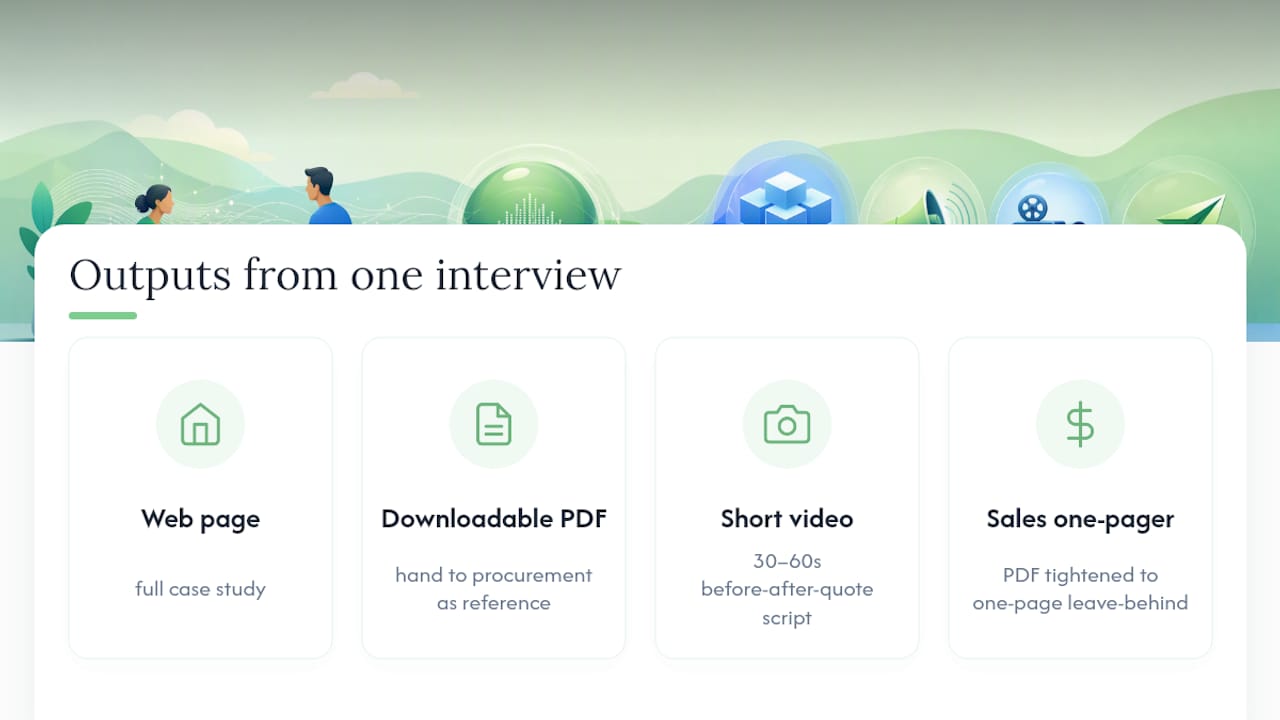
Map it out simply: headline plus three bullet points for a LinkedIn post, the strongest quote as a standalone tweet, and a 30 to 60 second script built around the “before, after, quote” arc for a video or customer success film. Sales teams can hand the PDF straight to a procurement contact as a reference document, no extra formatting needed. That same PDF, tightened to one page, becomes the leave-behind a rep drops after a meeting.
Why Most SMB Case Studies Read Like Ads (And What Changes That)
The biggest mistake in this format has nothing to do with layout. It’s writing the case study as a love letter to your own company instead of a document about the client’s decision. A reader can smell the difference in the first sentence: if it opens with what you did, they scroll past; if it opens with what changed for the client, they keep reading.
The second mistake is skipping the messy middle. Case studies that jump from “we had a problem” straight to “everything was perfect” read as fiction, because every real project involves some friction, a training curve, a workflow that needed adjusting twice, a metric that took longer to move than expected. Naming that friction is what makes the eventual result feel earned instead of staged.
Industry matters more than most owners think, too. A trades business wants time saved and fewer callbacks. A professional services firm wants faster turnaround and fewer client escalations. A restaurant wants labor hours saved or order accuracy. Reusing the exact same case study skeleton across all three works, but the metric you lead with should match what that specific buyer already loses sleep over.
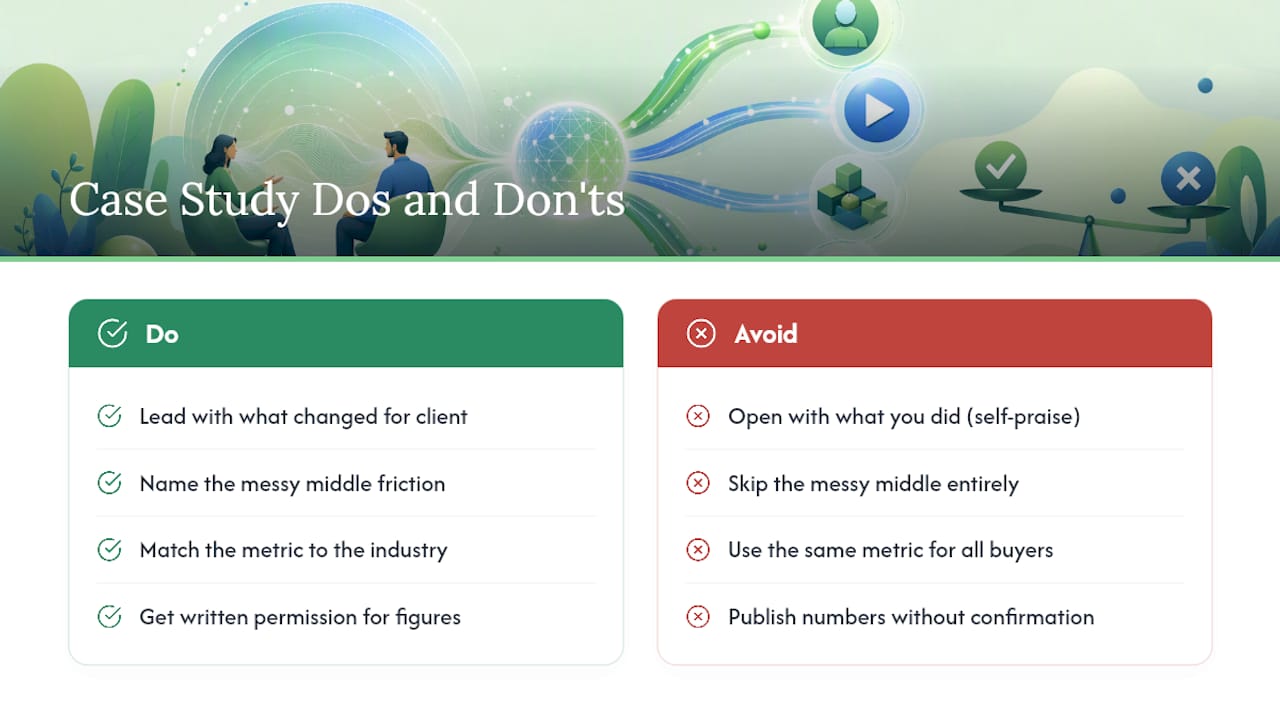
On the legal side, get written permission before publishing a client’s name, logo, or specific figures, not just a verbal nod on a call. If a client asks for anonymity, you can still use the story, “a 12-person HVAC company in the GTA,” works fine, but never publish a number you haven’t had explicitly confirmed for public use.
Where Cloudsprout applies this in its own work: every project starts with a free digital audit, which doubles as the raw material for a future case study, because you’re already gathering the before-state data you’ll need later. The format above is close to what shows up on client project pages once results are in.
— Cristo
Want a Case Study Written and Published, Not Just Outlined?
Cloudsprout is the alternative to hiring a freelance writer or leaving case studies on the to-do list indefinitely: one team runs the interview, writes the page, builds the visuals, and publishes it, with no separate designer or outside contractor to coordinate. For an owner who barely has time to answer emails, let alone conduct interviews and format a web page correctly, that in-house handoff is the actual time saved.
If you already have happy clients but no case studies to show for it, that’s usually a website and content gap, not a results gap. Cloudsprout’s website development service builds the page structure to hold these stories properly, and a free SEO audit is the fastest way to find out which client story should go up first and where it will actually get seen. Book the audit and bring one client’s contact info. That’s the whole first step.
Sources
- How to Write a Case Study That Builds Trust
- How to Write a B2B Case Study That Converts Customers (2026 Guide)
FAQ
What Is the Ideal Length for a Web Case Study?
Keep the web version under 500 words, with a 20 to 40 word executive summary near the top; save the fuller 700 to 800 word version for a downloadable PDF.
Do I Need Real Numbers, or Can I Use Qualitative Results?
Qualitative outcomes like time saved, fewer errors, or faster turnaround are valid results when formatted as one headline metric with two supporting facts and a timeframe.
How Long Should a Client Interview Take?
Thirty minutes is usually enough if you prepare outcome, process, and feeling questions in advance and already have basic data pulled before the call.
Where Should a Case Study Live on My Website?
Publish it on the relevant service page near your call to action, feature it on the homepage, and collect all of them in a dedicated results hub.
Can Cloudsprout Write and Publish the Case Study for Me?
Cloudsprout handles the interview, writing, design, and publishing in-house, starting from a free digital audit that also identifies which client story to feature first.
Recommended
Less reading. More growing.
We build the systems these articles describe. Websites, AI follow-up, reviews, automation. And run them for you.
Keep reading