

Video marketing is defined as the use of promotional video content to communicate a brand’s products, services, and values to a target audience. The role of video marketing for small businesses has shifted from a “nice to have” to a core growth driver. Customer testimonial videos deliver a 6.2x return on investment, and websites with video are 53 times more likely to rank on Google’s first page. For small business owners competing against bigger brands with larger budgets, video content levels the playing field in ways that blog posts and static images simply cannot.
What measurable benefits does video marketing provide small businesses?
Video marketing produces financial returns that most other content formats cannot match. 75% of businesses see measurable ROI from video within six months, averaging $4.20 back for every $1 spent. That figure means a $1,000 monthly video budget should realistically return $4,200 in attributable revenue within half a year.
The SEO advantages are equally significant. Websites with video content are 53 times more likely to reach Google’s first page and see organic traffic grow by 157%. Search engines treat video as a signal of content quality, which pushes pages higher in rankings without requiring additional paid advertising.

Social sharing amplifies reach far beyond what you pay for. Social video generates 1,200% more shares than text and images combined. A single well-produced testimonial or product demo can circulate across Facebook, Instagram, and LinkedIn without any additional spend.
Key benefits at a glance:
- Customer testimonial videos produce the highest ROI at 6.2x, making them the single best video investment for small businesses
- SEO lift from video increases organic traffic by up to 157%, reducing dependence on paid search
- Social sharing rates for video exceed text and image content by 1,200%, expanding reach organically
- Conversion rates improve when product pages include video, because buyers can see the product in action before purchasing
Pro Tip: Start with one customer testimonial video before producing anything else. It delivers the highest ROI and requires no studio, just a satisfied customer and a smartphone.
How can small businesses create video marketing strategies on a budget?
A video marketing strategy is a documented plan connecting specific video content to measurable business goals. Without that connection, random posting wastes budget and limits results regardless of production quality. The strategy comes before the camera.
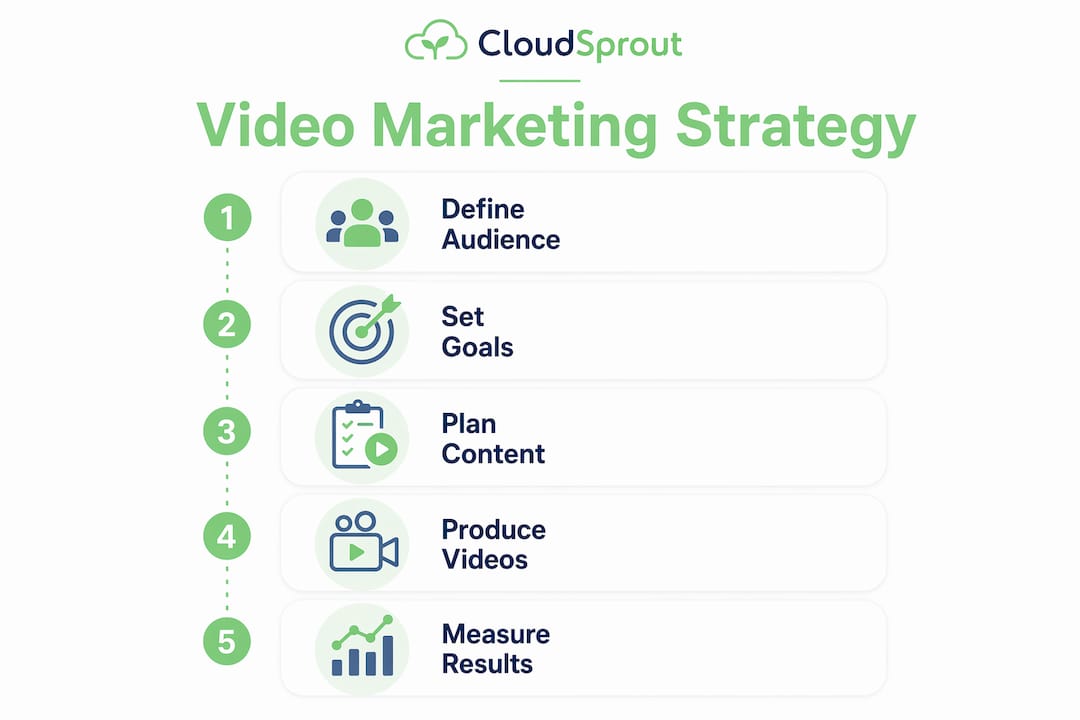
Define your audience, goals, and KPIs first
Before filming anything, write down who you are making the video for, what action you want them to take, and how you will measure success. Watch time, click-through rate, and lead form completions are stronger indicators than raw view counts. Engagement metrics like watch time and shares show audience trust far better than vanity numbers.
Use the 80/20 content rule
80% of your video effort should go toward reusable, high-impact content: testimonials, product demos, and how-to guides. The remaining 20% covers trend-based or platform-specific clips. This ratio keeps your core library growing while still allowing you to participate in timely social moments.
Reduce costs with AI tools
AI tools cut video production costs by up to 40%, enabling faster output and consistent quality without a full production crew. Small businesses can realistically produce 4–8 videos monthly for $500–$2,000, including tools and freelancers. That budget range is accessible for most owner-operators, especially when paired with smart financial planning. Resources like small business cost strategies can help you allocate that budget without cutting into operating cash.
Batch filming saves time and money
Batch filming means recording multiple videos in a single session rather than setting up equipment repeatedly. One two-hour filming session can produce enough content for an entire month. This approach limits burnout, keeps your backdrop and lighting consistent, and reduces the per-video cost significantly.
Pro Tip: Track watch time and click-through rate, not just views. A video watched to 80% completion by 200 people outperforms one with 2,000 views and a 10-second average watch time.
Which video types and platforms work best for small businesses?
Different video formats serve different business goals. Choosing the wrong format for the wrong platform wastes production time and misses the audience entirely.
Video types that drive results
Product videos, webinars, educational clips, and social content are the top-performing formats for engagement and lead generation. Each serves a distinct purpose:
- Testimonials build trust and convert hesitant buyers. Best placed on landing pages and product pages.
- Product demos show your offering in action. Ideal for e-commerce pages and email campaigns.
- How-to videos establish authority and attract search traffic. YouTube and your blog are the right homes for these.
- Behind-the-scenes clips humanize your brand. Instagram Stories and Facebook Reels work well here.
- Live webinars generate leads and allow real-time Q&A. LinkedIn Live and YouTube Live are the standard platforms for professional service businesses.
Platform selection matters as much as format
Instagram, Facebook, TikTok, and YouTube each prioritize video in their algorithms, but they reward different styles. TikTok favors short, fast-paced clips under 60 seconds. YouTube rewards longer, search-optimized content. Instagram Reels perform best at 15–30 seconds with captions, since many viewers watch without sound.
The hosting decision most small businesses get wrong
Embedding YouTube videos directly on your website is common, but it carries a real cost. YouTube embeds can slow site load times, hurt Core Web Vitals scores, and send visitors to competitor content through YouTube’s recommendation engine. Specialized business video hosting improves page speed, protects conversion rates, and keeps visitors on your site. For any video that lives on a landing page or product page, dedicated hosting is the better choice.
Want this running in your business without doing it yourself?
Book a Free Consultation →What are the most common pitfalls in small business video marketing?
Most small business video marketing fails not because of poor production quality, but because of poor planning. Success depends on connecting video content to clear business goals with defined KPIs. A beautiful video with no call to action and no distribution plan generates almost no return.
The second most common mistake is treating video as a one-time project. Consistent output matters more than occasional perfection. Video marketing budgets are growing slowly, with many teams spending under $5,000 annually, which means efficiency and repeatability are more important than production value.
Watch your website’s technical performance. A video that takes five seconds to load on a product page will cost you conversions before the viewer sees a single frame. Test load times after adding video, and consider dedicated hosting for any page where conversion is the goal.
Avoid outsourcing your entire video strategy to a freelancer without a documented brief. Freelancers can execute well, but they cannot define your business goals for you. Write a one-page brief covering your audience, the video’s purpose, the call to action, and the platform before any production begins.
Pro Tip: Audit your existing content before producing anything new. A well-performing blog post can become a how-to video script in under an hour, cutting research time entirely.
Key Takeaways
Video marketing drives measurable growth for small businesses when production is tied to clear goals, the right formats are matched to the right platforms, and performance is measured by engagement rather than views.
| Point | Details |
|---|---|
| ROI starts fast | 75% of businesses see measurable video ROI within six months, averaging $4.20 per $1 spent. |
| SEO lift is significant | Websites with video are 53 times more likely to rank on Google’s first page. |
| Use the 80/20 rule | Put 80% of effort into reusable content like testimonials and demos; 20% on trend clips. |
| Watch your hosting choice | YouTube embeds on landing pages slow load times and send visitors to competitor content. |
| Measure engagement, not views | Watch time, shares, and click-through rate show real audience trust better than raw view counts. |
Why I think most small businesses are still underusing video
I have worked with dozens of small business owners who treat video as a luxury they will get to “eventually.” The data does not support that delay. Customer testimonial videos alone return 6.2x, which is a better return than most paid ad campaigns I have seen at comparable budgets.
The shift that changed my thinking was watching AI tools enter the production process. What used to require a videographer, an editor, and a half-day shoot can now be handled in a fraction of the time and cost. That 40% cost reduction is not theoretical. It shows up in real project budgets.
The businesses I see winning with video are not the ones with the best cameras. They are the ones who batch film once a month, post consistently, and track watch time instead of obsessing over view counts. They treat video like a sales tool, not a creative project.
My honest advice: pick one video type, produce four videos this month, and measure engagement for 30 days. You will have more useful data than a year of planning ever gave you.
— Cristo
Cloudsprout helps small businesses get real results from video
Small business owners who want to use video marketing without wasting budget on trial and error have a faster path available.

Cloudsprout is an Ontario-based digital agency that builds and executes video marketing strategies for small and mid-sized businesses across Canada. The team handles content planning, AI-assisted production, SEO integration, and performance tracking, all in-house with no outsourcing. Every client starts with a free digital audit so you know exactly where video fits into your current marketing before spending a dollar. Month-to-month pricing and no lock-in contracts mean you stay in control of the budget at every stage.
FAQ
What is the role of video marketing for small businesses?
Video marketing helps small businesses build brand awareness, drive website traffic, and convert visitors into customers. Customer testimonial videos and product demos consistently deliver the highest returns for owner-operated businesses.
How much does small business video marketing cost?
Small businesses can produce 4–8 videos monthly for $500–$2,000, including tools and freelancers. AI tools reduce production costs by up to 40%, making consistent output achievable on limited budgets.
Which video type gives the best ROI?
Customer testimonial videos deliver the highest ROI at 6.2x, making them the most cost-effective starting point for any small business video strategy.
Does video content actually help with Google rankings?
Websites with video are 53 times more likely to reach Google’s first page and see organic traffic increase by 157%. Video signals content quality to search engines, which improves rankings without paid advertising.
Should I host videos on YouTube or a dedicated platform?
YouTube is effective for social reach and search discovery, but embedding YouTube videos on landing pages can slow load times and redirect visitors to competitor content. Dedicated business video hosting is the better choice for any page where conversion is the goal.
Recommended
Less reading. More growing.
We build the systems these articles describe. Websites, AI follow-up, reviews, automation. And run them for you.
Keep reading
One Page Voice Chart: 8 Brand Voice Examples Small Businesses Can Use