Brand voice examples are real patterns of language and behavior other companies have already tested in public, which means you can copy the structure without copying the words. This article breaks down eight brand voice archetypes with named examples from companies like Mailchimp, Nike, Duolingo, Canva, Taco Bell, Walmart, and Dove, plus a one-page voice chart you can paste into a brief or an AI prompt today.
TL;DR:
- Small businesses should limit their brand voice traits to three to five and clearly define do and don’t examples to ensure consistent messaging.
- The primary channels for maintaining voice consistency include website headlines, social media captions, support replies, and email subject lines, which should reflect a unified personality.
- A one-page voice chart with specific traits and examples significantly reduces drift and acts as a practical reference tool for daily content creation.
- Using AI tools effectively requires inputting persistent context, such as traits and sample sentences, to prevent gradual loss of personality over multiple sessions.
- Regular audits of copy across channels can identify inconsistencies and help reinforce a cohesive brand voice aligned with core personality traits.
Table of Contents
- What Is Brand Voice, and How Is It Different From Tone?
- 8 Brand Voice Archetypes You Can Model Today
- 1. Playful/Irreverent
- 2. Warm/Human
- 3. Authoritative/Expert
- 4. Aspirational/Bold
- 5. Rebellious/Outsider
- 6. Earnest/Mission-Driven
- 7. Humorous/Absurdist
- 8. Plain-Spoken/Confident
- How Do You Build Your Own Brand Voice Chart?
- Where Does Your Voice Show Up, and How Does It Change Slightly?
- How Do You Keep Your Brand Voice Consistent Over Time (Including With AI)?
- Common Brand Voice Mistakes (and One-Step Fixes)
- Why a One-Page Voice Chart Is the Highest-Leverage Document a Small Business Owns
- Need Help Turning Your Voice Into Actual Copy?
- Sources
- FAQ
What Is Brand Voice, and How Is It Different From Tone?
Brand voice is the personality a business expresses through language, and it stays the same no matter where it shows up. Tone is how that personality bends to fit a moment. A plumbing company in Hamilton might have a voice that is “no-nonsense, friendly, direct.” Its tone shifts depending on context: cheerful in a social post about a summer promotion, calm and reassuring in a text confirming an emergency call.
The distinction matters because Hootsuite defines brand voice as the consistent personality a company expresses through language, tone, and style, while tone is the situational adjustment layered on top. Get the voice locked and the tone will flex naturally without losing the personality underneath.
Here’s the difference in practice:
- Voice (fixed): “We keep things simple and we don’t talk down to people.”
- Tone in a support reply: “That’s frustrating, let’s fix it right now.”
- Tone in a product launch email: “This one’s been a long time coming. Here’s what’s new.”
Small businesses often skip this distinction entirely, writing every channel in the same flat register. That’s how a Facebook caption ends up sounding like a legal disclaimer, and a customer service email sounds like a sales pitch.
8 Brand Voice Archetypes You Can Model Today
Every recognizable brand voice fits into a handful of repeatable patterns. Below are eight archetypes, each with real examples and two takeaways you can lift straight into your own messaging.
1. Playful/Irreverent
Duolingo built an entire personality around being a little unhinged. The owl mascot sends passive-aggressive push notifications and jokes about “stalking” users who skip lessons, and it works because the app never breaks character across social, email, or in-app copy.
- Takeaway: Give your mascot or brand a slightly petty streak; predictability kills playful voice faster than repetition does.
- Takeaway: Push notifications and error messages are the cheapest place to test irreverent copy before rolling it out everywhere.
2. Warm/Human
Mailchimp built its style guide around clear, conversational language instead of forced cleverness. Its content design principles specifically warn that trying too hard to be clever undermines trust, and Mailchimp’s own guidance leans on plain, human sentences instead.
- Takeaway: Write support replies the way you’d explain something to a neighbor, not a legal team.
- Takeaway: Cut any sentence that sounds better in a boardroom than out loud to a real person.
3. Authoritative/Expert
Walmart speaks with the flat confidence of a company that doesn’t need to convince anyone it’s credible. Its copy states facts, prices, and policies without hedging or exclamation points, which reinforces a “we’ve got this handled” personality at scale.
- Takeaway: Cut qualifiers like “we think” or “hopefully” from anything meant to sound expert.
- Takeaway: Let numbers and specifics carry the confidence instead of adjectives.
4. Aspirational/Bold
Nike rarely explains itself. Copy like “Just Do It” works because it assumes the reader already wants the outcome and skips the justification entirely.
- Takeaway: Cut the explanation sentence after your bold claim; if the claim needs defending, it’s not bold enough.
- Takeaway: Use short imperative sentences for hero headlines and CTAs, not full explanations.
5. Rebellious/Outsider
Taco Bell built a voice that pokes fun at its own category, mocking “fancy” fast food and leaning into absurdity on social media. It works because the brand never pretends to be something more upscale than it is.
- Takeaway: Name what your category takes too seriously, then make fun of it gently.
- Takeaway: Self-deprecating humor about your own product reads as confident, not weak.
6. Earnest/Mission-Driven
Dove built its “Real Beauty” positioning on plain, sincere language about self-image rather than jokes or slogans. The voice stays consistent because every campaign ties back to the same stated belief instead of chasing trends.
- Takeaway: State your actual belief in one plain sentence, then repeat it across every campaign instead of rewriting it.
- Takeaway: Back mission language with visible proof (real customers, real data), since messaging frameworks stress that claims need traceable evidence to stay believable.
7. Humorous/Absurdist
Mailchimp’s internally documented persona, nicknamed the “Expert Absurdist,” pairs genuine subject-matter expertise with unexpected, slightly weird humor in illustrations and copy. The persona gives writers a consistent character to write “as,” which keeps jokes from feeling random.
- Takeaway: Name your internal persona (even informally) so every writer on the team is performing the same character.
- Takeaway: Pair every joke with real usefulness; absurdist humor without substance reads as noise.
8. Plain-Spoken/Confident
Canva talks to non-designers like they already belong in the room. Copy avoids design jargon and instead uses everyday words like “make” and “create,” which lowers the intimidation factor for a tool that could easily sound technical.
- Takeaway: Replace industry jargon with the verb a beginner would actually use.
- Takeaway: Confidence in plain-spoken voice comes from short sentences, not big words.
Consistency across these archetypes isn’t cosmetic. Brands that keep the same voice across their website, social, and email channels build stronger recognition over time, and HubSpot’s research on consistent brand voice points to Duolingo and Taco Bell specifically as brands that maintain the same personality no matter which channel a customer meets them on first.
How Do You Build Your Own Brand Voice Chart?
Most small businesses don’t need a 40-page brand bible. They need one page they can actually reference on a Tuesday afternoon while writing a Facebook post.
Step 1: Audit what you already have. Pull your last 10 social posts, five emails, and your homepage copy. Read them back to back. Do they sound like the same person wrote them? Most businesses find they don’t, and that’s the starting point.
Step 2: Pick 3 to 5 voice traits and place them on scales. Don’t just list adjectives, since “friendly” means nothing without a boundary. Put each trait on a spectrum:
- Funny ↔ Serious
- Formal ↔ Casual
- Respectful ↔ Irreverent
- Enthusiastic ↔ Matter-of-fact
Step 3: Build do/don’t rows. According to SivonHQ’s framework, a short chart pairing traits with do/don’t examples is the single most useful artifact for keeping a voice consistent day to day, and the “don’t” column often teaches writers more than the “do” column because it flags the exact failure mode to avoid.
| Trait | What It Means | Do | Don’t |
|---|---|---|---|
| Warm | Talk like a person, not a policy | “We’ll fix this today.” | “Your request has been escalated per protocol.” |
| Confident | State facts without hedging | “This works in most kitchens.” | “This might possibly work for some kitchens.” |
| Direct | Short sentences, one idea each | “Book your quote below.” | “Should you be interested in learning more, feel free to reach out.” |
Step 4: Write five sample phrases. Draft a hero headline, a CTA button, a support reply, a social caption, and an error message, all in the same voice. If they don’t sound related, your traits are too vague.
Want this running in your business without doing it yourself?
Book a Free Consultation →Step 5: Store it somewhere everyone actually opens. A voice chart buried in a shared drive folder gets ignored. Pin it in your team’s messaging app, or attach it to your content marketing checklist so it’s part of the weekly workflow, not a one-time exercise.
Pro Tip: Write your three worst “don’t” examples before you write a single “do.” Seeing the failure mode in black and white makes the right version obvious.
Where Does Your Voice Show Up, and How Does It Change Slightly?
The same voice needs light adjustments depending on where it lands, but the personality underneath should never flip.
- Website: Hero headlines carry the boldest version of your voice; CTAs stay short and match your formal/casual scale exactly.
- Email: Subject lines can lean playful even if your body copy is more direct; preview text should never contradict the subject’s tone.
- Social: Captions get the most personality latitude; replies to comments should sound like the same person who wrote the caption, not a separate customer service script.
- Support: First responses stay warm and specific (“I see the issue, here’s what happens next”); escalation language stays calm, never defensive.
Run a quick spot-audit monthly: pull one email, one social caption, and one support reply, and read them back to back. If they don’t sound related, your channel rules need tightening, and your website copy is usually the first place drift shows up because it gets updated least often.
How Do You Keep Your Brand Voice Consistent Over Time (Including With AI)?
Voice drifts the moment more than one person writes for a brand, and AI tools make that drift faster if you don’t feed them the right context upfront.
Build these four assets once:
- A one-page voice chart (traits, scales, do/don’t rows)
- A short do/don’t file with real examples pulled from your own copy
- A channel sample pack (one example per channel: web, email, social, support)
- A one-page onboarding brief for anyone new writing for the brand
For AI tools specifically, don’t re-paste your voice guidelines into every prompt. Optimizely’s field notes on AI and brand voice recommend loading your traits, do/don’t examples, and sample sentences into the tool’s persistent context or system prompt once, so every output starts from the same baseline instead of drifting a little further each session.
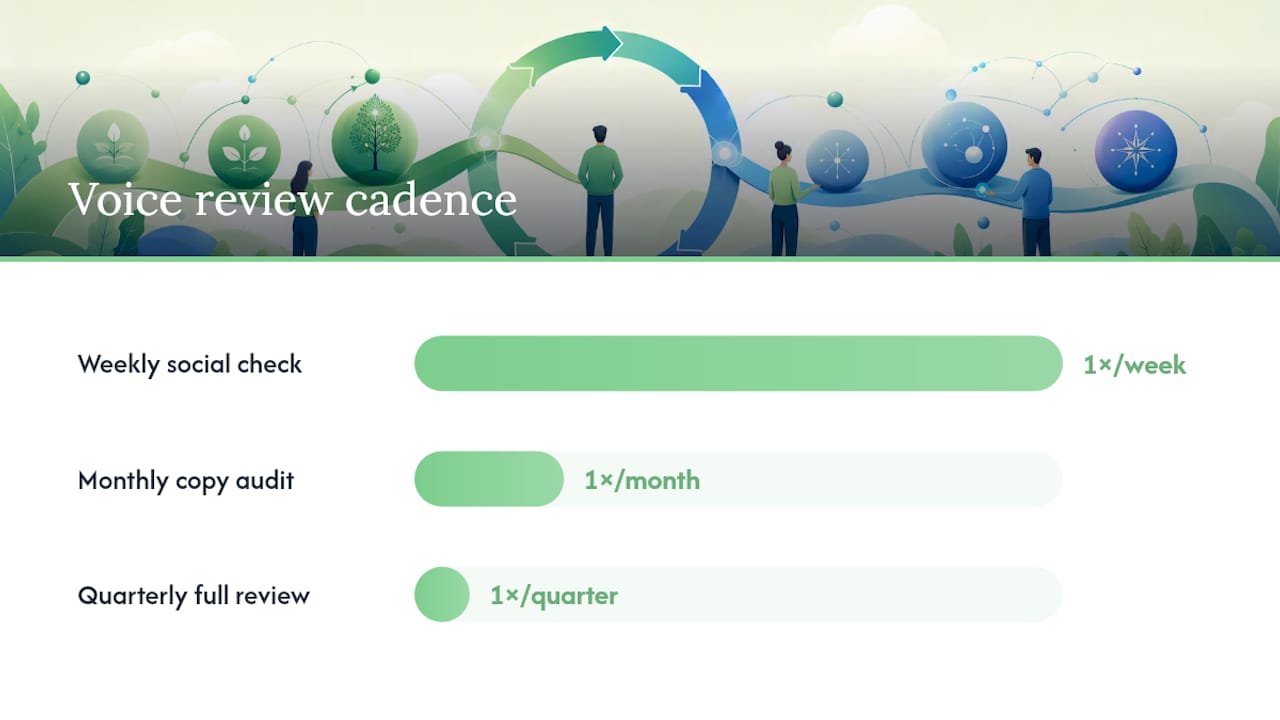
Set a simple cadence: a weekly social spot-check, a monthly copy audit across channels, and a quarterly full voice review to catch drift before it becomes the new normal.
Pro Tip: Store five canonical example sentences and three “never write this” examples in your AI tool’s saved context. That short list does more to prevent robotic-sounding output than any lengthy style guide.
Common Brand Voice Mistakes (and One-Step Fixes)
- Too many traits: Pick 3 to 5 max; more than that and writers can’t hold them all in their head. Fix: cut the list in half.
- Forced humor: Jokes that don’t land read as trying too hard. Fix: swap the joke for plain clarity. Before: “We’re basically wizards with a wrench!” After: “We fix it right the first time.”
- Inconsistent microcopy: Error messages and buttons often get skipped in voice work. Fix: audit these last, since they’re where drift hides longest.
- Missing proof points: Bold claims without evidence from a trusted consultancy feel hollow. Fix: attach one real number or example to every claim.
- AI drift: Generated copy slowly loses personality over multiple sessions. Fix: reload persistent context weekly.
- No governance: Nobody owns the voice chart, so it rots. Fix: assign one person to update it quarterly.
Why a One-Page Voice Chart Is the Highest-Leverage Document a Small Business Owns
Most owner-operators don’t have a marketing department; they have themselves, maybe one part-time hire, and whatever an agency delivers. That’s exactly why the one-page chart matters more for a small business than a large one. A 40-page brand book gets opened once and forgotten. A one-page chart with three traits and six do/don’t lines gets pinned above a desk and actually used before the next social post goes out.
A landscaping company we’ve seen mentioned in industry writeups switched from generic “professional and reliable” copy to a specific, plain-spoken voice with a hard rule against jargon, and the shift alone made their quotes read like a person wrote them instead of a template. That’s the entire point: copy-ready examples beat abstract adjectives every time. Build the chart, then hold everyone to the “don’t” column, since that’s the half that actually prevents drift.
— Cristo
Need Help Turning Your Voice Into Actual Copy?
Brand voice charts, messaging frameworks, and the website and social copy that carries them can be built in-house without outsourcing.
If your current website, social captions, and support replies all sound like they were written by three different people, that’s a branding and content gap, not a writing-talent problem. Cloudsprout’s branding & identity work builds the voice chart first, then applies it across your website, social, and email so the same personality shows up everywhere a customer meets you. Every engagement starts with a free digital audit and trial, and pricing stays transparent and month-to-month with no long-term contracts, starting at $300 CAD a month on the Sprout plan. Book your free audit and see exactly where your current voice is inconsistent before you spend another dollar on content that doesn’t sound like you.
Sources
- How to create a brand voice (Hootsuite)
- Mailchimp content design principles
- Brand voice guidelines: a practical framework with examples (SivonHQ)
- Using AI for brand voice (Optimizely field notes)
- Consistent brand voice (HubSpot)
FAQ
How do I determine my brand voice?
Start by auditing your existing copy across your website, social, and emails to see how inconsistent it already is. Then pick 3 to 5 traits, place them on scales like formal versus casual, and write do/don’t examples for each one so the trait becomes usable, not just an adjective on a slide.
What are the 12 brand personality types?
Definitions of brand archetypes vary across marketing frameworks, and no single canonical list is universally agreed on. This article focuses on eight practical, evidence-backed voice archetypes, including playful, warm, authoritative, and rebellious, since they map more directly to real copy decisions than abstract personality labels.
What is Nike’s brand voice?
Nike’s voice is aspirational and bold, using short, confident statements that assume the reader already wants the outcome rather than explaining or justifying the claim. Its copy rarely hedges, which reinforces the brand’s “just do it” attitude across every channel.
What is Taco Bell’s brand voice?
Taco Bell’s voice is rebellious and self-aware, often poking fun at its own fast-food category instead of taking itself too seriously. That irreverence stays consistent whether it shows up in a tweet, a menu description, or a promotional campaign.
What’s the fastest way to keep AI-generated copy on-brand?
Load your voice traits, do/don’t examples, and five sample sentences into the AI tool’s persistent context or system prompt instead of retyping them each time, which is the exact fix Optimizely recommends for preventing voice drift. Cloudsprout’s content and social services build that context file as part of setting up a brand’s messaging system.
Recommended
Less reading. More growing.
We build the systems these articles describe. Websites, AI follow-up, reviews, automation. And run them for you.
Keep reading

Small Teams: Automate Customer Onboarding in 1–4 Weeks, Keep It Human