

Search engine optimization (SEO) is defined as the practice of improving your website so it appears higher in search results when customers look for your products or services. For Canadian small businesses, getting SEO basics right means going beyond generic tactics. It means adapting your site to Canadian English, local search intent, and region-specific directories that your American counterparts simply do not use. Google Business Profile, LocalBusiness schema, and NAP consistency are the three technical pillars every Canadian owner-operator needs in place before anything else. Get these right, and your site starts working for you around the clock.
What are the Canadian business website SEO basics?
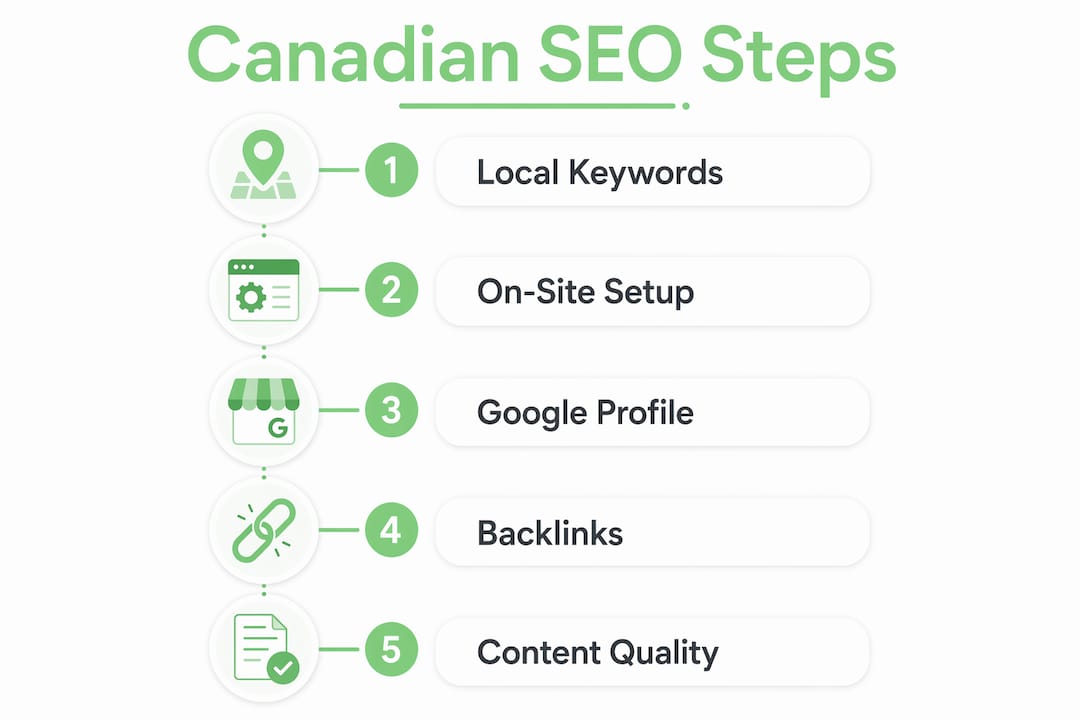
SEO for Canadian small businesses is built on four core elements: local keyword targeting, on-site technical setup, Google Business Profile optimization, and quality backlinks from Canadian sources. Each element reinforces the others. A fast, mobile-friendly site with accurate business information and locally relevant content will consistently outrank a site that ignores even one of these areas. SEO is one half of search engine marketing (SEM).
The Canadian market adds a layer of complexity that most generic SEO guides skip entirely. Canada has two official languages, distinct regional terminology, and a population that searches differently than Americans do. A plumber in Hamilton, Ontario, is not competing with a plumber in Houston, Texas. Your SEO strategy should reflect that reality from the very first page of your website.

Small business owners often assume SEO is expensive or requires a full-time specialist. SEO costs in Canada for small businesses typically range from CAD $1,000 to $5,000 monthly depending on scope and goals. That range is wide because the work required varies enormously. A local trades business with one location needs a very different approach than a multi-city e-commerce store.
How does Canadian English and local terminology impact SEO?
Canadian English sits between British and American English, and that middle ground creates real SEO consequences. Canadian English variations help your pages read as local to Canadian searchers. Google usually understands both spellings, but a customer in Toronto searching for “colour consultation” notices right away whether your page was written for Canadians.
The terminology gap goes deeper than spelling. Canadians use words that Americans simply do not. Consider these examples:
- Hydro refers to electricity in Ontario and British Columbia. A heating company that writes “electricity bills” instead of “hydro bills” misses a significant chunk of local search intent.
- Toque is the Canadian word for a knit winter hat. A clothing retailer using only “beanie” loses local relevance.
- Riding describes an electoral district. A political consulting firm or community organization should use this term.
- Loonie and toonie are the $1 and $2 coins. Financial content aimed at Canadians should use these terms naturally.
- Postal code replaces “zip code” in every Canadian address field and contact form.
Weaving these terms into your page titles, meta descriptions, and body content signals to Google that your site serves a Canadian audience. It also builds immediate trust with visitors who recognize the language as their own.
Pro Tip: Run your top five pages through a simple word search for American-only spellings like “colour,” “center,” and “organize.” Replace them with Canadian variants where they appear in customer-facing text, and update your meta descriptions to match.
What foundational on-site SEO steps should Canadian small businesses take?
On-site SEO is the work you do directly on your website to help search engines understand what you offer and where you operate. Adding local keywords to title tags and meta descriptions targets geographic search intent effectively. A title tag like “Plumbing Repairs in Ottawa | Licensed & Local” tells Google exactly who you serve and where.
Follow these foundational steps in order:
- Write location-specific title tags. Every key page should include your city or region in the title tag. Keep title tags under 60 characters so they display fully in search results.
- Craft meta descriptions with a local hook. Meta descriptions do not directly affect rankings, but they influence click-through rates. Include your city name and a clear benefit in under 155 characters.
- Format your NAP correctly. Your Name, Address, and Phone number must appear on every page, formatted to Canadian standards. Use a Canadian postal code format (A1A 1A1) and a 10-digit phone number with area code.
- Add LocalBusiness schema markup. Schema markup is code that tells search engines your business type, location, hours, and contact details. Google uses this data to confirm your business details and understand your location.
- Check mobile responsiveness. Open your site on a smartphone and navigate it as a customer would. If text is hard to read or buttons are hard to tap, you have a problem that hurts both rankings and conversions.
- Improve site speed. Mobile responsiveness, site speed, and HTTPS significantly affect search rankings and user experience. Compress images, enable browser caching, and confirm your site runs on HTTPS.
Pro Tip: Use Google’s free PageSpeed Insights tool to get a specific speed score for your site on mobile. Anything below 50 on mobile is a red flag worth fixing before you invest in any other SEO work.
What role does Google Business Profile play in Canadian local SEO?
Google Business Profile is the single most important free tool for Canadian small business local SEO. It controls how your business appears in Google Maps and the local “3-pack” results that show up above organic listings. Many customers never scroll past those three results.
Complete Google Business Profile optimization starts with accurate NAP information formatted to Canadian postal code and phone standards. Every detail matters. A mismatched phone number between your website and your Google profile confuses search engines and reduces your ranking.
Beyond the basics, a strong Google Business Profile includes:
- Business category selection. Choose the most specific primary category available. “Electrician” outperforms “Contractor” for electrical searches.
- Photos updated regularly. Profiles with current photos receive significantly more direction requests and website clicks than profiles with no images.
- Hours kept current. Outdated holiday hours frustrate customers and signal neglect to Google.
- Products and services kept current. List each service with a short description so Google can match your profile to specific searches.
- Reviews responded to promptly. Responding to every review, positive or negative, shows Google and potential customers that you are an active, credible business.
Building local citations across Canadian directories establishes business legitimacy and improves local SEO performance. Citations must match your Google Business Profile NAP exactly. Key Canadian directories include Yellow Pages Canada, Canada411, Yelp Canada, and industry-specific platforms like HomeStars for trades businesses. Each consistent listing adds a small but cumulative trust signal to your domain.
How do backlinks and local content improve your Canadian website’s SEO?
Backlinks are links from other websites pointing to yours. They function as votes of confidence in Google’s algorithm. One reputable backlink from a trusted Canadian source carries more SEO weight than dozens of low-quality links from unrelated directories. Quality always beats quantity here. Small teams can start with link building on a budget.
Build backlinks through these practical steps:
- Partner with local organizations. Sponsor a community event, join your local Chamber of Commerce, or participate in a Business Improvement Area. These organizations typically link to member websites.
- Pitch local media. A story in a regional newspaper or a mention on a local news site earns a high-authority backlink and drives direct traffic.
- Write guest posts for Canadian industry blogs. A landscaping company in Calgary can contribute a seasonal lawn care article to a home improvement publication serving Western Canada.
- List your business in Canadian professional associations. Accountants, lawyers, and tradespeople all have national and provincial associations that maintain member directories with links.
- Create content around local events and news. Content focused on local events and community interests attracts local visitors and builds organic traffic relevant to Canadian searchers.
Avoid purchased link packages or link farms. Google’s algorithms identify these patterns quickly, and the penalty can set your rankings back by months. One well-placed link from a respected Canadian source is worth far more than 500 links from irrelevant overseas directories.
Pro Tip: Search for “[your city] + business association” or “[your industry] + Canada + blog” to find legitimate link opportunities specific to your market. Keep a running list and reach out to two or three new prospects each month.
Key Takeaways
Canadian small businesses that combine local keyword targeting, accurate Google Business Profile data, consistent citations, and quality backlinks from Canadian sources will outrank competitors who rely on generic SEO tactics.
| Point | Details |
|---|---|
| Use Canadian English | Match spelling and terminology to how Canadian customers actually search, including words like “hydro” and “colour.” |
| Optimize title tags locally | Include your city or region in every key page title tag to capture geographic search intent. |
| Keep NAP consistent | Your Name, Address, and Phone must match exactly across your website, Google Business Profile, and all directories. |
| Prioritize Google Business Profile | A complete, actively managed profile is the fastest way to appear in local map results. |
| Earn Canadian backlinks | One link from a trusted Canadian source outweighs dozens of low-quality links from unrelated sites. |
What I’ve learned working with Canadian small business owners on SEO
The most common mistake I see is business owners treating SEO as a one-time project. They update their website once, add a few keywords, and then wonder why nothing changes six months later. SEO is an ongoing practice, not a checkbox.
The second mistake is copying American SEO advice without filtering it for the Canadian context. A guide written for a business in Phoenix will not mention Canadian postal code formatting, hydro bills, or Yellow Pages Canada. Those details seem small, but they add up to a meaningful gap in local relevance.
My honest recommendation: start with your Google Business Profile and your NAP consistency before touching anything else. These two areas deliver the fastest visible results for local search. Once those are solid, move to on-site title tags and meta descriptions. Only after that should you invest time in content creation and backlink outreach.
The owners who see the best results are the ones who make small, consistent improvements every month rather than chasing a single big fix. SEO rewards patience and discipline more than any other digital marketing channel. That is not always what people want to hear, but it is what the data consistently shows.
— Cristo
How CloudSprout helps Canadian small businesses get found online
Canadian small business owners who want local SEO done right without managing it themselves have a clear option. CloudSprout is an Ontario-based digital agency that handles local SEO and website optimization entirely in-house, with no outsourcing and no lock-in contracts. The team understands Canadian market nuances, from Google Business Profile setup to citation building on Canadian directories.
Every new client starts with a free digital audit that identifies exactly where their website stands and what needs fixing first. Services include custom website builds, SEO, content marketing, and Google Business Profile management, all under one roof. If you are a Canadian small business owner ready to stop guessing and start ranking, CloudSprout offers the direct, transparent support that most agencies do not.
Guides in this topic
More CloudSprout guides on SEO:
- Owner-Operated Business SEO Checklist for 2026
- What Is On-Page SEO? A 2026 Guide for Small Businesses
- What Is Technical SEO? A Small Business Guide
- Why Website Copy Matters for SEO: A Small Business Guide
- The Role of Content in SEO: What Small Businesses Need to Know
- 5 Step Framework to Choose Blog Length for SEO for Small Teams
- Hand Optimize 20–50 SKUs: Template First Product Page SEO for Stores
- What Is Ecommerce SEO? A Guide for Online Stores
- Pay-Per-Click Advertising: A Small Business Guide
- E-E-A-T for Small Businesses: Start With an Afternoon Audit
- 3–6 Month Link Building Plan for Canadian Small Businesses on a Budget
- What Is Search Engine Marketing? A Small Business Guide
Other topics
- Local SEO: Google Business Profile Optimization for Canadian SMBs
- Websites: $50–$150 Starter Website Maintenance Plan for Small Canadian Businesses
- Costs and hiring help: How Much Does a Website Cost in Canada? 2026 Pricing Guide
- Social media: Canadian Business Social Media Content Plan for 2026
- Content and brand: What Is Content Marketing? A Guide for Small Businesses
- Digital marketing strategy: Canada Small Business Digital Marketing Guide 2026
- AI for small business: AI Agents for Business: A Founder’s Pilot Playbook
- Automation and CRM: Marketing Automation Checklist for Canadian Small Businesses
FAQ
What are the most important SEO basics for a Canadian business website?
The most important basics are accurate Google Business Profile information, consistent NAP data across all directories, location-specific title tags, and mobile-friendly site speed. These four areas drive the majority of local search visibility for Canadian small businesses.
How does Canadian English affect my website’s search rankings?
Canadian English mostly affects how local your pages feel and which local terms you rank for. Google treats “colour” and “colour” as the same word, but terms like “hydro” and “postal code” match how Canadians actually search. Using local terms like “hydro” instead of “electricity” helps your site match the exact phrases your local customers type into Google.
How much does SEO cost for a small business in Canada?
SEO costs in Canada typically range from CAD $1,000 to $5,000 per month for small businesses, depending on the scope of work and competitive market. Businesses in less competitive local markets often see strong results at the lower end of that range.
What is a Google Business Profile and why does it matter?
Google Business Profile is a free listing that controls how your business appears in Google Maps and local search results. A complete, accurate profile is the fastest way for a Canadian small business to appear in the local “3-pack” results that most customers click first.
How do I build backlinks for my Canadian small business website?
Join your local Chamber of Commerce, sponsor community events, pitch stories to regional media, and list your business in Canadian professional associations. Each of these sources produces a quality backlink from a trusted Canadian domain, which carries far more SEO weight than purchased links.