

A local citation is any online mention of your business name, address, and phone number, usually shortened to NAP. Local citations for SEO work as trust signals: they tell Google, Bing, and even AI assistants that your business is real, active, and located exactly where you say it is. If you do nothing else this week, do this: lock down one master version of your NAP and claim your Google Business Profile.
That single move fixes the two most common reasons a business vanishes from map results.
- Define it once: your business name, street address, and phone number, written exactly the same way everywhere.
- Claim Google Business Profile first, since it feeds directly into Maps and most AI-generated local answers.
- Why it matters now: mismatched NAP data confuses ranking systems before you even get to keywords or backlinks.
Key Takeaways
Consistent NAP data across a focused set of high-authority citations does more for local visibility than a large volume of low-quality directory listings.
| Point | Details |
|---|---|
| Lock one master NAP | Standardize your business name, address, and phone number before submitting anywhere. |
| Claim global anchors first | Google Business Profile, Apple Business Connect, and Bing Places feed Maps and AI answers directly. |
| Aim for quality over quantity | Target a moderate number of high-authority listings rather than large volumes of generic ones. |
| Audit and verify quarterly | Re-check listings after any business change and confirm verification didn’t lapse. |
| Get a free audit from CloudSprout | CloudSprout’s free SEO audit flags citation inconsistencies and handles cleanup in-house. |
Table of Contents
- Why Local Citations Matter for Local SEO and AI Search
- Where Citations Actually Appear Online
- How to Audit the Citations You Already Have
- Building Citations Step by Step
- Keeping Citations Accurate Over Time
- DIY, Automation, or Hiring It Out
- CloudSprout’s Citation Templates and Process
- What Bad Citations Actually Cost You in Rankings
- Good Citations vs. Spammy Ones
- How Citation Priorities Have Shifted With AI Search
- Checking a Directory’s Authority Before You Submit
- Sources
- FAQ
Why Local Citations Matter for Local SEO and AI Search
Citations don’t carry much weight as a direct ranking factor on their own. Their real value is indirect: they verify that your business exists, they support your Google Business Profile status, and they generate the kind of backlinks that build domain trust over time, according to WordStream’s citation research.
That trust-building function has gotten more important, not less. AI search tools increasingly reward businesses with clean, consistent presence signals when generating summaries and recommendations, per Neil Patel’s analysis of trust signals AI engines reward. Three things happen when your citations line up:
- Google can verify your business faster during Business Profile reviews.
- Map pack visibility improves because location data matches across sources.
- AI assistants pull consistent facts instead of conflicting old addresses.
Where Citations Actually Appear Online
Not every directory deserves your time. Start with the global anchors, because they feed Maps, voice search, and AI answers directly: Google Business Profile, Apple Business Connect, Bing Places, and OpenStreetMap, which is community-edited and often overlooked despite powering navigation apps and some AI location lookups.
From there, layer in high-authority general sites. Facebook Business Pages, Yelp, and Trustpilot carry weight because customers actually use them to check you out before calling. BrightLocal’s citation building guide recommends this exact sequence: anchors first, then country-level directories, then niche sites.
For Canadian businesses, add:
- Your provincial business registry and the federal corporation search from Corporations Canada, which give you a government-backed record.
- Yellow Pages Canada and your local chamber of commerce listing.
- Industry-specific directories only after your core listings are solid. A plumber benefits from a trades directory; a bakery doesn’t.
How to Audit the Citations You Already Have
Most small businesses have listings they forgot existed, an old address from three moves ago, or a phone number tied to a call-tracking campaign that expired years back. Before building anything new, find out what’s already out there.
- Lock your master NAP in a single document. Pick one address format, one phone number, one business name spelling. This becomes your reference copy for everything else.
- Set up one monitored inbox and use your canonical phone number, not a call-tracking number, for every listing going forward.
- Search your business using the pattern “business name” plus phone number plus city in Google. Repeat with just the address. This surfaces listings you didn’t create yourself.
- Log everything in a simple tracker: site name, listing URL, NAP as it currently appears, status (correct, wrong, duplicate, missing), and the action needed.
- Check indexation by searching site:domain.com plus your business name for major directories, confirming Google has actually crawled the listing.
Pro Tip: Duplicate listings on the same directory are worse than one wrong listing. Search engines can’t tell which one is current, so they sometimes trust neither. Always claim and edit the existing listing instead of creating a second one.
Building Citations Step by Step
Building citations for local SEO follows a sequence, and skipping ahead usually creates duplicate or inconsistent listings you’ll have to clean up later.
- Finalize your master NAP. Write out the exact format: “123 Main St.” versus “123 Main Street,” “Unit 4” versus “#4.” Small formatting differences confuse aggregators more than you’d expect.
- Claim Google Business Profile first. It’s the anchor everything else references, both for Maps and for AI-generated local results.
- Claim Apple Business Connect and Bing Places next. These two round out the “global anchor” trio that most other directories and apps pull from.
- Submit to primary aggregators and core directories, including Facebook, Yelp, Trustpilot, and OpenStreetMap. Neil Patel’s guide on local citation building suggests a starting target of 30 to 50 high-quality listings for most competitive markets, not hundreds of low-value ones.
- Add niche directories relevant to your industry once the core list is done.
- Verify every listing through whatever method the platform offers, email, phone call, or postcard, and save the confirmation.
- Record it in your tracker the moment it’s verified, and flag any duplicate or outdated listing for removal.
- Keep screenshots of confirmation emails; some directories delete verification records after 90 days.
- Never leave a listing in “pending” status for more than two weeks without following up.
Keeping Citations Accurate Over Time
Citation building isn’t a one-time project. Directories change ownership, aggregators re-scrape old data, and a business move or new phone number can quietly break a dozen listings you forgot you had.
Run a quarterly check. After any real change (new address, new phone line, rebrand), search your NAP again the same way you did during the initial audit. Watch specifically for:
- Old addresses that resurface after a data refresh, even months after you corrected them.
- Duplicate listings created by a directory’s own aggregator feed, not by you.
- Call-tracking numbers that got submitted instead of your canonical number.
When you find an error, claim the listing and correct it directly if the platform allows it. If a directory won’t let you claim an existing page, contact them and request removal rather than adding a competing listing.
Pro Tip: Fix the error at the aggregator level first (the data source many directories pull from) rather than chasing each individual site. One correction upstream can quietly fix a dozen listings downstream over the following weeks.
DIY, Automation, or Hiring It Out
Manual submission works, but it eats time. Expect roughly 15 to 30 minutes per listing once you include verification steps, and that’s before you account for follow-up when a postcard gets lost or an email verification expires.

Automated tools like BrightLocal, Whitespark, and Semrush speed up discovery and let you push updates to multiple directories from one dashboard. They typically run on monthly subscription pricing, which makes sense once you’re managing citations across several locations or need ongoing monitoring rather than a one-time cleanup.
If you’re hiring an agency instead, ask direct questions before signing anything:
- Who owns the login credentials and data once the engagement ends?
- Will you get screenshots or a report showing each listing claimed and verified?
- Is reporting monthly, quarterly, or only on request?
Outsourcing or automating makes sense once you’re past a handful of locations or you’d rather spend that time running the business instead of chasing verification postcards.
CloudSprout’s Citation Templates and Process
CloudSprout built its citation cleanup process around the same audit → claim → verify → track sequence covered above, applied for owner-operators who don’t have a spare afternoon for directory hunting. The Owner-Operated Business SEO Checklist walks through the discovery and prioritization steps in more detail, and pairs well with the Google Business Profile setup covered in CloudSprout’s optimization guide.
- Audit: full NAP scan across major directories and aggregators.
- Claim: global anchors first, then core and niche directories.
- Verify: email, phone, or postcard, with proof saved.
- Track: one master log, updated quarterly.
What Bad Citations Actually Cost You in Rankings
Inconsistent NAP data doesn’t just look sloppy. It creates real friction for the systems that decide whether your business shows up in local search results and map packs.

When your business name, address, or phone number differs across listings, Google’s algorithms have to decide which version to trust. Sometimes they split the difference and show an outdated address in Maps while your website shows the correct one. Sometimes they simply hold back visibility until the conflict resolves itself, which can take months if nobody’s actively fixing it.
The damage compounds in a few specific ways. A wrong phone number on a high-traffic directory sends calls to a disconnected line, and every unanswered call is a lost customer who won’t try calling twice. An old address that outranks your new one in a directory search sends foot traffic to the wrong building, which is its own kind of bad review waiting to happen. And when aggregators scrape a stale listing and redistribute it to a dozen smaller sites, one small error multiplies fast.
There’s also a verification problem specific to Google Business Profile. Google occasionally re-checks listings against outside data sources, and a mismatch between your profile and what a citation site shows can trigger a suspension or a request for re-verification. That’s downtime you didn’t plan for, sitting right in the middle of your busiest season if you’re unlucky with timing.
The fix isn’t complicated, but it does require discipline: one master NAP record, checked against your live listings on a schedule, rather than assuming a listing you created two years ago is still accurate. Most owner-operators who go looking find at least one directory quietly showing an address they moved out of a year ago.
Good Citations vs. Spammy Ones
Not all citations carry the same value, and chasing volume over relevance can actually work against you.
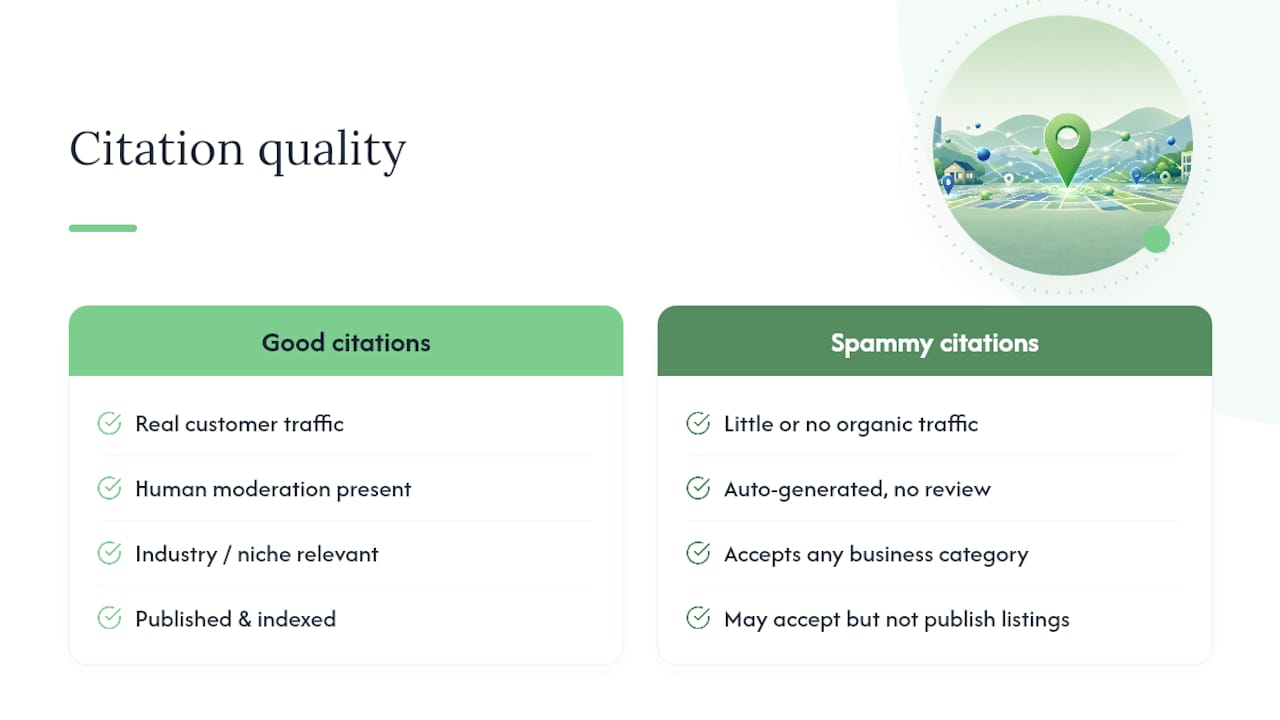
High-quality citations come from directories your actual customers use, ones with real traffic, human moderation, and a track record search engines already trust. Semrush’s guide to citation building points out that niche industry directories often convert better and carry stronger topical signals than generic mass-listing sites, because they’re built around the exact audience searching for what you offer. A directory listing for HVAC contractors, for instance, tells search engines something a generic “business directory #47” never will.
Low-quality citations tend to share a few traits: they’re auto-generated with no human review, they accept submissions from any business regardless of category, and they rarely get organic traffic themselves. Some exist purely to sell “citation packages” in bulk, submitting your business to hundreds of directories overnight. That approach can backfire, since a sudden flood of new listings with slightly different formatting looks less like organic growth and more like a pattern worth flagging.
The better strategy is selective and slower. Prioritize directories relevant to your industry and region, confirm each one actually indexes and displays listings (some technically accept submissions but never publish them), and skip anything that asks for payment just to appear in search results at all, since legitimate high-authority directories like Google Business Profile, Yelp, and Bing Places don’t charge for basic listings.
How Citation Priorities Have Shifted With AI Search
The rules around what counts as a valuable citation have moved in the last couple of years, mostly because of how search results get generated now.
AI-generated overviews and chat-based assistants pull from structured, verified data more heavily than they pull from raw backlink counts. That shift rewards businesses with consistent NAP data across trusted platforms, because an AI summarizing “the best plumber near me” is more likely to surface a business it can verify across multiple sources than one with a single, unconfirmed listing. Trust signals that AI systems favour tend to overlap heavily with the same citation fundamentals that mattered for traditional search, according to Neil Patel’s research on AI trust signals cited earlier, just with less patience for inconsistency.
Google’s own emphasis has moved toward Business Profile completeness and verification status as a gatekeeper for visibility, rather than treating it as one input among many. A profile with mismatched hours, an unverified phone number, or a stale address can lose map pack placement even when the website behind it is otherwise solid.
The practical takeaway: citation building today is less about racking up a large listing count and more about keeping a smaller set of high-authority listings accurate and verified. Quarterly maintenance, not one-time submission sprints, is what keeps a business visible as these systems keep tightening their standards.
Checking a Directory’s Authority Before You Submit
Before submitting your business anywhere, a few quick checks separate a worthwhile listing from a waste of an afternoon.
Start with traffic and relevance. Does the directory get real visitors, or does it exist only to host other businesses’ listings? A quick search for the directory name plus your industry and city tells you whether it shows up in results people actually click. If a directory doesn’t rank for anything and has no organic audience, a listing there won’t do much for you either.
Check whether the site allows Google to index individual listing pages. Some directories technically publish your listing but block search engines from crawling it, which means it exists but contributes nothing toward citation value. A quick site search for your business name on the directory, combined with checking whether the URL shows up in a normal Google search, answers this in under a minute.
Look at who else is listed. A directory full of dead links, defunct businesses, or obvious spam accounts tells you the moderation is weak, and Google tends to discount citation value from sites with poor overall quality control. Compare that against a directory that clearly reviews submissions and keeps listings current.
Finally, confirm the category fit. A general business directory is fine for broad citations, but an industry-specific directory only helps if your business genuinely belongs in that category. Submitting a bakery to a directory built for industrial suppliers doesn’t build relevant trust, it just adds noise to your citation profile.
A quick note on getting it right the first time
Common mistakes I see: businesses format their address three different ways across five listings, then lose the verification email in a junk folder for months. The fix takes one afternoon: standardize your NAP, then correct your top five listings this week.
— Cristo
CloudSprout’s Free SEO Audit Checks Your Citation Health
CloudSprout runs a free digital audit that includes a citation and NAP consistency check across your core listings, the same audit process an agency would normally charge for before even discussing a contract.
Unlike agencies that outsource this work or hand you a spreadsheet and disappear, CloudSprout’s in-house team claims your global anchors, verifies each listing, and builds the tracking log for you, then keeps checking it quarterly as part of ongoing SEO work. You get direct access to the people doing the work, month-to-month terms with no lock-in contract, and a clear picture of exactly what’s inconsistent before anything gets fixed. If your website itself needs the NAP and schema markup cleaned up to match, website development work can happen alongside the citation cleanup rather than as a separate project. Start with the free SEO audit and see exactly which listings are costing you visibility right now.
Sources
- How to Build Local Citations & Boost Your Visibility Online | WordStream
- Canada
- What is local citation building? | BrightLocal
FAQ
What Are Local Citations in SEO?
A local citation is any online mention of your business name, address, and phone number, appearing on directories, review sites, maps, or social platforms, and it helps search engines verify your business is real and correctly located.
How Much Should I Pay for Local SEO?
Costs vary widely depending on whether you do it yourself, use a subscription tool, or hire an agency, but CloudSprout offers a free SEO audit that includes a citation check with no upfront cost.
What Is the Best Local SEO Tool for Citations?
BrightLocal, Whitespark, and Semrush are commonly used for citation discovery and cleanup, each offering monitoring dashboards that flag duplicate or inconsistent listings across directories.
What Is an Example of a Local Citation?
A restaurant’s listing on Yelp showing its exact name, street address, and phone number is a local citation, and that same information appearing identically on Google Business Profile and Facebook strengthens the signal.
How Many Citations Does a Business Need?
Most competitive markets call for around 30 to 50 high-quality, verified citations rather than a large volume of low-authority listings, according to citation-building best practices from Neil Patel.