
AI lead qualification takes an inbound inquiry, enriches it with firmographic and behavioral data, scores it against your closed-won patterns, and routes it to the right rep before a human ever opens the CRM. Done right, it can cut speed-to-lead from the industry-average 20-plus minutes down to roughly a minute. It’s appropriate once your inbound volume outpaces your team’s ability to respond fast, and only if you’re willing to check the model’s math every month, not just install it and walk away.
TL;DR:
- AI lead qualification can drastically reduce response times from over 20 minutes to about one minute by automatically enriching, scoring, and routing inbound leads.
- The most effective systems update scores dynamically based on real-time activity and provide explainability through reason codes, boosting sales rep trust.
- Successful pilots require at least 90 days of data, focus on a single inbound channel initially, and incorporate ongoing calibration of the model based on actual outcomes.
- Integration robustness, handling incomplete data, and monitoring score drift are critical factors to test during demos to ensure reliable performance over time.
- A managed, small-scale pilot approach simplifies implementation for small teams by handling calibration and integration, avoiding long-term vendor lock-in or complex in-house setup.
Table of Contents
- What Is AI Lead Qualification, Really?
- What Capabilities Should You Actually Test in a Demo?
- Building the Pilot: From First Click to First Follow-Up
- How Do You Choose Between a Tool, a Platform, and a Managed Pilot?
- Why Do AI Scoring Models Break Down Over Time?
- What CloudSprout Has Learned Running These Pilots for Small Teams
- Three Things We’d Tell Any Business Before Turning This On
- Ready to Stop Losing Leads While You’re on a Job Site?
- Sources
- FAQ
What Is AI Lead Qualification, Really?
AI lead qualification is the process of using machine learning to enrich, score, and route incoming prospects automatically, instead of a rep manually deciding who’s worth calling. The industry term you’ll hear alongside “AI lead qualification” is AI lead scoring, and the two overlap so much most vendors use them interchangeably. Scoring is the ranking piece; qualification is the fuller pipeline that acts on that ranking.
Here’s where it actually beats a spreadsheet full of if/then rules. A rules engine says “if job title contains ‘director,’ add 10 points.” That’s static, and it breaks the moment your ideal customer profile shifts. Machine learning lead evaluation instead studies your historical closed-won and closed-lost records, spots patterns a human would miss, and updates as new outcomes roll in. Demandbase describes this as a continuous, four-stage loop: collect data, analyze it, build a predictive model, then score new leads against that model, and repeat.
A basic chatbot answers questions. An AI agent used for qualification actually does things: it enriches a record the second a form is submitted, assigns a score, and in more mature setups, books a meeting on a rep’s calendar without anyone touching the lead first. That’s the distinction worth pressing a vendor on during a demo.
Two signal types feed the score:
- Fit signals — company size, industry, tech stack, job title, budget indicators
- Intent signals — pages visited, email opens, demo requests, response speed, content downloads
The best systems don’t just spit out a number. They attach a reason code, something like “Score: 82, High. Drivers: visited pricing page twice, company size matches ICP, opened last three emails within an hour.” That explainability is what turns a black-box score into something a sales rep will actually trust and act on, a point echoed across AI scoring workflow guides. Without it, reps override the score or ignore it entirely.
What Capabilities Should You Actually Test in a Demo?
Vendor decks show polished dashboards. What you need to know is whether the thing works on your data, in your CRM, at your volume. Test these five areas before you sign anything.
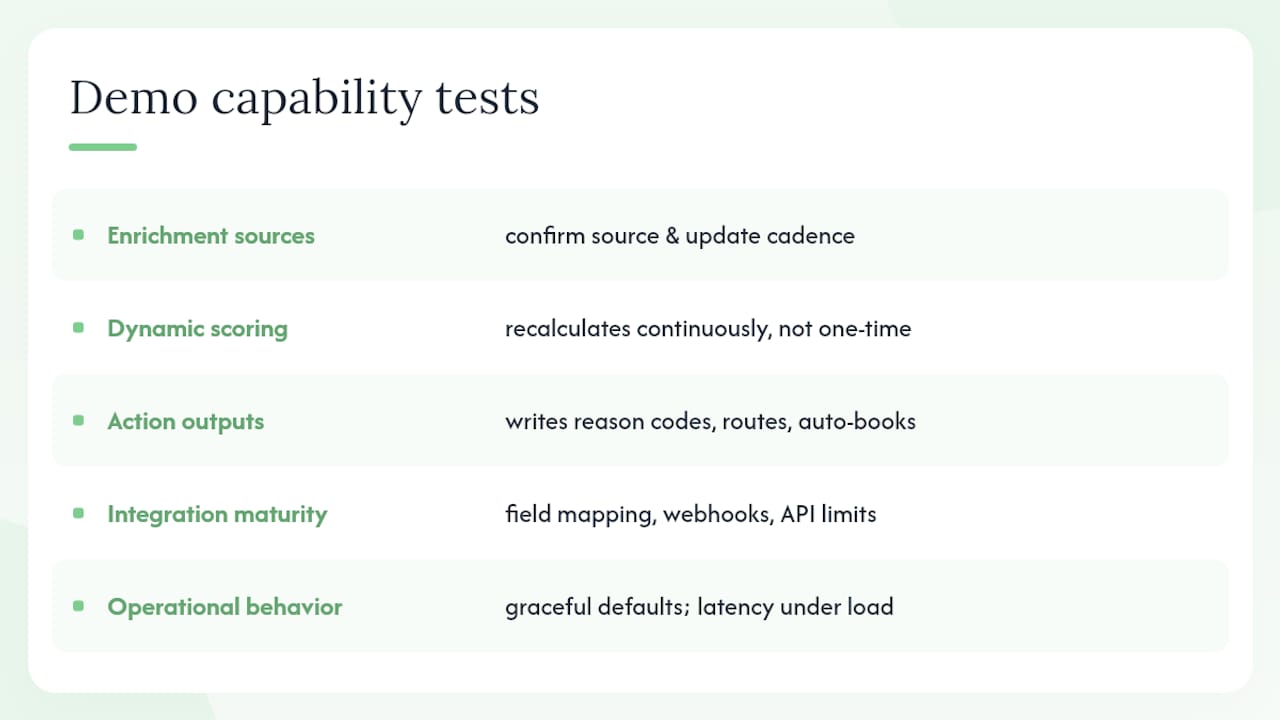
Enrichment sources and depth. Ask exactly where firmographic, technographic, and intent data comes from, and whether it updates in real time or on a batch schedule. A tool that enriches once at form submission and never again will miss a lead who suddenly starts researching your competitor a week later.

Dynamic versus static scoring. HubSpot’s AI scoring feature evaluates a contact’s lifecycle changes and recommends a score based on historical behavior, and it keeps recalculating as new activity comes in. That’s the bar. If a tool only scores once at intake and never revisits it, you’re buying a snapshot, not a system.
Action outputs. Does the platform just display a number, or does it write reason codes back to the CRM, trigger routing rules, and offer auto-booking for high scores? Salesforce’s own materials stress that predictions only matter if they land directly inside the CRM where reps already work, not in a separate dashboard nobody checks.
Integration maturity. Look past the “we integrate with Salesforce and HubSpot” line. Ask about field-mapping flexibility, webhook support, API rate limits, and where the data physically lives if you have compliance obligations.
Operational behavior under stress. What happens when enrichment data is missing? Does the score default gracefully, or does the system break silently? What’s the latency between form submission and a routed lead landing in a rep’s queue?
Pro Tip: Ask every vendor to run a live enrichment on a test lead during the call, not a pre-baked example. Watching it fail, or lag, tells you more than any slide deck.
Building the Pilot: From First Click to First Follow-Up
A working AI qualification pipeline moves through five stages, and skipping any one of them is usually why a pilot stalls.
- Capture and enrich. The moment a form, chat, or call comes in, the system pulls firmographic and technographic data through an API or webhook, ideally within seconds, not overnight. No-code platforms like Pecan show this can happen without custom development work, which matters for a small team without an in-house data engineer.
- Score against threshold logic. This is where most teams get lazy and use one model for everyone. Don’t. Operational best practice separates inbound form fills from outbound-targeted accounts, because someone who filled out a demo request behaves nothing like a cold account your SDR is chasing. Weight them differently.
- Route and hand off. High-scoring leads get routed by territory, round-robin, or account ownership, and the strongest setups let a hot lead book directly onto a rep’s calendar without a manual assignment step.
- Nurture the rest. Lower-score leads don’t disappear. They drop into an automated nurture sequence and get rescored as their behavior changes.
- Feed outcomes back in. Every closed-won and closed-lost record should flow back into the model. This is the step teams skip, and it’s the one that keeps the score honest over time.
For a first pilot, keep the data requirement minimal: one inbound channel, at least 90 days of historical lead and outcome data to train against, and a CRM field structure that’s already clean enough to map. Trying to qualify every channel at once, before you’ve validated the model on one, is the most common way a 30 to 60 day pilot turns into a six-month slog. If your website’s forms and chat widgets aren’t feeding clean data into that pipeline yet, that’s worth fixing through a website development review before enrichment even starts, and mapping the workflow against your existing stack with a marketing automation checklist helps catch gaps early.
Track these during the pilot window:
- Speed-to-lead, from form submission to first meaningful contact
- Conversion rate by score band (are your “high” leads actually converting higher?)
- Rep override rate (how often are reps ignoring the score?)
How Do You Choose Between a Tool, a Platform, and a Managed Pilot?
Start with five criteria, in this order of importance for a small team: explainability, data fit, CRM compatibility, customization limits, and the support model behind it. A platform that scores brilliantly but can’t explain why, or can’t push that score into the CRM field your reps actually look at, isn’t usable no matter how accurate its model is.
Bring these questions into every demo:
- Can you show me a live reason code for a real lead right now, not a mockup?
- What happens when enrichment data is incomplete or a source goes down?
- How often does the model recalibrate, and can I see the calibration workflow?
- What does field-mapping into my specific CRM actually involve?
- What’s the fallback if the AI misroutes a lead, and how fast can a human correct it?
Watch for these red flags: a vendor who can’t produce a reason code on request, a “set it and forget it” pitch with no mention of recalibration, and any tool that can’t name its specific enrichment data sources. Documented playbooks for automated qualification consistently flag the same pattern: tools that skip calibration workflows are the ones that drift into irrelevance within a few months.
Want this working in your business. Without doing it yourself?
Start a Project →For owner-operators without a dedicated RevOps person, a self-serve tool often sits unconfigured for months because nobody has time to tune thresholds or interpret score drift. That’s exactly the gap an agency-managed pilot is built to close, where someone else owns the calibration cycle while you run your business.
Pro Tip: If a vendor’s answer to “how do you handle bad data” is vague, assume the model will silently degrade the moment your form fields change.
Why Do AI Scoring Models Break Down Over Time?
Four failure modes account for most of the AI lead qualification projects that quietly stop delivering value.
- Garbage in, garbage out. If your CRM has duplicate records, missing fields, or inconsistent naming, the model learns from that mess and scores accordingly.
- The speed trap. Teams chase faster response times without checking whether the leads getting fast responses are actually worth it, burning rep time on low-fit prospects that just happen to move quickly.
- Threshold drift. Your ideal customer profile shifts, maybe you expand into a new vertical, but the scoring thresholds don’t move with it, so yesterday’s “high score” definition stops matching today’s best customers.
- Silent bias. A model trained heavily on one type of closed-won deal (say, all inbound, all one region) will keep favoring that pattern even after your market changes.
The fix isn’t complicated, but it does require a routine. Check score distribution weekly, sample a handful of routed leads by hand once a week to see if the routing actually made sense, and run a full recalibration against fresh closed-won data monthly. Guides on maintaining AI qualification accuracy point to this exact cadence as the difference between a model that stays useful and one that quietly stops mattering. Keep a human-in-the-loop override on any auto-booked meeting, and keep an audit trail of every score change so you can trace why a lead’s rating moved.
The metric that matters most isn’t accuracy in a vacuum. It’s the combination of speed-to-lead, conversion rate by score band, and the gap between false positives (high scores that go nowhere) and false negatives (low scores that convert anyway). If that speed-to-lead number drops from 20 minutes to under a minute but conversion by band stays flat, the model isn’t actually helping yet, it’s just moving faster in the wrong direction.
What CloudSprout Has Learned Running These Pilots for Small Teams
Every AI qualification project we’ve scoped for Ontario businesses shares the same starting problem: the data exists, but nobody’s connected it. A trades business with 12 employees might have form submissions in one tool, a phone system in another, and a CRM that nobody updates consistently.

A typical pilot we’d scope for a business that size runs through one high-volume channel, usually the website contact form, over a 30 to 60 day window. The scope covers a digital audit of existing lead sources, integration into the CRM the client already uses, a live pilot with weekly score reviews, and a calibration pass at the end before deciding whether to expand.
What a managed pilot removes is the burden of owning that calibration cycle yourself:
- No need to hire or train a RevOps specialist just to interpret score drift
- Integration work handled by the same team that built the CRM connection, not a third-party contractor
- A CRM and automation project history you can look at before committing to anything
Cloudsprout’s free digital audit is the entry point for this, and it starts with looking at what your website and CRM are currently capturing before anyone talks about AI at all.
Three Things We’d Tell Any Business Before Turning This On
Start small. One channel, one scoring model, ninety days of history to learn from. Trying to qualify every lead source on day one guarantees you won’t know which signal actually moved the needle.
Make the score explainable before you make it fast. A rep who sees “High, 82, visited pricing twice” will act on it. A rep who sees a bare number will ignore it within a week, and you’ll have built an expensive system nobody trusts.
Automate the feedback loop or the model rots. Here’s the video-ready version of that idea: picture two identical leads, same score, same day. Three months later, one closed and one didn’t, but the model never learned why, because nobody fed the outcomes back in. That’s the whole story in one visual, and it’s the one thing worth fixing this week: check whether your closed-won and closed-lost data is actually flowing back into whatever’s generating your scores.
— Cristo
Ready to Stop Losing Leads While You’re on a Job Site?
Cloudsprout builds AI qualification pilots the way owner-operators actually need them: fixed scope, no long-term contract, and one team handling the audit, integration, and calibration instead of three different vendors passing the buck.
If your business gets more inbound inquiries than you can call back in an hour, that’s the exact gap this closes. A plumbing company fielding thirty web forms a week doesn’t need enterprise RevOps software, it needs someone to look at where those leads actually go once they land, score them against what’s already closed, and route the hot ones straight to whoever picks up the phone fastest. That’s the pilot scope, start to finish, no outsourcing and no month-to-month surprise fees.
The free digital audit is the place to start. It looks at your current lead capture, your CRM setup, and where response time is actually leaking, before anyone recommends spending a dollar on automation.
Sources
- Automated lead qualification — ZoomInfo pipeline article
- Build contact lead scores with AI — HubSpot Knowledge
- AI lead scoring guide — Demandbase blog
- AI lead generation fundamentals — Salesforce
FAQ
How Do You Use AI for Lead Qualification?
Connect your form or CRM to an enrichment source, set up a scoring model trained on your closed-won history, and route leads above a set threshold to a rep automatically, then feed outcomes back in monthly to keep the model accurate.
What Is the 30% Rule in AI?
If you’ve seen this referenced, it likely comes from a different context, so treat any source claiming a fixed AI industry rule with caution.
How Much Do Qualified Leads Typically Cost?
Cost varies widely by industry, channel, and how “qualified” is defined, so there’s no universal figure to quote. The more useful question is what a pilot costs relative to the rep hours it saves, which a scoped audit can estimate for your specific lead volume.
What Does Lead Qualification Mean?
Lead qualification is the process of determining whether a prospect fits your ideal customer profile and shows enough buying intent to justify a rep’s time, traditionally done manually and increasingly handled through AI lead scoring instead.
How Is AI Lead Scoring Different From Traditional Scoring?
Traditional scoring uses fixed point rules that someone has to update manually. AI lead scoring updates continuously by learning from real outcomes, which is why it requires ongoing calibration rather than a one-time setup.
Recommended
Less reading. More growing.
We build the systems these articles describe. Websites, AI follow-up, reviews, automation. And run them for you.
Keep reading