

The Canada Digital Adoption Program (CDAP) is no longer open. The federal program concluded on March 31, 2025, so Canadian businesses cannot submit new applications for either of its former funding streams in 2026.
While CDAP once offered up to $2,400 for e-commerce adoption and up to $15,000 toward a Digital Adoption Plan, those programs are now historical funding options rather than grants businesses can apply for today.
If you participated in CDAP before it closed, review your original agreement and documentation rather than assuming funding or financing is still available. The Business Development Bank of Canada (BDC) states that access to the former CDAP grant and 0% loan depended on having signed a valid grant agreement before February 19, 2024 and meeting the program’s deadlines.
For businesses that missed CDAP, the more useful question in 2026 is: what funding or financing options are available now for websites, CRM systems, automation, AI and other digital technology?
Key Takeaways
| Point | What It Means in 2026 |
|---|---|
| CDAP has ended | The Canada Digital Adoption Program officially concluded on March 31, 2025. |
| New applications are not available | Businesses cannot apply for the former $2,400 or $15,000 CDAP grants in 2026. |
| The old BDC loan was tied to CDAP | The 0% CDAP loan required an approved Digital Adoption Plan and compliance with the program’s deadlines. |
| Do not assume an old agreement is still active | Businesses with historical CDAP paperwork should confirm their individual status directly with BDC or ISED. |
| Other support still exists | Federal, provincial and regional programs continue to support technology, productivity, AI, training and business growth. |
| Funding should not drive the project | Define the business problem and technology requirements first, then look for programs that fit the project. |
Table of Contents
- Is the CDAP Grant Still Available in 2026?
- What Was the Canada Digital Adoption Program?
- How Much Funding Did CDAP Offer?
- Who Qualified for CDAP?
- What Happened to the CDAP BDC Loan?
- What If You Had an Existing CDAP Agreement?
- What Are the Alternatives to CDAP in 2026?
- How Should You Look for Digital Funding?
- What Digital Projects Are Worth Funding?
- How Can CloudSprout Help?
- Sources
- FAQ
Is the CDAP Grant Still Available in 2026?
No. The Canada Digital Adoption Program is no longer an active grant program.
Innovation, Science and Economic Development Canada (ISED) states that CDAP concluded on March 31, 2025. The Boost Your Business Technology stream had already stopped accepting new applications on February 19, 2024 after reaching its program capacity.
That means businesses searching for a “CDAP grant 2026” should not plan a technology purchase, website project or digital transformation around receiving new CDAP funding.
Some older government and business pages remain online because they document how the program operated. That can make CDAP look more active than it actually is, especially when search results display historical eligibility information without clearly showing the program’s final end date.
For current information, use official ISED and BDC sources and verify the status of any funding program before signing contracts or spending money.
What Was the Canada Digital Adoption Program?
CDAP was a federal initiative launched in 2022 to help Canadian small and medium-sized businesses adopt digital technologies. Funding or not, the full digital marketing guide shows where to spend first.
The program originally included two major streams:
- Grow Your Business Online: a microgrant of up to $2,400 designed primarily to help consumer-facing small businesses adopt e-commerce technologies.
- Boost Your Business Technology: a grant covering up to 90% of eligible advisory costs, to a maximum of $15,000, for the development of a Digital Adoption Plan.
The Boost stream could also provide eligible participants with access to BDC financing to help implement recommendations from an approved Digital Adoption Plan.
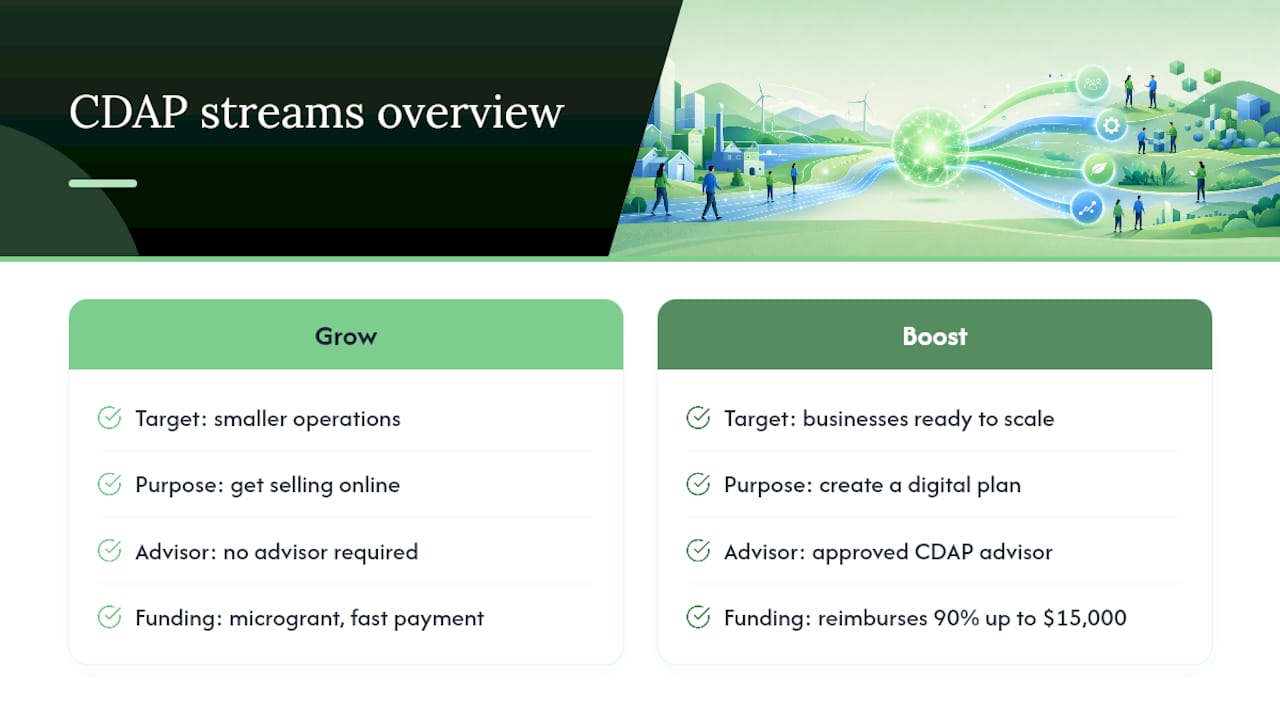
The distinction between planning and implementation was important. The Boost grant primarily helped pay for the advisory work required to develop the technology plan. It was not simply a $15,000 cheque that a business could spend directly on a website, CRM or advertising campaign.
How Much Funding Did CDAP Offer?
| Former CDAP Support | Amount | Purpose |
|---|---|---|
| Grow Your Business Online | Up to $2,400 | Eligible e-commerce and digital adoption expenses |
| Boost Your Business Technology | Up to $15,000 | Up to 90% of eligible Digital Adoption Plan advisory costs |
| BDC CDAP Loan | Up to $100,000 | Implementation of recommendations in an approved Digital Adoption Plan |
Under Boost Your Business Technology, the maximum $15,000 grant represented 90% of eligible advisory costs. A business therefore needed eligible advisory expenses of approximately $16,667 to reach the full grant amount.
The BDC financing component was separate from the grant. According to BDC’s CDAP documentation, eligible loan amounts depended on company revenue and could range from $25,000 to $100,000.
The former BDC loan had a five-year repayment term with the possibility of postponing principal payments for 12 months at the start of the loan. It was specifically intended to implement recommendations from a Digital Adoption Plan recognized under the Boost stream.

Who Qualified for CDAP?
Because CDAP is closed, its eligibility requirements are now mostly useful for understanding historical applications rather than determining whether you can apply today.
For the Boost Your Business Technology stream, ISED reports that eligible recipients generally included Canadian-owned for-profit businesses with:
- between $500,000 and $100 million in annual revenue
- between 1 and 499 full-time equivalent employees
- a need to adopt more advanced digital technology
Businesses had to complete the required application process, sign a grant agreement and work within strict program timelines.
For the former BDC 0% loan, BDC states that businesses also had to satisfy its lending, creditworthiness and program requirements. Approval for the CDAP grant did not automatically guarantee approval for financing.
What Happened to the CDAP BDC Loan?
The special 0% BDC loan was part of the CDAP ecosystem rather than a permanent general-purpose technology loan.
BDC’s legacy program page says businesses needed a valid grant agreement signed before February 19, 2024, an approved Digital Adoption Plan and compliance with the program’s applicable deadlines.
BDC also states that businesses had six months after approval of their Digital Adoption Plan to complete the CDAP loan application. Because CDAP itself concluded on March 31, 2025, businesses looking for new technology financing in 2026 should not treat the former CDAP loan as a currently open financing option.
BDC now directs businesses interested in digital transformation toward newer programs, including LIFT — Lead with Innovation and Focus on Technology.
What If You Had an Existing CDAP Agreement?
If your business participated in CDAP before it ended, do not rely on a general blog post to determine whether a historical payment, claim or financing obligation remains outstanding.
Instead:
- Locate your original grant agreement. Check the signed date, expiry dates and any deadlines stated in the agreement.
- Find your Digital Adoption Plan approval. Keep the approval notice and related invoices together.
- Review previous correspondence. Look for messages from ISED, your digital advisor and BDC concerning deadlines or claims.
- Contact the responsible organization directly. Ask ISED about a historical grant issue and BDC about an existing CDAP loan or financing file.
- Do not incur new costs expecting reimbursement. CDAP is no longer an active intake program.
This is particularly important because historical BDC materials use language such as “may be eligible” for businesses that signed before the cutoff. That should not be interpreted as a blanket promise that an old agreement still creates access to new money in 2026.
What Are the Alternatives to CDAP in 2026?
There is no direct one-for-one replacement for CDAP that every Canadian small business can use. Current support is more fragmented and often depends on your province, industry, revenue, project type and technology investment.
1. BDC LIFT
One of the most relevant current options for larger digital transformation projects is BDC’s LIFT program.
LIFT combines consulting and financing for eligible Canadian businesses investing in areas such as:
- AI adoption
- digital systems
- CRM and ERP technology
- cybersecurity
- data infrastructure
- automation
- digitally enabled equipment
For its digital transformation and AI path, BDC currently lists a minimum annual revenue requirement of $1 million, along with financial, credit and project requirements. BDC says the financing amount depends on your revenue, project scope, business profile and financial strength.
This is financing and advisory support, not a replacement $15,000 CDAP grant, so businesses should compare the cost and terms against the expected value of the technology project.
2. Canada’s Regional Development Agencies
Federal regional development agencies periodically provide funding for productivity, technology adoption, innovation and business growth.
These include FedDev Ontario, FedNor, PacifiCan, PrairiesCan, the Atlantic Canada Opportunities Agency, Canada Economic Development for Quebec Regions and CanNor.
Availability varies by location and intake period, so businesses should verify current application windows directly with their regional agency.
3. Regional Artificial Intelligence Initiative
The federal government is expanding the Regional Artificial Intelligence Initiative, which is delivered through Canada’s regional development agencies.
The initiative is designed to support AI commercialization and adoption, including helping Canadian businesses improve productivity and competitiveness with AI applications. Intake dates and requirements vary by region.
4. NRC IRAP
Businesses developing innovative technology rather than simply buying ordinary business software may also investigate the National Research Council of Canada Industrial Research Assistance Program (NRC IRAP).
IRAP is not a general website grant. Projects need to meet its technology innovation and business requirements.
5. Provincial and Local Programs
Provincial, municipal and regional programs can also support technology adoption, training, hiring and productivity projects.
Ontario businesses, for example, may encounter programs relating to digital competence, training, student placements and specific regional economic-development initiatives.
Because programs open, close and change frequently, avoid relying on a static list of grant names without checking each official program page.
How Should You Look for Digital Funding in Canada?
The Government of Canada’s Business Benefits Finder is one of the most practical starting points.
It pulls together federal, provincial and territorial support and allows businesses to filter for:
- grants and funding
- loans and capital
- tax credits
- wage subsidies
- expert advice
- research and collaboration support
CloudSprout also maintains a digital funding resource for Ontario businesses with links to official programs that may relate to CRM, online booking, automation, AI, payments, cybersecurity and other operational technology.
CloudSprout is not a government agency and cannot determine whether a business qualifies for funding. Program administrators make all eligibility and funding decisions.
Never sign a technology contract solely because someone tells you a grant will reimburse it. Obtain written confirmation from the official program administrator before treating government funding as part of your project budget.
What Digital Projects Are Worth Funding?
CDAP’s biggest lesson is that technology adoption works best when the project starts with a measurable business problem rather than a list of software products.
A useful project might address questions such as:
- Are website leads disappearing because nobody follows up quickly?
- Is staff repeatedly entering the same information into multiple systems?
- Are customers calling for appointments that could be booked online?
- Is the business operating from spreadsheets instead of a structured CRM?
- Are reporting and customer data spread across disconnected tools?
- Could automation reduce repetitive administrative work?
- Does the current website fail to connect leads with sales and operations?
A cosmetic website redesign may improve presentation, but a digital adoption project becomes easier to justify when it connects directly to revenue, productivity, customer experience or operating efficiency.

Before applying for financing or funding, write down the problem, proposed system, implementation cost, ongoing cost, expected result and how you will measure whether the investment worked.
How Can CloudSprout Help With a Digital Adoption Project?
CloudSprout helps Canadian small businesses plan and implement the systems that programs such as CDAP were designed to encourage businesses to adopt.
Depending on the project, that can include:
- custom website development
- CRM setup and integration
- lead capture and automated follow-up
- online booking and scheduling
- AI-assisted business workflows
- reporting and analytics
- e-commerce and online payments
- SEO and digital marketing
The important distinction is that CloudSprout is an implementation partner, not a government funding administrator. It cannot approve a grant, guarantee reimbursement or determine whether a specific expense will qualify.
What CloudSprout can do is turn a digital project into a clear scope showing what will be built, what business problem it addresses, how the systems connect, what implementation will cost and what the timeline looks like.
If you are researching current funding before starting a project, visit the CloudSprout Digital Funding page. If you already know what needs to be built, review CloudSprout’s digital services or the current pricing options.
Have a digital project but are not sure whether to wait for funding? Start with a funding-aware technology review so you can understand the project scope first and verify any potential funding separately before spending.
Sources
- Innovation, Science and Economic Development Canada: Info Source 2026 Update
- ISED: 2024–25 Supplementary Information Tables
- Business Development Bank of Canada: Canada Digital Adoption Program
- Business Development Bank of Canada: LIFT
- ISED: Regional Artificial Intelligence Initiative
- Government of Canada: Business Benefits Finder
- National Research Council Canada: NRC IRAP Financial Support
Frequently Asked Questions About the CDAP Grant
Is the CDAP grant still available in 2026?
No. The Canada Digital Adoption Program concluded on March 31, 2025. New applications are not available in 2026.
When did the CDAP program end?
The Boost Your Business Technology stream stopped accepting new applications on February 19, 2024. ISED states that the overall Canada Digital Adoption Program concluded on March 31, 2025.
Can I still apply for the $2,400 CDAP grant?
No. The Grow Your Business Online microgrant was part of the former CDAP program and is no longer open for new applications.
Can I still apply for the $15,000 CDAP grant?
No. The Boost Your Business Technology grant is closed. It previously covered up to 90% of eligible advisory expenses to a maximum grant of $15,000.
Can I still apply for the CDAP 0% BDC loan?
The 0% loan was tied to the former CDAP Boost Your Business Technology stream and its deadlines. BDC’s legacy documentation says businesses needed a valid grant agreement signed before February 19, 2024 and an approved Digital Adoption Plan, and had six months after plan approval to complete the loan application. Businesses seeking new financing in 2026 should review BDC’s current financing programs instead.
What replaced the CDAP grant?
There is no single direct replacement for CDAP. Businesses should check current federal, provincial and regional programs based on their location, industry and project. BDC’s LIFT program is one current option for eligible businesses investing in AI, digital systems, cybersecurity, automation and other advanced technologies, but it is financing and consulting rather than a direct replacement for the former CDAP grant.
How do I find current Canadian business grants?
Start with the Government of Canada’s Business Benefits Finder, which provides a tailored list of federal, provincial and territorial programs based on your business and funding needs. Always verify eligibility and application deadlines on the official program website before spending money.