Yes, if you’re missing calls, losing bookings after 5 p.m., or paying someone $18 an hour just to say “can you hold?” An AI receptionist answers every call, books appointments straight into your calendar, and captures leads while you’re on a job site, in surgery, or asleep. For most small businesses that miss calls regularly, it pays for itself within weeks.
Here’s what changes once it’s running:
- Every call gets answered, day or night, no exceptions for lunch breaks or long weekends
- Appointments get booked directly into your calendar without a game of phone tag
- Leads get captured and logged instead of disappearing into a missed-call notification
- Your team stops fielding “what are your hours” calls fifteen times a day
If you want to see one in action before committing to anything, book a free digital audit with Cloudsprout and ask for a live walkthrough showing how it connects to your booking system.
Key Takeaways
An AI receptionist works best when it’s piloted for 30 to 90 days on real calendar and CRM data before full commitment, with a clear plan for what happens to call data if you cancel.
| Point | Details |
|---|---|
| Verdict for most small businesses | If you’re missing calls regularly, an AI receptionist pays for itself through recovered bookings within weeks. |
| Pilot before you commit | Run a two-week test measuring answered-call rate, bookings, and transfer accuracy before signing a long contract. |
| Ask about data first | Confirm where recordings are hosted, retention length, and whether you can export or delete data on cancellation. |
| Watch pricing structure | Flat monthly fees are more predictable than per-minute metering, which can spike with call volume. |
| Cloudsprout’s approach | Cloudsprout manages setup, CRM/calendar integration, staff training, and monthly monitoring under no-lock-in, month-to-month terms. |
Table of Contents
- What Does an AI Receptionist Actually Do All Day?
- What Features Actually Matter When You’re Comparing Options?
- How Much Does an AI Receptionist Cost, and What’s the Real ROI?
- What Does Setup and Rollout Actually Look Like?
- What Should You Check Before Trusting a Vendor With Your Call Data?
- Which Small Businesses Get the Most Value From This?
- How Does Cloudsprout Set Up an AI Receptionist for a Client?
- When I’d Actually Recommend a Managed AI Receptionist
- How Cloudsprout Can Get You Live in Days, Not Months
- Where to Learn More Before You Buy
- Sources
- FAQ
What Does an AI Receptionist Actually Do All Day?
An AI receptionist is software that answers your business phone using artificial intelligence to understand caller intent, then either handles the request itself or routes it to a human. It’s not a phone tree with pretty voice acting. It’s a system that listens to “hey, do you guys do emergency plumbing on weekends” and gives a real answer, then offers to book the slot.
Day to day, here’s what it handles without a human touching the call:
- Answers every incoming call, 24 hours a day, including holidays and 2 a.m.
- Detects what the caller actually wants (booking, pricing question, directions, cancellation)
- Books, reschedules, or cancels appointments directly on your calendar
- Answers common questions about hours, pricing ranges, location, and services offered
- Transfers urgent or complex calls to a real person or an on-call line
- Sends SMS or email confirmations after a booking is made
- Captures lead details (name, number, reason for calling) into an intake form or CRM
A landscaping company gets a call at 9 p.m. asking about spring cleanup pricing. The AI receptionist quotes the standard range, checks calendar availability, and books a site visit for Tuesday. No voicemail, no callback tag, no lost job.
There are real limits, though. An AI receptionist shouldn’t be the first point of contact for anything involving legal advice, sensitive medical intake, or a customer who’s angry and needs a human to de-escalate. Good systems recognize these situations and route them immediately rather than trying to script their way through them.

What Features Actually Matter When You’re Comparing Options?
Most AI receptionist pitches sound identical on the surface. The differences show up in the details, and those details decide whether the thing actually saves you time or becomes one more system you have to babysit.
Here’s the checklist worth running through before you sign anything:
- Natural-language understanding that handles real speech patterns, interruptions, and regional accents, not just scripted keywords
- Calendar integrations with Google Calendar, Outlook, or Calendly so bookings land where you already work
- CRM integration so every call becomes a tracked lead instead of a note on a sticky pad
- Booking confirmation flows that text or email the customer automatically
- Multi-language support if your customer base isn’t English-only
- Clear transfer rules so calls that need a human actually reach one, fast
- Live-human handoff that’s smooth, not a dead-air transfer that drops the caller
- Analytics and call transcripts so you can see what’s working and what’s getting missed
| What It Handles | Basic Providers | Full-Service Providers |
|---|---|---|
| Calls only | Common | Rare |
| Calls + SMS + booking | Sometimes available as add-on | Standard |
| CRM/calendar sync | Often manual setup | Usually included in onboarding |
| Live-human handoff | Basic transfer only | Configurable routing rules |
| Analytics/transcripts | Limited or none | Detailed reporting included |
When you get on a demo call, ask direct questions: Which calendar systems do you actually integrate with, not just support in theory? What are your support hours if something breaks on a Saturday? Can I run a two-week pilot before committing to a year? What happens to my data and call transcripts if I cancel?
Pro Tip: Ask every vendor to show you a live call handling a real edge case, like a customer trying to cancel and rebook in the same call. Scripted demos hide the weak spots; a messy real-world scenario reveals them fast.
Watch for red flags: pricing that’s never stated clearly on the website, no calendar integration without a costly custom build, no free trial or demo access, and contracts that lock your call data inside their platform if you leave.
How Much Does an AI Receptionist Cost, and What’s the Real ROI?
Pricing generally falls into a few patterns, and knowing them upfront keeps you from getting surprised on invoice three.
- Flat monthly fee: one price covers unlimited or high-volume call handling
- Per-line tiered plans: price scales with number of phone lines or locations
- Per-call or per-minute metering: you pay based on actual usage, which can spike unpredictably
- Usage-based add-ons: extra charges for SMS confirmations, advanced voice options, or multi-location support
The ROI math is simpler than most vendors make it sound. If your business misses even five calls a week and a third of those would have booked a $150 service, that’s roughly $1,950 a month in lost revenue from voicemail alone. An AI receptionist that captures even half of those missed calls back covers its own cost several times over.
These are illustrative estimates to build your own math from, not guaranteed outcomes, since actual recovery rates depend on your call volume and close rate.
Cost red flags to watch for: steep onboarding or setup fees disclosed only after you’ve signed, per-minute charges that aren’t capped or estimated upfront, and long-term contracts that lock you in before you’ve even seen a full month of real call data.
What Does Setup and Rollout Actually Look Like?
Rollout isn’t a six-month IT project. A well-run setup takes days, not months, if the vendor has done this before.
- Choose or forward your existing business phone number to the new system
- Add your business information: hours, services, pricing ranges, common questions
- Connect your calendar and CRM so bookings and leads flow automatically
- Map your booking rules (appointment lengths, buffer times, which staff handle what)
- Train the FAQ responses using your actual customer questions, not generic templates
- Run test calls internally to catch gaps before real customers hit them
- Go live, ideally with a short pilot window before full rollout
Integration is where most of the friction actually happens, so verify each piece before assuming it works.
| Integration | What to Confirm |
|---|---|
| Phone system | Number porting or forwarding works without downtime |
| Calendar | Real-time two-way sync, not one-way push |
| Booking tool | Buffer times and staff availability map correctly |
| CRM | Lead data flows in automatically after each call |
| SMS/email | Confirmation messages send instantly, not with delay |

Best practice on the technical side: your vendor should expose a schedulable calendar endpoint through Google Calendar, Office 365, or Calendly, along with a reliable mailbox pattern for confirmation messages. If they can’t clearly explain how that connection works, that’s worth pausing on.
Run a short pilot before going all in. A one to two week test with clear goals tells you far more than any sales deck:
- Track the answered-call rate compared to your old voicemail setup
- Count actual appointments booked through the system
- Check contact info accuracy on captured leads
- Confirm transfer accuracy when calls need a human
What Should You Check Before Trusting a Vendor With Your Call Data?
Every call your AI receptionist handles gets recorded and transcribed somewhere. Where that “somewhere” is matters more than most buyers realize until something goes wrong.
Before signing, get clear answers on:
Want this running in your business without doing it yourself?
Book a Free Consultation →- Where are recordings and transcripts actually hosted, and by whom?
- Is there a clear data residency answer, or does the vendor dodge the question?
- Can you export or delete your own call data and transcripts on request?
- What encryption standards protect stored recordings?
- How long is data retained by default, and can that be shortened?
If you operate in a regulated field, dig deeper. Vendors serving healthcare should be able to speak clearly to HIPAA-related safeguards and business associate agreements; if you handle protected health information, don’t accept a vague “we’re secure” answer. Ask specifically where audio recordings and transcripts get stored, how long they’re kept, and whether they’re exportable or deletable on request.
For Canadian buyers, this is worth pressing on directly. Ask whether your call data is hosted in Canada or whether it crosses the border to US-based servers, and get that disclosure in writing rather than a verbal assurance.
Pro Tip: Before you sign a contract, ask what happens to your data if you cancel. A vendor that can’t give you a straight answer on data export is telling you something about how they’ll handle the rest of the relationship too.
Which Small Businesses Get the Most Value From This?
Not every business needs the same setup, and knowing where you fit changes what to prioritize.
- Clinics and dental offices benefit heavily from automated booking and rescheduling, since missed calls often mean missed patient appointments that competitors happily pick up
- Trades and service businesses (plumbers, electricians, HVAC) see fast wins from 24/7 answering, since after-hours emergency calls are exactly the ones that turn into paid jobs
- Restaurants use it for reservation bookings and takeout order callbacks during rush periods when staff can’t answer the phone
- Professional services (law firms, accountants, consultants) use it for intake and appointment scheduling, freeing staff from repetitive scheduling calls
- E-commerce businesses use it to handle order status questions and basic support without a full call center
Owner-operators with high missed-call rates and businesses that run on scheduled appointments see the fastest payoff. If you’re already losing calls to voicemail regularly, this closes that gap almost immediately.
It’s not the right fit everywhere. Businesses that need complex human judgment on the very first contact, like certain legal consultations or high-stakes medical triage, shouldn’t route that first call to AI. Same goes for high-touch sales where the whole point of the call is building a relationship before anyone talks numbers.
How Does Cloudsprout Set Up an AI Receptionist for a Client?
Cloudsprout builds and manages AI receptionist systems in-house, meaning the same team handling your website and CRM also configures your call handling, without outsourcing pieces to a third party.
The process runs in a consistent order:
- Discovery call to understand your business, call volume, and current pain points
- Data gathering: pulling your hours, pricing, FAQs, and service details from your existing website and materials
- Calendar and CRM mapping, connecting the receptionist directly into your existing business systems
- Configuration of booking rules, transfer logic, and FAQ responses tailored to your business
- Pilot testing with real call scenarios before anything goes fully live
- Staff training so your team knows how handoffs work and what to expect
- Go-live, followed by ongoing monitoring and monthly support
One example: an electrical contracting client (ARC Electrical) needed after-hours call coverage because emergency service calls were going straight to voicemail overnight, and competitors were picking up that business. Routing calls through an AI receptionist connected to their CRM and scheduling system meant every after-hours inquiry got logged and, where appropriate, booked automatically instead of sitting in a voicemail box until morning.
Cloudsprout’s onboarding includes the integration work, pilot testing, staff training, and ongoing monitoring, all under month-to-month terms with no long-term lock-in.
Pro Tip: Ask to see how a system handles a canceled appointment mid-call. That single scenario reveals more about a vendor’s real capability than a dozen scripted demo questions.
When I’d Actually Recommend a Managed AI Receptionist
Here’s where I land after looking at how these systems actually get deployed versus how they’re pitched: pilot first, always. Don’t sign a year-long contract based on a demo call. Run it for 30 to 90 days, connected to your real calendar and CRM, and measure answered-call rate and booking conversions before deciding it’s working.
I’m generally skeptical of self-serve AI receptionist tools for businesses without in-house technical staff. They’re cheaper on paper, but the calendar mapping, transfer rules, and FAQ training take real setup time that most owner-operators don’t have spare hours for. A managed setup, where someone else handles the integration and troubleshooting, tends to actually get used correctly instead of half-configured and abandoned after a frustrating first week.

Where I’d push back on the industry’s usual sales pitch: this isn’t a “set it and forget it” fix. The businesses that get the most value are the ones that treat the first month as a tuning period, adjusting FAQ answers and transfer rules based on what real callers actually ask, not what the vendor assumed they’d ask.
One caveat worth repeating: read the cancellation and data-export terms before you sign, not after. A contract that makes it hard to leave with your own call data is a bigger risk than the monthly fee ever will be.
How Cloudsprout Can Get You Live in Days, Not Months
Cloudsprout is the alternative to hiring a full-time receptionist or wrestling with a self-serve AI tool alone. We handle the entire setup in-house, connecting your AI receptionist directly to your website, calendar, and CRM so bookings and leads flow automatically from the first live call.
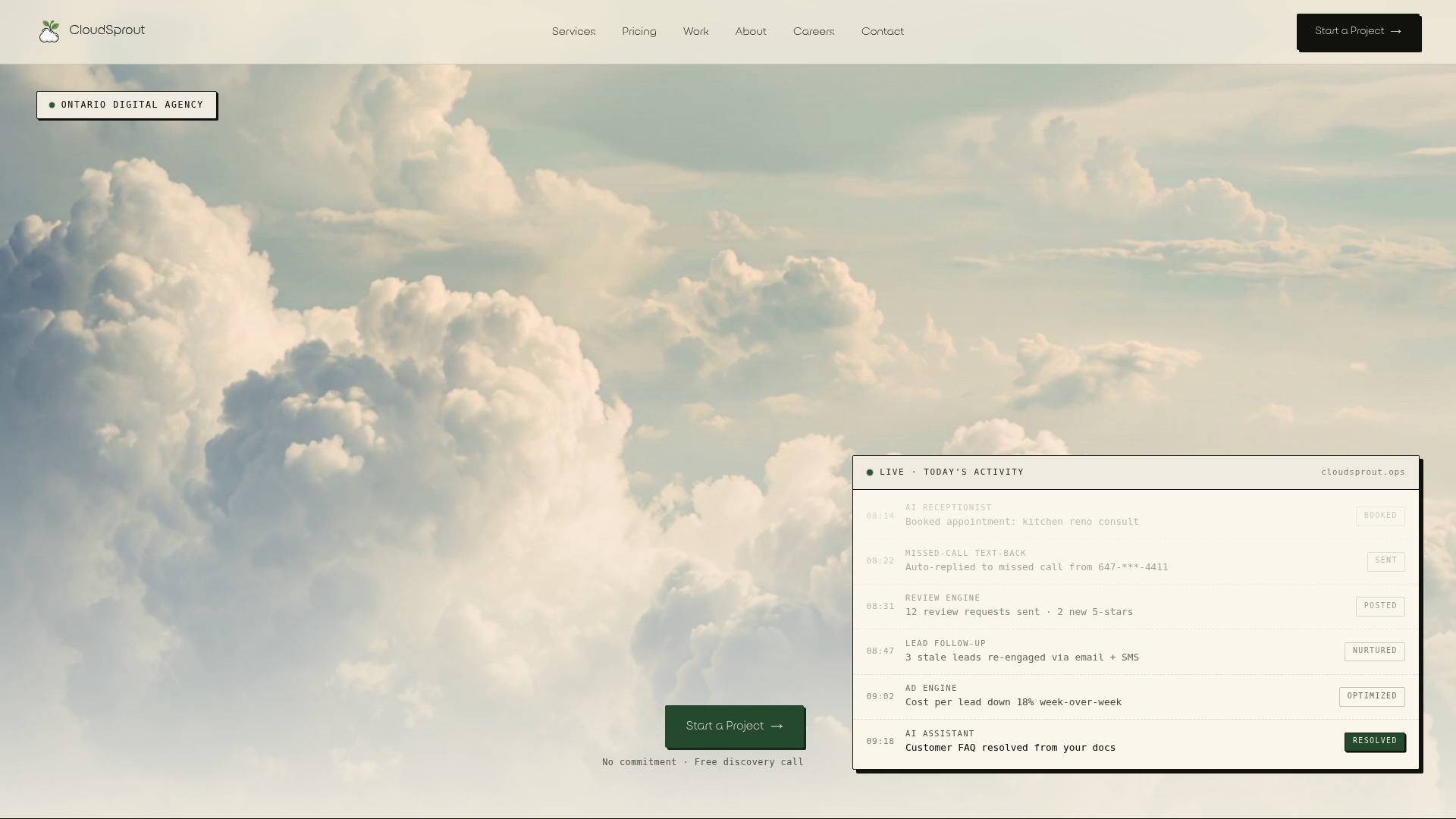
Our approach includes integration with your existing business systems, staff training so your team knows exactly how handoffs work, and ongoing monthly monitoring to catch and fix issues before they cost you a booking. Every engagement runs month-to-month with transparent pricing and no lock-in contract, so you’re never stuck if it’s not delivering results.
If your website isn’t set up to support online booking flows alongside the receptionist, that’s worth fixing at the same time. Cloudsprout’s website development team can build that infrastructure directly into your site rather than bolting it on separately.
Start with a free digital audit to see where your calls, bookings, and leads are currently falling through the cracks, and what a pilot rollout would look like for your business.
Where to Learn More Before You Buy
- Read a small-business focused primer on features, pilot advice, and common use cases before booking your first vendor demo
- Review the technical integration notes on calendar endpoints and confirmation mailboxes if you want to understand what’s happening behind the scenes
- Hear a live product walkthrough to get a feel for how natural an AI receptionist actually sounds on a real call
- Check Cloudsprout’s CRM and business systems work if you want your receptionist data flowing into a system you already use
- Always request a live demo and a trial phone number from any vendor before signing; a scripted sales deck tells you far less than five minutes of real call testing
Sources
- What Is an AI Receptionist? A Practical Guide for Canadian …
- Email and Mailboxes for AI Scheduling Agents | Sendmux
FAQ
How much does an AI receptionist cost?
Pricing typically runs as a flat monthly fee, a per-line tiered plan, or per-call and per-minute metering, with add-ons for SMS or multi-location support. Get exact numbers during a demo since rates vary widely by call volume and feature set.
What do AI receptionists do?
They answer business calls around the clock, detect what the caller wants, book or reschedule appointments, answer common questions, and transfer complex calls to a human. Everything gets logged, and confirmations typically go out by SMS or email automatically.
Is there an AI receptionist service available in Canada?
Yes. Cloudsprout builds and manages AI receptionist systems for small businesses across Canada, handling setup, integration, and ongoing support in-house. Canadian buyers should always confirm data residency directly with any vendor before signing.
Can I create an AI receptionist myself?
Self-serve platforms exist, but the calendar mapping, transfer logic, and FAQ training take real setup time that most owner-operators don’t have spare hours for. A managed setup with a provider like Cloudsprout tends to get configured correctly and stays maintained instead of being abandoned mid-setup.
How long does setup usually take?
A straightforward rollout, from number forwarding to a live pilot, typically takes days rather than months when the vendor has a proven onboarding process. Complex CRM integrations or multi-location setups can extend that timeline slightly.
Recommended
Less reading. More growing.
We build the systems these articles describe. Websites, AI follow-up, reviews, automation. And run them for you.
Keep reading