

Yes, AI can reliably qualify your leads, but only if you feed it clean data and give it a clear path into your CRM. That’s the whole verdict. AI for lead qualification works by scoring leads the moment they arrive, asking a few smart questions, and handing your sales team only the ones worth calling.
Here’s what that looks like in practice:
- What it does: scores leads in real time, routes them to the right rep, and books meetings automatically.
- How to start: pilot one channel first, like inbound chat or webform routing plus auto-booking.
- Next step: run a data checklist, then launch a 2 to 8 week pilot before touching your whole funnel.
AI-driven scoring can cut the time it takes to service a lead and make qualification more consistent than gut-feel triage, as long as the model is trained on your own closed-won and closed-lost history.
Key Takeaways
AI for lead qualification works reliably when you pair clean historical data with a narrow, single-channel pilot before scaling to your full funnel.
| Point | Details |
|---|---|
| Start with real-time scoring | Score leads the moment they arrive to cut servicing time and speed up rep response. |
| Require reason codes | Explainable scores build rep trust and tell them exactly what to ask on the call. |
| Pilot one channel first | Test routing and auto-booking on a single lead source for 2 to 8 weeks before expanding. |
| Meet data minimums early | Provide months of labeled closed-won and closed-lost outcomes before training a model. |
| CloudSprout offers hands-on setup | CloudSprout ran a six-week routing and booking pilot for an Ontario trades client with in-house CRM automation. |
Table of Contents
- What Does AI for Lead Qualification Actually Mean?
- Which AI Capabilities Actually Move the Needle?
- How Does the Lead Qualification Workflow Actually Run?
- Where Does AI Lead Qualification Deliver the Most Value?
- What Do You Need Before Launching a Pilot?
- What Can Go Wrong With AI Lead Qualification?
- How Do You Measure Whether It’s Working?
- Should You Build an In-House System or Buy From a Vendor?
- What Does a Real AI Qualification Pilot Look Like?
- Sources
- FAQ
What Does AI for Lead Qualification Actually Mean?
Strip away the buzzwords and AI for lead qualification comes down to three things working together: an AI agent that talks to or reads about a lead, a predictive scoring model that ranks that lead against your best past customers, and a reason code that tells your rep why the score landed where it did. That last part matters more than people expect. A score with no explanation is just a number a sales rep learns to ignore.
This is different from old-school rule-based scoring, where you’d assign points for filling in a job title field or downloading a whitepaper. It’s also different from a manual BANT checklist (budget, authority, need, timeline) that a rep fills out by hand after a call. AI systems watch behaviour, cross-reference firmographic data, and update the score as new signals come in, rather than locking in a static point total the day a form gets submitted.
Here’s a small example. A visitor lands on a plumbing company’s site and opens the chat widget. An AI agent asks three questions: what’s the issue, when do they need service, and what’s their postal code. Within seconds, that answer set gets scored, written back to the CRM record, and if the score clears the threshold, a calendar invite goes out to the closest available technician. No human touched it.

Which AI Capabilities Actually Move the Needle?
Not every feature in an AI qualification tool deserves your attention. Some drive real outcomes; others are just dashboard decoration. Here’s how the core capabilities map to business results:
- Real-time scoring shortens the gap between a lead landing and a rep calling, which is often the single biggest lever for conversion, according to speed-to-lead research.
- Conversational qualification (chat or voice agents asking a few pointed questions) tends to lift meeting-booked rates because it replaces a static form with a back-and-forth.
- Auto-booking removes the email tag that kills momentum after a lead says yes.
- Intelligent routing matches leads to the rep with the right territory or specialty, improving how efficiently your team spends its time.
- Enrichment filters out fake numbers, disposable emails, and obvious tire-kickers before a human ever sees them.
Reason codes tie all of this together. When a system tells a rep “scored 82, high intent, visited pricing page three times, matches your best-fit company size,” that rep trusts the lead and knows exactly what to say on the call.
Pro Tip: If you can only pilot one capability first, pick routing plus auto-booking. It’s the fastest to set up, and reps notice the difference within days, not months.
How Does the Lead Qualification Workflow Actually Run?
A working AI qualification setup follows a predictable path from the moment a lead shows up to the moment a rep or a booked meeting takes over. Here’s the sequence:
- Capture — a lead fills out a form, opens a chat, or calls in. This happens in seconds.
- Enrichment and validation — the system checks the email and phone against known bad patterns and appends firmographic data. Seconds to a couple of minutes.
- Real-time scoring — the AI model scores the lead against your historical closed-won and closed-lost data. Near instant.
- Rule-based routing — the lead gets assigned based on score, territory, or product interest. Seconds.
- Booking or handoff — if the score clears your threshold, a calendar invite gets sent automatically; if not, it goes to an SDR queue or a nurture sequence. Minutes.
- CRM update and next-best-action — the full record, score history, and reason codes sync back so reps see everything in one place.
During a pilot, expect the whole loop to take a few minutes end to end, with integration syncs (webhooks, CRM writeback, calendar APIs) settling in over the first two to eight weeks. Before going live, test each handoff point manually: does the score actually write back? Does the calendar invite land in the right rep’s inbox? A clean CRM integration at this stage saves you from chasing phantom bugs later.
Where Does AI Lead Qualification Deliver the Most Value?
Once leads are scored, pilot an AI sales assistant for the follow-up. Some situations get far more lift from AI qualification than others. If you’re getting a trickle of five leads a week, the ROI case is thinner. If you’re drowning in volume or losing leads to slow response times, this is where AI earns its keep:
- High-volume inbound (contact forms, gated content) where manual triage can’t keep pace.
- Product-led growth activation, spotting which free-trial users show buying intent.
- Event and trade show follow-up, when hundreds of scanned badges need sorting fast.
- Re-engagement of stale leads sitting untouched in a CRM for months.
- Channel-specific qualification, since a chat conversation, a form fill, and an inbound call all carry different signal strength.
When businesses apply AI scoring to inbound leads, the biggest ROI consistently shows up where speed-to-lead was the bottleneck, not where the sales pitch itself needed work.
What Do You Need Before Launching a Pilot?
Before you turn any of this on, get your data house in order. Skipping this step is the number one reason pilots stall. Lead scoring is often the first agent a business tries; see how to pilot an AI agent before you commit.
Data checklist:
- Clean CRM records with duplicates merged and dead fields removed.
- At least several months of historical closed-won and closed-lost outcomes labeled clearly. Microsoft’s Dynamics 365 platform, for instance, requires a minimum of 40 qualified and 40 disqualified closed leads before it will even train a predictive model.
- Enrichment sources connected (firmographic data, intent signals).
- Event streams from your site, email platform, and product usage if applicable.
Integration checklist:
- CRM writeback so scores and reason codes show up on the contact record.
- Calendar API access for auto-booking.
- Webhooks connecting your capture forms and chat widget to the scoring engine.
- Consent and privacy flags captured at the point of collection.
A basic pilot on a single channel typically runs 2 to 8 weeks. Full deployment across every lead source stretches to 6 to 20 weeks depending on how many systems need to talk to each other. If you’re operating in Canada, capture explicit consent at the point of collection and keep records of it. When in doubt about anything touching personal data, loop in legal counsel before scaling past the pilot. A quick digital audit before you start will surface most of these gaps in one pass.
What Can Go Wrong With AI Lead Qualification?
AI qualification fails in predictable ways, and almost all of them trace back to rushing the setup.
- Poor data quality produces confident-sounding scores built on garbage inputs.
- Model bias can quietly favour certain industries or company sizes if your training data skews that way.
- False confidence shows up when a conversational agent invents an answer rather than admitting it doesn’t know.
- Slow sync windows between systems create stale scores that mislead reps.
- Privacy noncompliance turns a good pilot into a legal headache fast.
- False positives waste rep hours chasing leads that were never real.
Mitigate these with audit logs, periodic human review of scored leads, conservative thresholds that loosen only as accuracy proves out, and score decay so a hot lead from three months ago doesn’t stay hot forever.
Pro Tip: Require explainable reason codes from day one and set your routing thresholds conservatively for the first month. It’s easier to loosen the gate later than to rebuild trust after reps get burned by bad handoffs.
How Do You Measure Whether It’s Working?
Track outcomes, not vanity metrics. The core numbers worth watching:
- Time-to-first-contact — how fast a lead gets a human or automated response.
- Qualified lead percentage — the share of inbound leads that clear your threshold.
- Meeting-to-opportunity conversion — whether booked meetings actually turn into pipeline.
- Pipeline velocity — how fast qualified leads move through your stages.
- Model precision and recall, plus score decay over time.
Run a simple A/B test: hold back a control group on your old process, measure both groups against second-meeting-booked or opportunity-created rates, and give it enough time or volume to be meaningful before you draw conclusions. Set an initial threshold (many teams start around 80+ for immediate sales handoff and 60 to 79 for nurture) and adjust as real outcomes come in rather than guessing upfront.
Should You Build an In-House System or Buy From a Vendor?
This decision comes down to five factors: how mature your data already is, whether you have engineering capacity to maintain a model, how fast you need results, how much control you need over the scoring logic, and what ongoing operations will cost you either way.
If you need results in weeks and don’t have a data science team on staff, a vendor almost always wins. If your business has genuinely unique signals that generic models can’t capture, and you have the engineering bandwidth to maintain it, building in-house can pay off long term.
Whichever path you choose, ask these questions before committing:
- Does it connect natively to your CRM, or will you need custom middleware?
- Can it explain its scores in plain language reps will actually read?
- How often does the model retrain, and can you see when it last updated?
- What’s the guaranteed latency between a lead landing and a score appearing?
- Where is your data stored, and does that meet your privacy obligations?
- What’s the pricing model, per-seat, per-lead, or flat monthly?
- Does the vendor support you through the pilot, or hand you documentation and walk away?
What Does a Real AI Qualification Pilot Look Like?
A small business client working with CloudSprout needed a way to stop losing inbound service requests overnight and on weekends. The pilot scope stayed narrow on purpose:
- Client profile: an Ontario trades business fielding inbound quote requests through its website and phone line.
- Pilot scope: AI-driven routing plus calendar auto-booking for one lead source, the website contact form.
- Timeline: roughly six weeks from data cleanup to live routing.
- Outcome: faster booking turnaround and a noticeably higher share of leads reaching a qualified status before a rep ever called.
The CRM and ERP automation work behind this kind of pilot is what makes the routing and booking steps actually stick instead of breaking after week two.
Pro Tip: Scope your first pilot to a single lead source. Mixing chat, phone, and form data too early makes it nearly impossible to tell which signal is actually driving your results.
Our Take on Where This Is Headed
I’d rather see a small business nail one channel with AI qualification than half-automate five. The businesses getting real value are the ones treating this as an operational fix, not a moonshot AI project. Start narrow, measure the booking rate, expand from there.
How CloudSprout Helps You Get This Running
CloudSprout is the alternative to hiring an outside consultant for AI lead qualification. Ontario small business owners get in-house CRM automation, no long-term contracts, and direct access to the team building your pilot instead of a rotating cast of account managers.
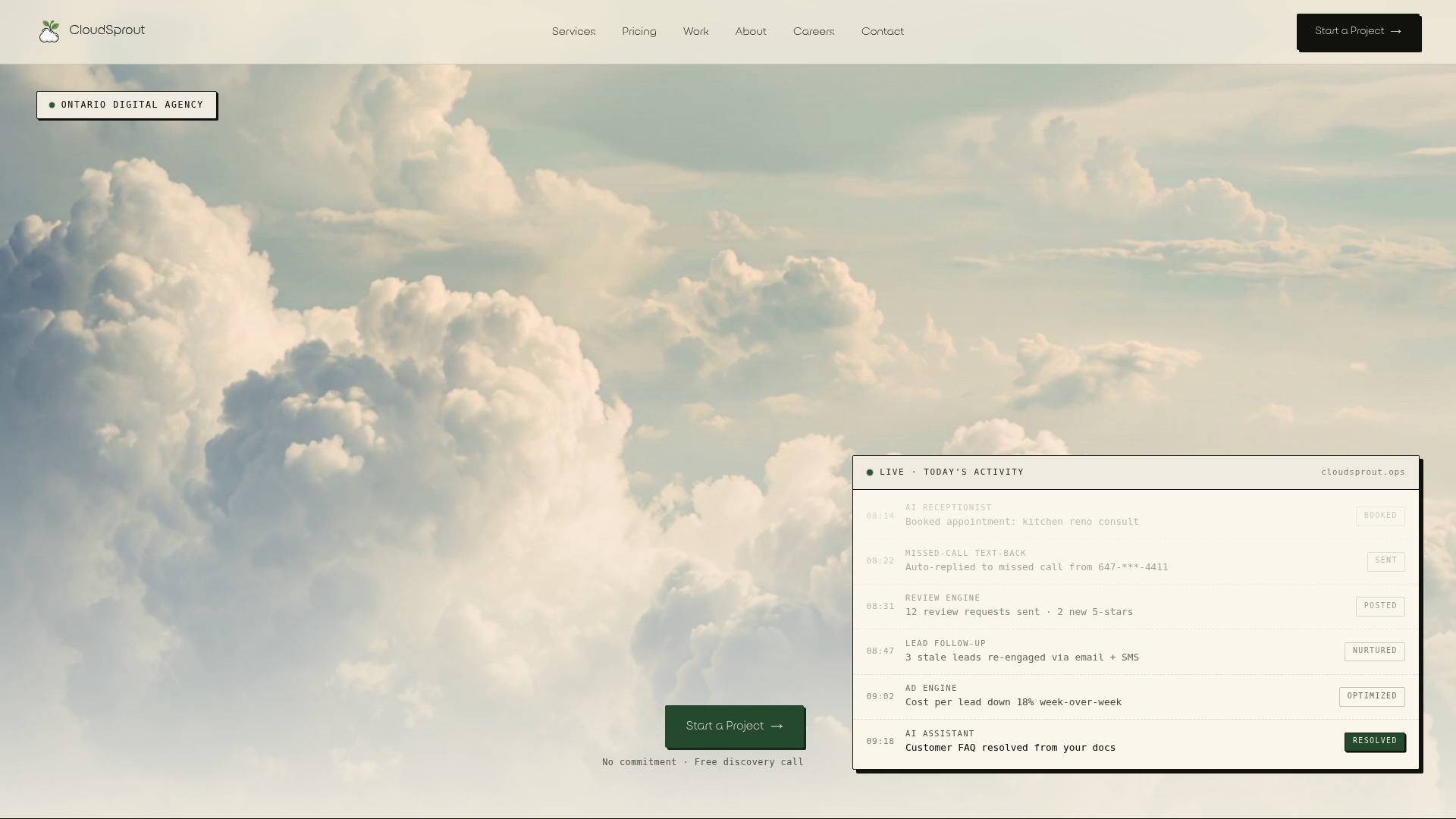
If your website’s capture forms or chat setup aren’t ready to feed an AI scoring system, that’s usually the real blocker, not the AI itself. CloudSprout’s website development team can rebuild your capture flow while the CRM and ERP side handles the routing and booking logic behind it. Start with a free digital audit to see exactly where your current setup is losing leads before you commit to a pilot.
Sources
- Configure predictive lead scoring – Dynamics 365 Sales | Microsoft Learn
- AI Lead Scoring: Definition, Benefits & How it Works (in 2026) | Default
FAQ
Which AI Is Best for Lead Generation?
There’s no single best tool across every business. CRM-native scoring tools work well if you already run HubSpot or Dynamics 365, while dedicated AI agent platforms fit better if you need conversational qualification on your site.
Can You Use AI to Generate Leads?
AI mostly excels at qualifying and prioritizing leads you already capture rather than creating brand-new demand from nothing. Pairing AI qualification with strong SEO and content work drives the actual lead volume it needs to sort through.
Can AI Replace Lead Generation Entirely?
No. AI replaces the manual sorting and triage work, but you still need marketing, SEO, and outreach to bring leads in the door in the first place.
How Much Data Do I Need Before Starting?
Platforms like Dynamics 365 require at least 40 qualified and 40 disqualified closed leads to train a reliable model, so a few months of consistent CRM history is a reasonable starting point.