Six marketing agency pricing models dominate the industry right now: monthly retainer, project-based fixed fee, hourly billing, performance-based pay, value-based pricing, and hybrid arrangements that blend a base retainer with a performance bonus. For ongoing work like SEO, PPC, or social media, a retainer or hybrid model is the practical default. One-off jobs like a website rebuild or brand overhaul fit a project fee better. The rest comes down to matching the model’s incentives to what you’re actually trying to achieve.
TL;DR:
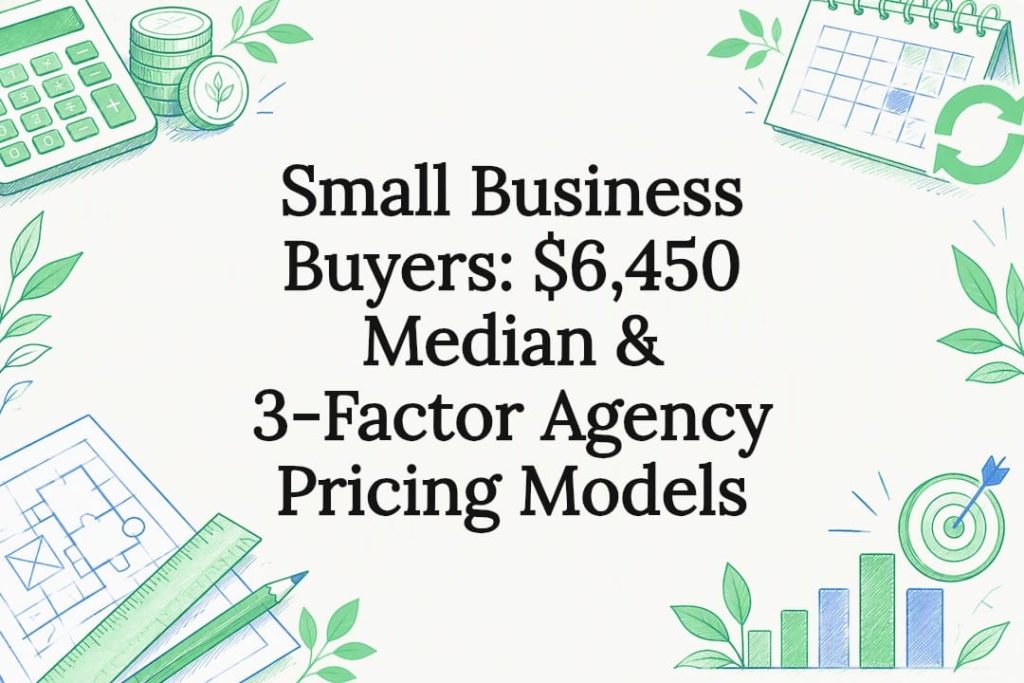
- Most agencies now favor retainer and hybrid models for ongoing work, with retainers averaging around $6,450 monthly, mostly falling between $3,500 and $5,000.
- Project-based fees suit clear, one-time deliverables like website rebuilds or rebrands, while hourly billing is mainly used for short, unpredictable fixes and rarely for strategic work.
- Hybrid pricing, combining a base retainer with performance incentives, is the preferred model for predictable cash flow and measurable results in 2026.
- Agency rates vary widely from $50/hour for freelancers to over $200/hour for large firms, with local SEO starting at around $1,500 monthly and enterprise SEO reaching $20,000 or more.
- Buyers should evaluate quotes using formulas like effective hourly rate and management fee percentage, and watch for hidden costs that can add roughly 20% to initial proposals.
Table of Contents
- Marketing Agency Pricing Models Explained: How Each One Works
- What Marketing Agencies Actually Charge in 2026
- How to Choose the Right Pricing Model for Your Business
- The Hidden Costs That Turn a Good Quote Into a Bad Deal
- Quick Math: Is Your Agency Quote Actually Reasonable?
- How Cloudsprout Structures Pricing for Small Business Clients
- What Buyers Get Wrong About Pricing Models
- A Straightforward Way to Get Started With Cloudsprout
- Sources
- FAQ
Marketing Agency Pricing Models Explained: How Each One Works
Every pricing structure rewards a different behavior — learn more about common pricing approaches in agency white-label and partnership models at BabyLoveGrowth. That’s the part most business owners skip past when they’re staring at a proposal, and it’s the part that determines whether the relationship works six months in.
Monthly retainer. You pay a fixed amount each month for an agreed scope of work, either hours-based (X hours of work) or deliverable-based (X blog posts, Y ad campaigns managed). Retainers suit ongoing channel work like SEO, paid social, and content because the agency needs consistent time on your account to see results compound. Industry surveys peg retainers as the majority of agency engagements now, reflecting how many businesses have shifted from one-off projects to always-on management.
Project-based fees. You pay one price for a defined deliverable: a new website, a rebrand, a one-time audit. This works because scope and end date are both clear. The risk sits with the agency if the job runs long, which is why experienced shops build in buffer. Project work still makes up roughly half of agency revenue even at firms that primarily sell retainers, because clients keep coming back for discrete builds between ongoing contracts.
Hourly billing. You pay for time logged, period. It’s transparent for short, unpredictable jobs like troubleshooting a broken checkout flow, but it’s a poor fit for anything strategic. There’s no incentive for the agency to work efficiently. In fact, the incentive runs the other way. Most agencies that bill hourly for long-term work eventually push clients toward a retainer.
Performance-based pay. You pay based on outcomes: cost per lead, a percentage of ad spend, or a cut of revenue generated. It sounds appealing until you realize agencies rarely want full performance risk on a channel they don’t fully control (a landing page they didn’t build, a sales team that doesn’t follow up fast enough). Pure performance deals are less common than hybrid versions for exactly this reason.
Value-based pricing. You pay based on the outcome’s worth to your business, not the hours or channels involved. This only works when both sides can agree on what a result is actually worth, which means you need clean historical data and a level of trust that usually takes a few project cycles to build. It’s rare as a starting point, common as an evolution.
Hybrid. A modest base retainer, often $2,000 to $15,000 a month depending on scope, plus a bonus tied to agreed metrics. This has become the buyer-friendly compromise in 2026: you get predictable cash flow for the agency (so they stay staffed and responsive) and real accountability for you. It’s the structure most agencies land on once they can reliably measure results and both sides agree on a baseline.
- Retainer: best for ongoing, compounding work like SEO and social
- Project fee: best for one-off builds with a clear finish line
- Hourly: best for small, unpredictable fixes, not strategy
- Performance: best when results are cleanly attributable to the agency’s work
- Value-based: best once you have a trusted history with a provider
- Hybrid: best when you want predictability plus skin in the game
Pro Tip: If an agency insists on hourly billing for a strategic channel like SEO, ask why. There’s rarely a good reason beyond it being easier for them to justify slow progress.
What Marketing Agencies Actually Charge in 2026
Pricing swings hard based on who’s doing the work and what you’re asking for. A freelancer charging $50 an hour and a 40-person agency charging $200 an hour might both call themselves “digital marketing experts,” and both might be right for different jobs.
Agency size sets the floor. Solo freelancers and micro-agencies typically run $50 to $100 an hour or $1,500 to $3,000 a month for a limited retainer. Small agencies (5 to 15 people) tend to land in the $3,000 to $8,000 monthly retainer range. Mid-size shops with specialized teams often start retainers around $8,000 and climb past $20,000 for full-service accounts. Large agencies serving enterprise clients regularly charge $25,000 a month or more, with hourly rates north of $200.
Across a sample of 280 engagements, the median monthly retainer landed at $6,450, though the most common range clustered between $3,500 and $5,000. That gap between median and mode tells you something: a handful of large accounts pull the average up, but most small businesses are paying closer to the lower band.
| Service | Typical price range | Notes |
|---|---|---|
| Local SEO retainer | $1,500–$3,000/month | Lower end for single-location businesses |
| Enterprise SEO retainer | $5,000–$20,000+/month | Multi-location or competitive niches |
| PPC management | 10–30% of ad spend | Higher percentage on smaller budgets |
| Website project | $3,000–$25,000+ one-time | Depends on pages, features, e-commerce |
| Full-service retainer | $3,000–$20,000+/month | Combines SEO, social, content, ads |
PPC fee structures follow a clear pattern: agencies typically charge 20 to 30% of spend under $5,000 a month, dropping to 12 to 20% for mid-size budgets, and settling around 10 to 15% once monthly spend passes roughly $50,000. Setup fees and monthly minimums are common on top of that percentage.
These figures are U.S. and Canadian dollar benchmarks pulled from broad samples, so treat them as calibration points, not fixed rules. A Toronto business shopping for local SEO pricing will see different numbers than a national e-commerce brand, and geography, competition level, and service complexity all move the needle before you sign anything.

How to Choose the Right Pricing Model for Your Business
Run through this before you compare a single quote:
- Check your cash runway. If cash flow is tight, project-based work with clear milestones beats an open-ended retainer.
- Decide how much you need predictability. A fixed monthly retainer protects your budget; performance pay shifts risk to the agency but usually costs more per result if it works.
- Assess how measurable your outcomes are. Lead generation and e-commerce sales are easy to track, which makes performance and hybrid models viable. Brand awareness work is harder to tie to a number, so retainer fits better.
- Estimate the engagement length. Short, defined jobs favor project fees. Anything running past six months usually makes more sense as a retainer or hybrid.
Match those answers to a model:
Want this running in your business without doing it yourself?
Book a Free Consultation →- Tight cash, short job → project fee
- Need predictability, ongoing work → retainer
- Highly measurable results, established relationship → hybrid or performance
- One-time strategic clarity needed → project fee or short consulting engagement
Before signing, ask the agency directly: What specific deliverables are included in this fee? What happens if scope changes mid-contract? How is performance measured, and who owns that data? Those three questions expose more about incentive alignment than any pricing sheet.
The Hidden Costs That Turn a Good Quote Into a Bad Deal
Published rates rarely tell the whole story. Hidden costs typically add about 20% to the retainer figure you were originally quoted.
Watch for these line items before you sign:
- Setup or onboarding fees separate from the monthly rate
- Tool pass-throughs (software licenses billed back to you)
- Creative production costs (photography, video, custom graphics)
- Reporting or analytics dashboard fees
- Minimum ad spend requirements tied to management fees
Red flags worth walking away from: a guaranteed specific ROI (nobody can promise that honestly), a flat rate applied to every client regardless of scope, or a steep discount for prepaying a year upfront. That last one locks you into a relationship before you know if it works.
Pro Tip: Ask for an itemized scope, a defined reporting cadence, and a 30-day exit clause before you sign anything longer than three months.

Quick Math: Is Your Agency Quote Actually Reasonable?
Three formulas turn a vague quote into a real number:
- Effective hourly rate: Retainer amount ÷ estimated hours worked. A $5,000 retainer for 20 hours of monthly work is $250 an hour, well above typical small-agency rates, unless the deliverables justify it.
- Project multiplier check: Most agencies price projects at 2 to 5 times their raw labor cost, depending on tier and complexity. A wildly higher multiple deserves a scope conversation.
- PPC fee sanity check: Management fee ÷ monthly ad spend. If that number sits far outside the 10 to 30% band based on your spend tier, ask why.
How Cloudsprout Structures Pricing for Small Business Clients
Cloudsprout builds every engagement in-house, with transparent month-to-month pricing and no long-term lock-in. Most clients start with a free digital audit, then move into a plan (Sprout, Grow, or Scale) sized to their scope. A common path looks like this: a client starts with a one-off Website Development project, then transitions into a Grow retainer once SEO and content need ongoing attention. For mid-market clients running paid ads, Ads Management often gets layered on as a hybrid add-on tied to spend, giving both predictability and accountability in one contract.
What Buyers Get Wrong About Pricing Models
The mistake isn’t paying too much. It’s picking a model whose incentives fight against what you actually need, then blaming the agency six months later when the relationship sours. Run every quote through the formulas above before comparing sticker price.
— Cristo
A Straightforward Way to Get Started With Cloudsprout
Cloudsprout is the alternative to a traditional agency for small businesses tired of guessing what they’re actually paying for: every service is delivered in-house with no subcontractors, pricing stays month-to-month with no long-term contracts, and you get direct access to the people doing the work instead of a account manager relaying messages.
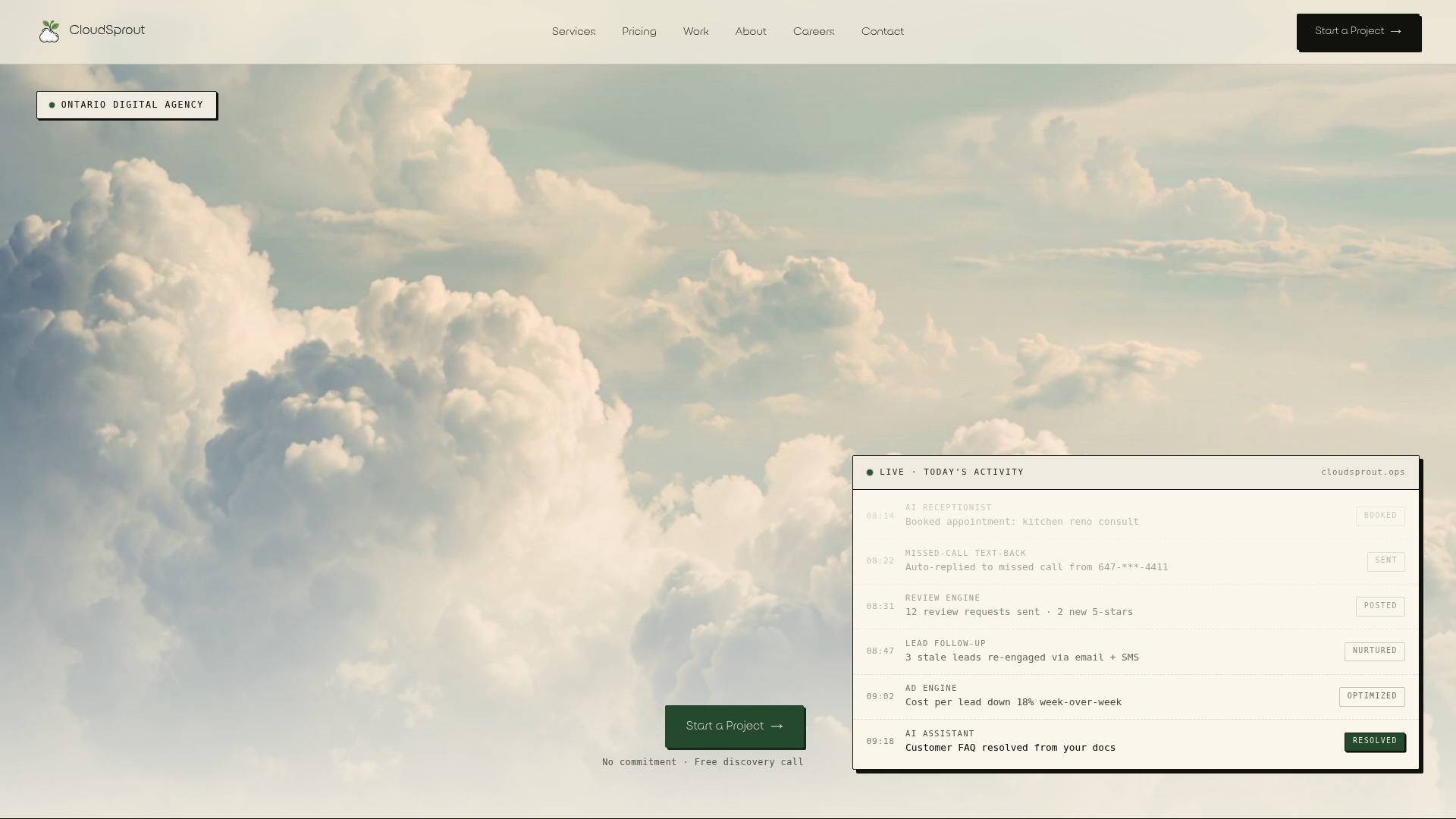
Plans run in three tiers, Sprout, Grow, and Scale, covering combinations of:
- Website Development and ongoing site management
- SEO and Local Search
- Content and Social
- Ads Management, priced based on spend
- Business Automation for repetitive back-office work
- Branding & Identity for businesses starting fresh or repositioning
Clients often have the option to start with a digital audit before committing, to understand where their current site and marketing stand. If you’re comparing pricing models from a handful of agencies right now, the fastest next step is booking that free SEO audit and using it as your baseline for every other quote you get.
Sources
- The Formula to Calculate Your Agency’s Rates — Swydo blog
- Marketing agency pricing study 2026: $40M+ analyzed
- Digital marketing agency pricing models explained (2026) — TechRadiant
- Agency pricing models guide — LoudScale
FAQ
What Are the Main Types of Agency Pricing Models?
The six main types are monthly retainer, project-based fixed fee, hourly billing, performance-based pay, value-based pricing, and hybrid (a base retainer plus a performance bonus). Retainers currently make up the majority of agency engagements (source), with hybrid models gaining ground fast.
What Is the 70/20/10 Rule in Marketing?
The 70/20/10 rule is a budget allocation guideline, not a pricing model: 70% of marketing spend goes to proven tactics, 20% to newer approaches showing promise, and 10% to experimental ideas. It helps businesses decide how to split budget across channels, separate from how they pay an agency for the work.
What Are the 5 C’s of Pricing?
Definitions vary across sources, but a common version covers Company (costs and goals), Customers (willingness to pay), Competitors (market rates), Collaborators (partners affecting cost), and Climate (economic and regulatory conditions). It’s a general pricing strategy framework, not specific to marketing agencies.
What Are the Four Pricing Models Agencies Use Most?
If you narrow it to the four most common structures, they’re retainer, project-based, hourly, and performance-based, with hybrid models increasingly treated as a fifth standard option. Retainer and hybrid arrangements dominate ongoing work in 2026, while project fees still cover one-off builds like websites and rebrands.
How Much Does Cloudsprout Charge for Ongoing Marketing Work?
Cloudsprout’s published plans start at $300 a month for Sprout, $600 a month for Grow, and $1200 CAD per month for Scale, each month-to-month with no lock-in contract. Ads Management runs $500 to $2,000 a month depending on scope, and setup fees vary by plan tier.
Recommended
Less reading. More growing.
We build the systems these articles describe. Websites, AI follow-up, reviews, automation. And run them for you.
Keep reading