

Ecommerce SEO is defined as the practice of optimizing an online store’s product pages, category pages, site structure, and technical foundation to rank higher in organic search results for purchase-ready buyers. Unlike general search engine optimization, ecommerce search engine optimization targets transactional intent: shoppers who are ready to buy, not just browse. Approximately 75% of users never scroll past the first page of results. That single fact explains why ranking on page one is not optional for any store that depends on search traffic. Organic search also delivers continuous traffic without per-click costs, making it a long-term asset that paid advertising cannot replicate.
What is ecommerce SEO and how does it differ from traditional SEO?
Ecommerce SEO and traditional SEO share the same foundation: keywords, content, and technical health. The difference is in focus and intent. Ecommerce SEO targets transactional keywords on product and category pages, while traditional SEO more often targets informational queries on blog posts and service pages. A furniture retailer optimizing for “buy solid oak dining table online” is doing ecommerce SEO. A home decor blogger optimizing for “how to style a dining room” is doing traditional SEO.
The page types are also different. Ecommerce stores live or die on product detail pages and category pages. Those pages must carry keyword-optimized titles, clear pricing, structured data, and compelling descriptions. Blog-heavy sites can rank on content volume alone. An online store cannot.
Ecommerce sites face technical challenges that most traditional sites never encounter:
- Faceted navigation: Filters for size, color, and price generate thousands of URL variations. Most of those URLs duplicate content and waste crawl budget.
- Product variants: A single product sold in 12 colors can create 12 near-identical pages if not handled correctly.
- Duplicate content: Manufacturer descriptions copied across multiple pages trigger ranking penalties.
- Crawl budget: Large catalogs with hundreds or thousands of pages require careful control over which URLs search engines index.
Pro Tip: Set canonical tags on filtered and sorted URLs to point back to the main category page. This tells Google which version to index and prevents duplicate content from diluting your rankings.
What are the key components of an effective ecommerce SEO strategy?
A complete ecommerce SEO strategy covers three layers: on-page optimization, technical SEO, and content. Skipping any one of them leaves ranking potential on the table.

On-page optimization
Every product and category page needs a unique title tag, a meta description written for click-through, and a product description that answers buyer questions. Titles should lead with the primary keyword and include a differentiator like brand, size, or material. Meta descriptions should state the benefit and include a call to action. Generic manufacturer copy does not rank. Original descriptions written for buyer intent do.
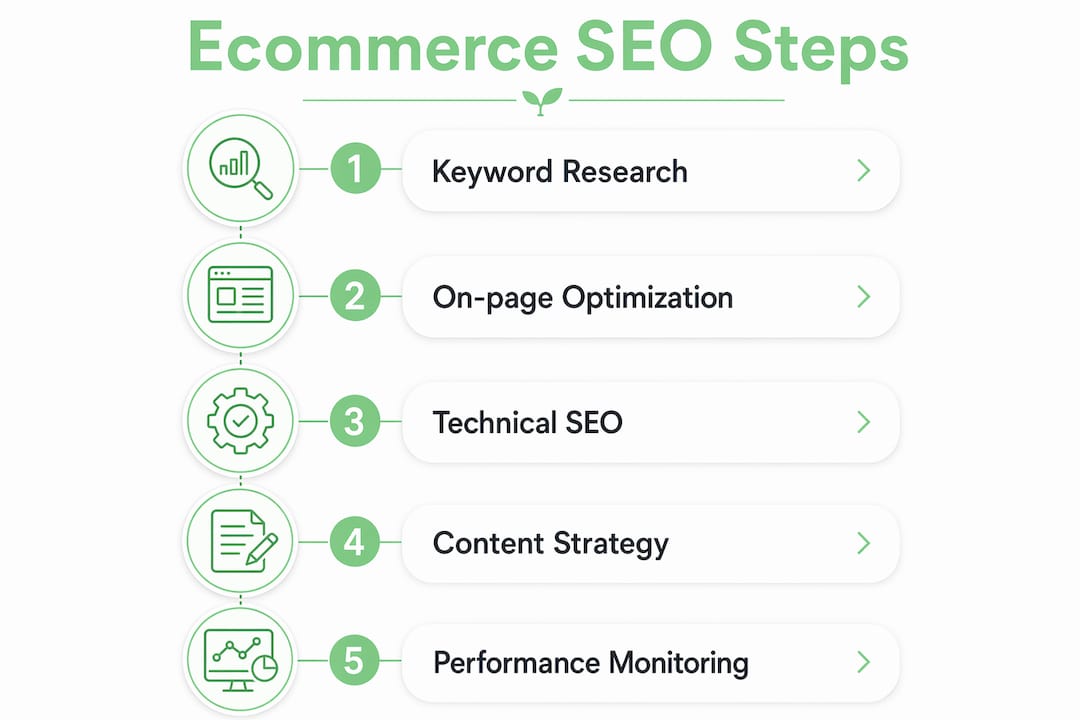
Structured data is no longer optional. Ecommerce SEO now requires structured product data to appear in AI-powered search features and rich results. Schema markup for Product, Review, Price, and Availability tells search engines exactly what your page contains. That information feeds Google’s Shopping panels, AI Overviews, and featured snippets. Writing effective product descriptions that pair naturally with schema markup gives your pages the best chance of appearing in those enhanced results.
Technical SEO priorities
- Site architecture: Keep category and product pages within three clicks of the homepage. Deep page hierarchies bury products from both users and crawlers.
- Mobile performance: Google indexes the mobile version of your site first. A slow or broken mobile experience directly harms rankings.
- Page speed: Large product image files are the most common speed killer. Compress images, use next-generation formats like WebP, and serve them through a content delivery network.
- Crawl efficiency: Submit an XML sitemap that includes only indexable pages. Exclude filtered URLs, admin pages, and duplicate variants.
- Internal linking: Link from category pages to top-selling products and from blog content to relevant product pages. This distributes authority and helps crawlers find new pages faster.
Pro Tip: Use Google Search Console’s Coverage report monthly. It shows which pages are indexed, which are excluded, and why. Fixing indexing errors there often produces faster ranking gains than publishing new content.
Content strategy
Buyer-focused content like buying guides, comparison FAQs, and how-to articles pulls in shoppers earlier in the decision process. A store selling running shoes can rank for “best trail running shoes for wide feet” with a buying guide, then convert that traffic on the product page. Reviews and ratings also contribute. They add unique, keyword-rich text to product pages and build the trust signals that both users and search engines reward.
| SEO Layer | Primary Focus | Key Tactic |
|---|---|---|
| On-page | Product and category pages | Unique titles, schema markup, original descriptions |
| Technical | Site health and crawlability | Canonicals, speed, mobile optimization |
| Content | Buyer intent and authority | Guides, FAQs, reviews, internal links |
How to improve ecommerce SEO for product and category pages?
Product and category pages are the revenue engine of any online store. Improving them is the fastest path to better rankings and more sales.
Start with keyword research focused on purchase-ready queries. A shopper searching “women’s waterproof hiking boots size 8” is far closer to buying than one searching “hiking boot tips.” Tools like Google Keyword Planner and Search Console show which queries already bring traffic to your store. Build your page titles and descriptions around those terms.
Category pages deserve as much attention as product pages. A well-optimized category page can rank for broad, high-volume terms that no single product page can capture. Add a short introductory paragraph at the top of each category that describes what the section contains and naturally includes the target keyword. Keep it useful, not padded.
Specific tactics that move the needle on these pages:
- Write unique product descriptions for every SKU. Even 100 words of original copy outperforms copied manufacturer text.
- Optimize image alt text with descriptive, keyword-relevant phrases. “red-leather-wallet-mens.jpg” with alt text “men’s red leather bifold wallet” helps both image search and accessibility.
- Display customer reviews directly on product pages. Reviews add fresh, unique content automatically and answer the questions buyers actually have.
- Use breadcrumb navigation on every product page. Breadcrumbs improve internal linking, help users orient themselves, and generate breadcrumb-rich results in Google.
- Add clear pricing and availability in the page body and in schema markup. Shoppers and search engines both want this information immediately.
The Canadian business SEO basics guide covers foundational principles that apply directly to product page optimization for stores serving Canadian markets.
What technical SEO challenges do ecommerce sites face?
Technical debt harms SEO, and ecommerce sites accumulate it faster than most. The most common problems are duplicate content, poor crawl efficiency, and mishandled out-of-stock pages.
Want this running in your business without doing it yourself?
Book a Free Consultation →Duplicate content from faceted navigation
Faceted navigation is the leading cause of duplicate content in ecommerce. When a shopper filters a category by color and size, the store generates a new URL for each combination. A category with 10 colors and 5 sizes can produce 50 near-identical pages. Search engines waste crawl budget on those pages and struggle to identify the canonical version.
The fix is to configure faceted navigation so filters are discoverable by users but not indexed by search engines. Use canonical tags pointing to the main category URL, or use the noindex directive on filtered pages that have no unique search value. Only index filtered pages when they target a genuinely distinct, high-volume query.
Pro Tip: Check your site’s crawl stats in Google Search Console under “Settings > Crawl Stats.” If Googlebot is spending most of its time on filtered or paginated URLs, your crawl budget is being wasted. Fix canonicals first before adding new content.
Out-of-stock product pages
Deleting out-of-stock product pages is one of the most common and costly SEO mistakes in ecommerce. When a page gets deleted, all the links pointing to it lose their value. Keeping pages live or using 301 redirects to relevant alternatives preserves that link authority. Redirect to the closest matching product or to the parent category. Never redirect to the homepage.
Site speed and structured data
| Technical Issue | Risk | Best Practice |
|---|---|---|
| Uncompressed images | Slow load times, higher bounce rate | Use WebP format, compress to under 100KB |
| Missing canonical tags | Duplicate content, diluted rankings | Set canonicals on all filtered and variant URLs |
| Absent schema markup | Missed rich results and AI features | Implement Product, Review, and Breadcrumb schema |
| Deleted out-of-stock pages | Lost link equity | Use 301 redirects to related products or categories |
Strong site architecture is a prerequisite for scaling ecommerce SEO results. Getting the technical foundation right before publishing more content is the correct order of operations. The Cloudsprout SEO checklist for 2026 walks through the technical audit steps that apply to ecommerce stores of any size.
Understanding business taxonomy and site structure also plays a role in how search engines interpret your catalog hierarchy, which directly affects how category pages rank.
Key Takeaways
Ecommerce SEO succeeds when technical foundations, on-page optimization, and buyer-focused content work together as a single system, not as separate projects.
| Point | Details |
|---|---|
| Page-one ranking is critical | 75% of users never scroll past page one, so ranking below it means near-zero organic traffic. |
| Transactional intent drives strategy | Optimize product and category pages for purchase-ready queries, not general informational terms. |
| Technical SEO comes first | Fix site architecture, canonicals, and crawl efficiency before scaling content production. |
| Structured data is now required | Schema markup for Product and Review feeds AI-powered search features and rich results. |
| Out-of-stock pages need redirects | Use 301 redirects to related products or categories to preserve link authority when items sell out. |
The part most store owners get wrong about ecommerce SEO
After working with ecommerce businesses across Ontario, the pattern I see most often is this: owners treat SEO as a one-time project. They optimize their product pages, submit a sitemap, and move on. Six months later, they wonder why rankings have stalled.
SEO for online stores is a continuous process, not a launch task. Search behavior shifts. Competitors update their pages. Google rolls out algorithm changes. AI-powered search features like AI Overviews are now pulling structured product data directly into results, which means stores without proper schema markup are becoming invisible in a new class of search results. That is not a future problem. It is happening now.
The stores I see winning long-term are the ones that treat their technical foundation as a living system. They audit crawl stats monthly, update product descriptions when inventory changes, and add schema markup as new product types enter their catalog. They also write content that answers real buyer questions, not just content that targets keywords. That combination of technical discipline and genuine buyer focus is what separates stores that grow organically from stores that depend entirely on paid ads to survive.
— Cristo
Cloudsprout’s ecommerce SEO and website services
Ecommerce SEO requires a technically sound website before any content strategy can work. Cloudsprout builds ecommerce-ready websites with clean architecture, fast load times, and proper schema markup built in from the start, not added as an afterthought.

Cloudsprout’s SEO services cover the full stack: technical audits, on-page optimization, structured data implementation, and buyer-focused content. Every engagement starts with a free digital audit so you know exactly where your store stands before any work begins. There are no lock-in contracts and no outsourcing. The team doing your audit is the same team doing the work. If your store is losing ground to competitors in organic search, that audit is the right starting point.
FAQ
What is ecommerce SEO in simple terms?
Ecommerce SEO is the process of optimizing an online store so it appears higher in search results when buyers search for products you sell. It focuses on product pages, category pages, site speed, and structured data.
How long does ecommerce SEO take to show results?
Most ecommerce stores see measurable ranking improvements within three to six months of consistent SEO work. Technical fixes like canonicals and site speed often produce faster results than content changes.
Why does ecommerce SEO matter more than paid ads?
Organic search traffic generates sales without a per-click cost, making it more profitable over time. Paid ads stop delivering traffic the moment you stop spending.
What is the biggest technical SEO mistake in ecommerce?
Faceted navigation without canonical tags is the most common technical mistake. It creates thousands of duplicate URLs that waste crawl budget and dilute rankings across your catalog.
Do product descriptions affect ecommerce SEO rankings?
Unique product descriptions directly improve rankings because they give search engines original, keyword-relevant content to index. Copied manufacturer descriptions compete with every other store using the same text.
Recommended
Less reading. More growing.
We build the systems these articles describe. Websites, AI follow-up, reviews, automation. And run them for you.
Keep reading

One Page Voice Chart: 8 Brand Voice Examples Small Businesses Can Use
