

Search engine marketing (SEM) is defined as the practice of using paid advertising to place your business at the top of search engine results pages immediately. Unlike organic SEO, which builds visibility over months, SEM delivers traffic from the moment your campaign goes live. The model most businesses use is pay-per-click (PPC), meaning you pay only when someone clicks your ad, not simply for the ad appearing. For small business owners and marketing managers, understanding what is search engine marketing means understanding one of the fastest ways to get in front of customers who are actively searching for what you sell.
How does search engine marketing work to increase website visibility?
SEM operates through a real-time auction system run by platforms like Google Ads. Every time a user types a search query, the platform runs an auction in milliseconds to decide which ads appear and in which order.

Your position in that auction depends on two things: your bid and your ad quality score. Ad quality scores are calculated based on the relevance of your ad copy, the expected click-through rate, and the experience users have when they land on your page. A business with a lower bid but a highly relevant ad can outrank a competitor spending more money.
Here is how the process works from start to finish:
- Keyword selection: You choose the search terms you want your ads to appear for, such as “emergency plumber Toronto” or “gluten-free bakery near me.”
- Bid setting: You set the maximum amount you are willing to pay per click on each keyword.
- Ad creation: You write a short headline and description that matches what the searcher wants.
- Landing page alignment: Your ad sends users to a page that delivers exactly what the ad promised.
- Performance tracking: You monitor clicks, conversions, and cost to refine the campaign.
The key advantage over organic search is timing. SEM provides instant results while SEO builds long-term traffic. A new business with a brand-new website can appear on page one of Google the same day a campaign launches.
Pro Tip: Set up conversion tracking before you spend a single dollar. Without it, you are flying blind on which keywords actually bring in customers versus which ones just burn through your budget.
What are the key differences between SEM and SEO?
SEM and SEO both aim to get your business found on search engines, but they work through completely different mechanisms. Knowing when to use each one is what separates businesses that grow online from those that stall.
SEM focuses on paid, immediate traffic while SEO focuses on organic, long-term results. SEM costs money every time someone clicks. SEO costs time and content investment, but the traffic it generates does not stop when you pause spending.
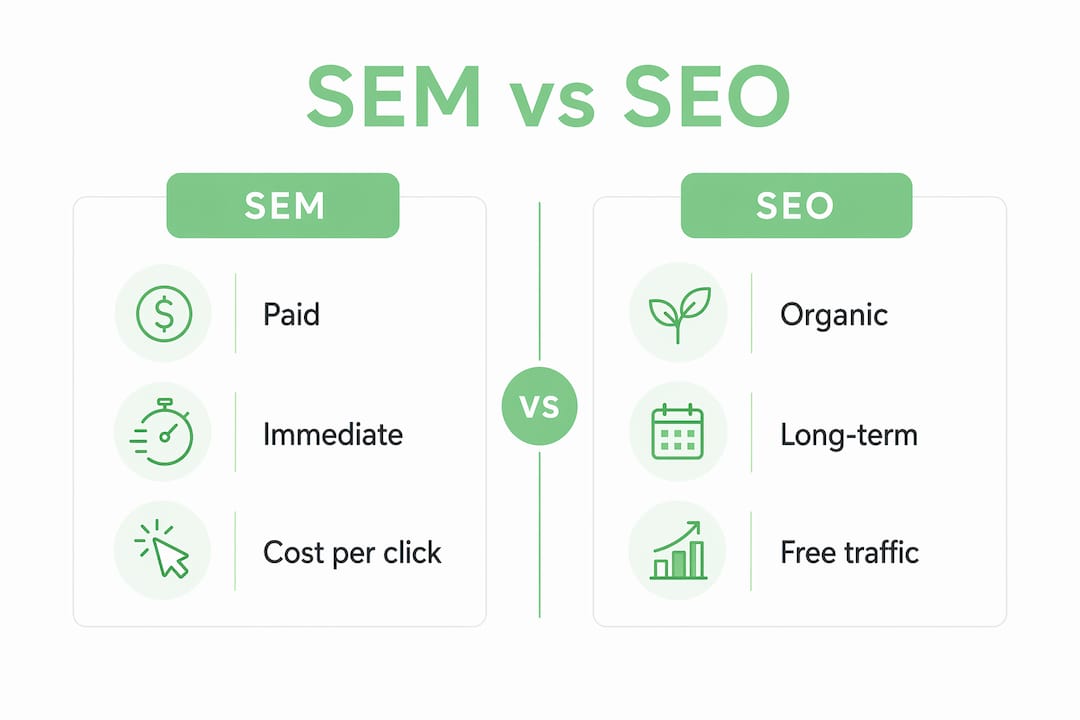
| Factor | SEM (Paid Search) | SEO (Organic Search) |
|---|---|---|
| Speed to results | Immediate, same day | Weeks to months |
| Cost model | Pay per click | Time and content investment |
| Visibility control | Full control over placement | Depends on algorithm |
| Long-term value | Stops when budget stops | Builds compounding value |
| Best use case | New launches, promotions, competitive keywords | Brand authority, sustained traffic |
The most effective approach combines both. SEM fills the visibility gap while your SEO strategy builds authority over time. A plumber launching in a new city, for example, can run Google Ads immediately to get calls while their website earns organic rankings over the following months. Experts recommend this hybrid model specifically because SEM fills visibility gaps for competitive keywords while SEO reduces long-term costs.
One clarification worth making: some older definitions of SEM included both paid and organic search. Most marketing professionals now use SEM to refer specifically to paid search advertising, distinct from SEO. Using both terms correctly matters when you are planning budgets and setting expectations with your team.
What are the main benefits of effective SEM campaigns?
The clearest benefit of paid search is control. You decide who sees your ads, when they see them, and how much you spend. No other advertising channel gives small businesses that level of precision at a comparable entry cost.
The specific advantages include:
- Instant visibility: Your business appears at the top of search results the same day your campaign launches, even if your website is brand new.
- Intent-based targeting: People searching for “best accountant for small business Ontario” are ready to hire. SEM puts you in front of buyers at the exact moment of decision.
- Measurable ROI: Every click, form submission, and phone call can be tracked back to a specific keyword and ad. You know exactly what your money is doing.
- Budget flexibility: You can start with a modest daily budget and scale up as you see results. There is no minimum spend requirement on most platforms.
- Fast testing: You can run two versions of an ad simultaneously, see which one converts better within days, and apply that learning immediately.
As of mid-2025, 15.5% of all retail sales occurred online, and that share continues to grow. Businesses that are not visible in paid search are missing a growing portion of buyers who never look past the first page of results.
SEM is often misunderstood as a fixed expense. It is actually a performance-based investment where every dollar spent ties directly to real traffic and lead generation. That distinction changes how you should think about it in your budget.
Pro Tip: Track cost per lead, not just cost per click. A keyword that costs $5 per click but converts at 20% is far more valuable than one that costs $1 per click but never converts.
What are the best strategies for running successful SEM campaigns?
Running a paid search campaign without a clear strategy wastes money fast. These are the practices that separate campaigns that grow a business from campaigns that drain a budget.
-
Start with long-tail, high-intent keywords. Broad keywords like “plumber” or “bakery” are expensive and attract people who are just browsing. Long-tail, high-intent keywords like “emergency drain repair Mississauga” cost less per click and attract people ready to act. Start narrow and expand once you know what converts.
-
Write ad copy that matches the search query exactly. If someone searches “affordable wedding photographer Hamilton,” your ad headline should include those words. Matching language builds immediate relevance and improves your quality score.
Want this running in your business without doing it yourself?
Book a Free Consultation → -
Align your landing page with your ad promise. The biggest mistake in SEM is sending ad traffic to a generic homepage. Landing page quality directly affects conversion rates and ROI. If your ad promises a free quote, the landing page should open with a free quote form, not a company history paragraph.
-
Monitor and adjust bids weekly. SEM campaigns require continuous optimization because competitors adjust their bids and strategies constantly. A campaign that performs well in week one can decline by week four if left untouched. Check your search term reports regularly to find irrelevant queries draining your budget.
-
Use negative keywords aggressively. Negative keywords tell the platform which searches should never trigger your ad. A law firm running ads for “business lawyer” should add “free,” “DIY,” and “template” as negatives to avoid clicks from people who will never hire them.
-
Test ad variants systematically. Run two versions of each ad with one variable changed, such as the headline or call to action. Let each version gather enough data before declaring a winner. Apply the winning version and test the next variable.
-
Connect your ad account to your analytics platform. Seeing clicks in your ad dashboard is not enough. You need to see what those visitors do after they land. Aligning the user journey from search query to ad copy to landing page call to action is what drives real conversion rates. You can find practical guidance on how website copy supports this alignment in a dedicated resource for small business owners.
For businesses that also want to build organic authority alongside their paid campaigns, the 2026 SEO checklist for owner-operated businesses covers the foundational steps that complement SEM well.
Key Takeaways
Search engine marketing is the fastest way for a small business to appear in front of high-intent buyers, but it only delivers consistent ROI when campaigns are built on tight keyword targeting, relevant ad copy, and well-matched landing pages.
| Point | Details |
|---|---|
| SEM delivers instant visibility | Paid ads appear at the top of search results the same day a campaign launches. |
| PPC model ties spend to results | You pay only when someone clicks, making every dollar traceable to real traffic. |
| Quality score determines placement | Ad relevance and landing page experience matter as much as your bid amount. |
| Long-tail keywords reduce waste | High-intent, specific keywords cost less and convert better than broad terms. |
| SEM and SEO work best together | Paid search fills immediate gaps while organic SEO builds compounding long-term value. |
What I have learned from watching small businesses run paid search
Most small business owners I have worked with treat SEM as an experiment they run once and then abandon when the first month’s results disappoint. That is the wrong frame entirely.
The businesses that get real returns from paid search treat it like a sales rep, not a lottery ticket. They review performance weekly, cut keywords that do not convert, and reinvest that budget into what works. The campaigns that fail are almost always the ones where the ad was written once, the budget was set, and nobody looked at it again for three months.
The other pattern I see constantly is a mismatch between the ad and the landing page. A business runs a compelling ad about a specific service, then sends the click to their homepage. The visitor lands, sees nothing relevant, and leaves in under ten seconds. The budget is gone and the business owner concludes that paid search does not work. Paid search worked fine. The landing page failed.
The businesses that win with SEM are the ones that treat the search query, the ad copy, and the landing page as a single connected conversation. When all three say the same thing, conversion rates climb and cost per lead drops. That alignment is not complicated, but it requires attention. Pair your SEM efforts with solid SEO fundamentals and you build a system where paid search brings in revenue while organic search reduces your dependence on ad spend over time. For businesses that want professional support with campaign-level SEO, SEO Cheaper offers specialized services worth exploring.
— Cristo
Cloudsprout’s approach to paid search for small businesses
Running paid search well requires more than setting a budget. It requires a website that converts, landing pages that match your ads, and ongoing campaign management that keeps pace with a competitive market.

Cloudsprout works with small and mid-sized businesses across Ontario to build the full system: custom websites designed to convert paid traffic, digital marketing services that include campaign strategy and management, and website development that ensures your landing pages are built to turn clicks into customers. Every engagement starts with a free digital audit so you know exactly where your current setup is losing money before you spend anything on ads. No lock-in contracts, no outsourcing, and direct access to the team doing the work.
FAQ
What is the search engine marketing definition?
Search engine marketing is the practice of using paid ads on search engines to increase a website’s visibility in search results. It operates primarily on a pay-per-click model where advertisers pay only when a user clicks their ad.
How is SEM different from SEO?
SEM uses paid ads to generate immediate traffic, while SEO builds organic rankings over time through content and technical improvements. SEM stops delivering traffic when the budget stops; SEO compounds in value over time.
What is paid search marketing and how does it work?
Paid search marketing is the process of bidding on keywords so your ad appears when users search for those terms. Platforms like Google Ads run real-time auctions that factor in both your bid amount and your ad quality score to determine placement.
How much does SEM cost for a small business?
SEM campaigns can start with any budget size. Success depends less on total spend and more on targeting long-tail, high-intent keywords and matching your landing page to your ad copy to maximize return on each click.
What are the main benefits of search engine marketing for small businesses?
SEM delivers instant visibility, intent-based targeting, and fully measurable results. Small businesses can track every click and conversion back to a specific keyword, giving them clear data on which spending drives real customer acquisition.
Recommended
Less reading. More growing.
We build the systems these articles describe. Websites, AI follow-up, reviews, automation. And run them for you.
Keep reading
One Page Voice Chart: 8 Brand Voice Examples Small Businesses Can Use
