Use a blog post when you need people to find you and trust you; use a landing page when you need them to act right now. Blogs build organic discoverability and authority over months. Landing pages exist for one campaign-specific conversion, whether that’s a form fill or a click to buy. The two aren’t rivals. A blog earns the visitor; a landing page closes them, and Cloudsprout builds both under one roof for small businesses that don’t have time to guess.
TL;DR:
- Most small businesses need both a blog for organic discovery and a landing page for conversions, as each plays a distinct role in the customer journey.
- Use a blog for educational content targeting early-funnel keywords to build authority and generate long-term organic traffic, often with internal calls-to-action.
- Deploy a landing page for direct conversions when the traffic comes from paid campaigns, referral links, or when the offer has a deadline or fixed budget.
- Ensure clear routing by placing CTAs at strategic points in blog posts and linking to dedicated landing pages, with proper tracking and automation in place.
- Building both a blog and a landing page in-house with shared analytics improves lead generation and prevents common pitfalls like overloaded pages or poor routing.
Table of Contents
- Blog vs Landing Page: Why the Blog Post Wins for Discovery
- What Is a Landing Page, and Why Does It Convert Better?
- How Do I Decide Between a Blog Post and a Landing Page?
- How Do I Send Blog Readers to a Landing Page That Converts?
- Common Mistakes Businesses Make Choosing Between the Two
- Why We Build Blogs and Landing Pages Together, Not as an Either/Or
- Want This Built Instead of Debated?
- Sources
- FAQ
Blog vs Landing Page: Why the Blog Post Wins for Discovery
A blog post exists to get found and to teach. It targets a keyword someone types into Google before they’ve decided to buy anything, and it answers the question well enough that they trust the business behind it. That’s the whole job: organic traffic, authority, and slow-building trust that pays off for years, not days.
Good blog posts share a few traits. A specific headline that matches search intent (not “Our Company News,” but “How Much Does a Furnace Repair Cost in Ontario?”). Scannable sections with real subheadings, because nobody reads a 1,500-word block of text on their phone at a red light. And internal calls-to-action, usually a line or two mid-article, pointing toward a relevant offer instead of a generic “contact us.”
Pick a blog post when:
- The keyword is early-funnel (“how to,” “what is,” “why does”) rather than transaction-ready.
- The topic is complex enough to need explaining before someone will trust you with money.
- You want repeat visits from the same reader over weeks or months, not a single conversion event.
Track blog performance with organic sessions, keyword rankings, and assisted conversions, meaning leads who read the article first and converted somewhere else later. That last metric is the one most small-business owners never check, and it’s usually where a blog proves its worth. A post that never generates a form fill directly might still be quietly warming up half your pipeline.
What Is a Landing Page, and Why Does It Convert Better?
A landing page is a standalone web page built around one conversion goal, with far fewer links than a homepage so nothing distracts from that goal. No main navigation. No blog sidebar. No “learn more about our team” link pulling attention away from the button you actually want clicked.
There are two main types. Lead-generation pages trade a resource, quote, or consultation for contact information through a form. Click-through pages skip the form entirely and push straight toward a purchase or signup, the pattern most people mean when they say “landing page”. A roofing company running a spring inspection promo wants a lead-gen page. A software company selling a $49 annual plan wants a click-through page.
The design rules that actually move conversion rates:
- One goal per page. If you’re tempted to add a second CTA “just in case,” don’t.
- Message match: the headline should echo the ad or email that brought the visitor there, word for word if possible.
- Strip out anything not serving the offer, including most of the navigation.
Landing pages simplify testing in a way blogs rarely allow. Because the page has one goal and one layout, A/B testing headline or CTA changes produces clean, actionable data fast. Use landing pages for paid ad campaigns, seasonal promotions, gated PDFs, and product launches, anything with a defined start and end date. Measure conversion rate, cost per lead, and lead quality (are these people actually calling back?), not just form submissions.
How Do I Decide Between a Blog Post and a Landing Page?
Run this three-step check before you build anything.
- Identify the traffic source and intent. Is this visitor arriving from organic search, or from a paid ad, email, or QR code? Organic, research-stage traffic wants a blog. Paid or referral traffic that already knows your offer wants a landing page.
- Match the goal to the format. Are you trying to educate someone who’s still deciding, or convert someone who already decided? Education goes to a blog; conversion goes to a landing page.
- Run the operational checklist before launch. Confirm UTM parameters are set, GA4 events are firing on form submits and button clicks, the offer is stated in one sentence a stranger could repeat back to you, and Core Web Vitals scores aren’t tanking load speed on mobile.
A few real decisions this framework settles fast. A plumbing company ranking for “how to fix a running toilet” needs a blog, because that searcher isn’t ready to hire anyone yet, they just want the leak to stop. The same company launching a $99 winter pipe-inspection promo for December needs a landing page, because that visitor is warm and the offer has an expiry date.
Copy this shortened decision tree into your planning doc:
- Where’s the traffic coming from? (Organic → blog. Paid/email → landing page.)
- What’s the visitor’s job right now? (Learning → blog. Deciding → landing page.)
- Does the offer have a deadline or budget attached? (Yes → landing page. No → blog.)
- Can you track the outcome with a UTM and a GA4 event? (If not, fix that before launch, not after.)
Pro Tip: Before building either one, check what’s already ranking. If a competitor’s blog post owns page one for your target keyword and their landing page owns the ad results for the same offer, you’re not choosing between formats, you need both, built to compete on each front separately.
How Do I Send Blog Readers to a Landing Page That Converts?
This is where most small-business content dies quietly: great blog, zero mechanism to turn readers into leads. Fix the routing, not the writing.
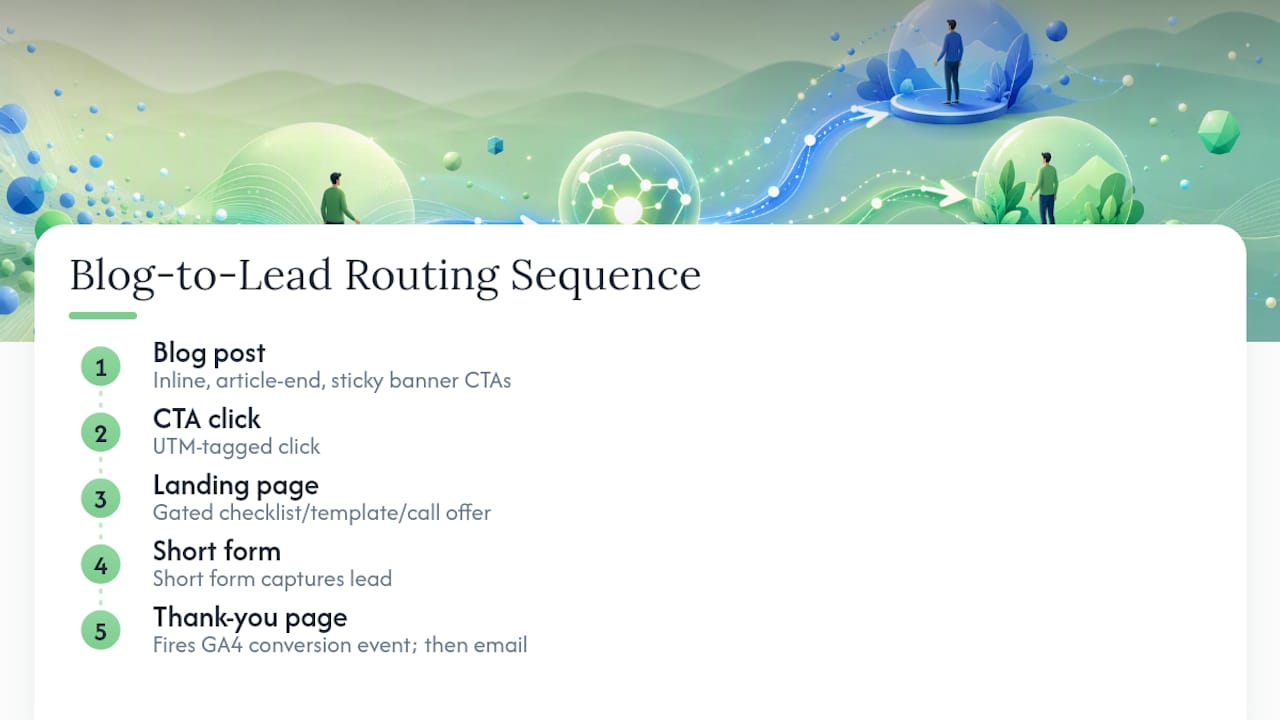
Place CTAs in three spots: inline after you’ve answered the reader’s core question (not at the top, before you’ve earned trust), a stronger one at the article’s end, and a sticky banner for longer posts. Build a content upgrade, a checklist, template, or calculator, that goes deeper than the blog post itself. Mirroring the blog’s exact topic with extra, actionable detail in the gated resource produces better lead quality than a vague “subscribe to our newsletter” box.
On the technical side: tag every CTA with a UTM so you know which blog post sent the click, set up a thank-you page that fires a GA4 conversion event, and connect the form to an automated follow-up email within minutes, not days.
Want this running in your business without doing it yourself?
Book a Free Consultation →Two examples. An electrician’s blog post on “how to childproof outlets” links to a landing page offering a free home electrical safety checklist, gated behind a short form. A bookkeeping firm’s post on “year-end tax prep mistakes” routes to a landing page offering a 20-minute tax review call.
Common Mistakes Businesses Make Choosing Between the Two
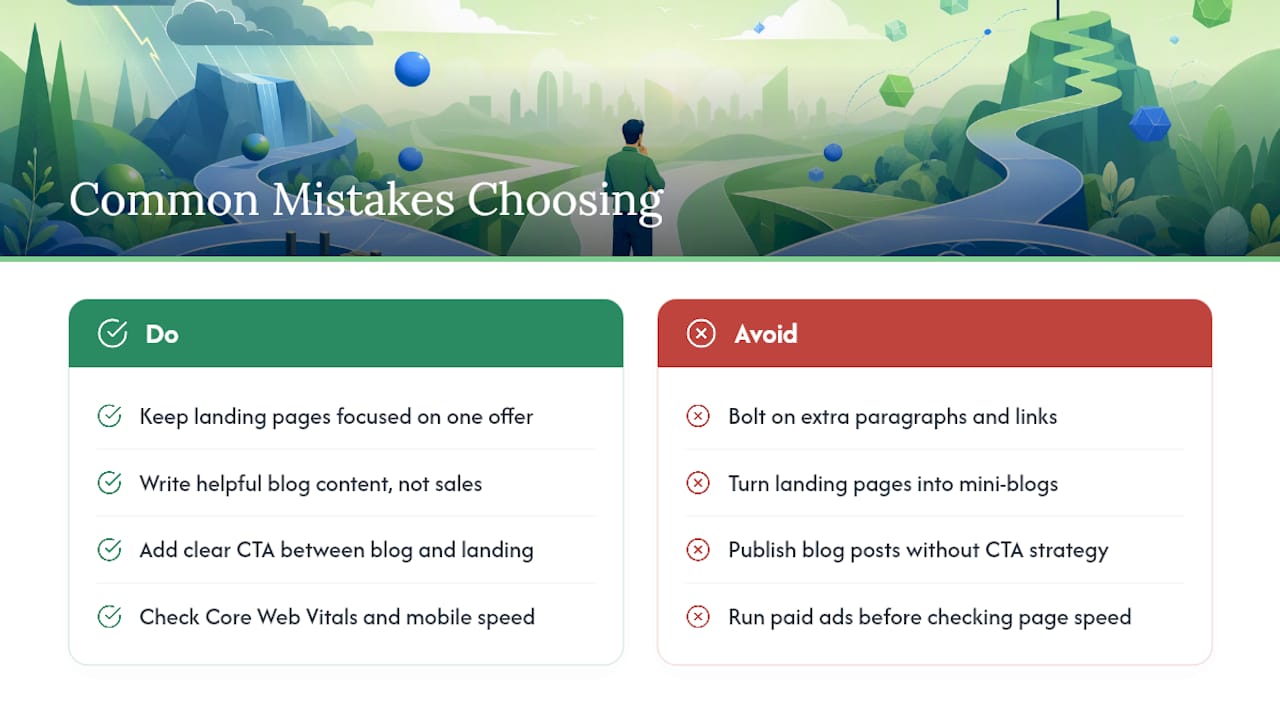
The most common error is using a landing page as a mini-blog. Owners get nervous about a page with “too little information” and start bolting on extra paragraphs, extra links, an FAQ nobody asked for. Overloading a landing page with intro text or multiple competing offers reliably tanks conversion rates, because you’ve turned a decision into homework.
The reverse mistake happens just as often: publishing a blog post that reads like a sales pitch. If a “how to” article spends three paragraphs praising your own service before answering the question, readers bounce, and Google notices the bounce too.
A third mistake is skipping the routing entirely. A blog is a discovery tool, a landing page is a conversion tool, and neither works without a bridge between them. Publishing dozens of blog posts with no CTA strategy is like running a busy storefront with no cash register visible.
Last one: building a landing page for paid traffic without checking Core Web Vitals or mobile load speed first. A slow page burns ad budget on visitors who never see the offer load.
Why We Build Blogs and Landing Pages Together, Not as an Either/Or
Most small-business owners treat this as a debate they need to settle once. It isn’t. The businesses getting real leads treat blog analytics as a shortlist generator: whatever topic keeps pulling traffic month after month becomes the next gated offer, not a coincidence, a pipeline.
Cloudsprout builds both pieces in-house: the blog content that earns the ranking, and the landing page that catches the reader once they’re warm. We preview the build before it goes live and track results against the same GA4 events from day one, so nobody’s guessing which post actually produced a lead six weeks later.
The businesses that struggle most usually have one half of this working, either strong content with nowhere for readers to convert, or a sharp landing page with no organic traffic feeding it. Fixing the gap matters more than perfecting either piece alone.
— Cristo
Want This Built Instead of Debated?
Cloudsprout is the alternative to hiring a separate content writer and a separate web developer and hoping they coordinate. We write the blog, build the landing page, and connect the tracking in one shop, month-to-month, with no lock-in contract.
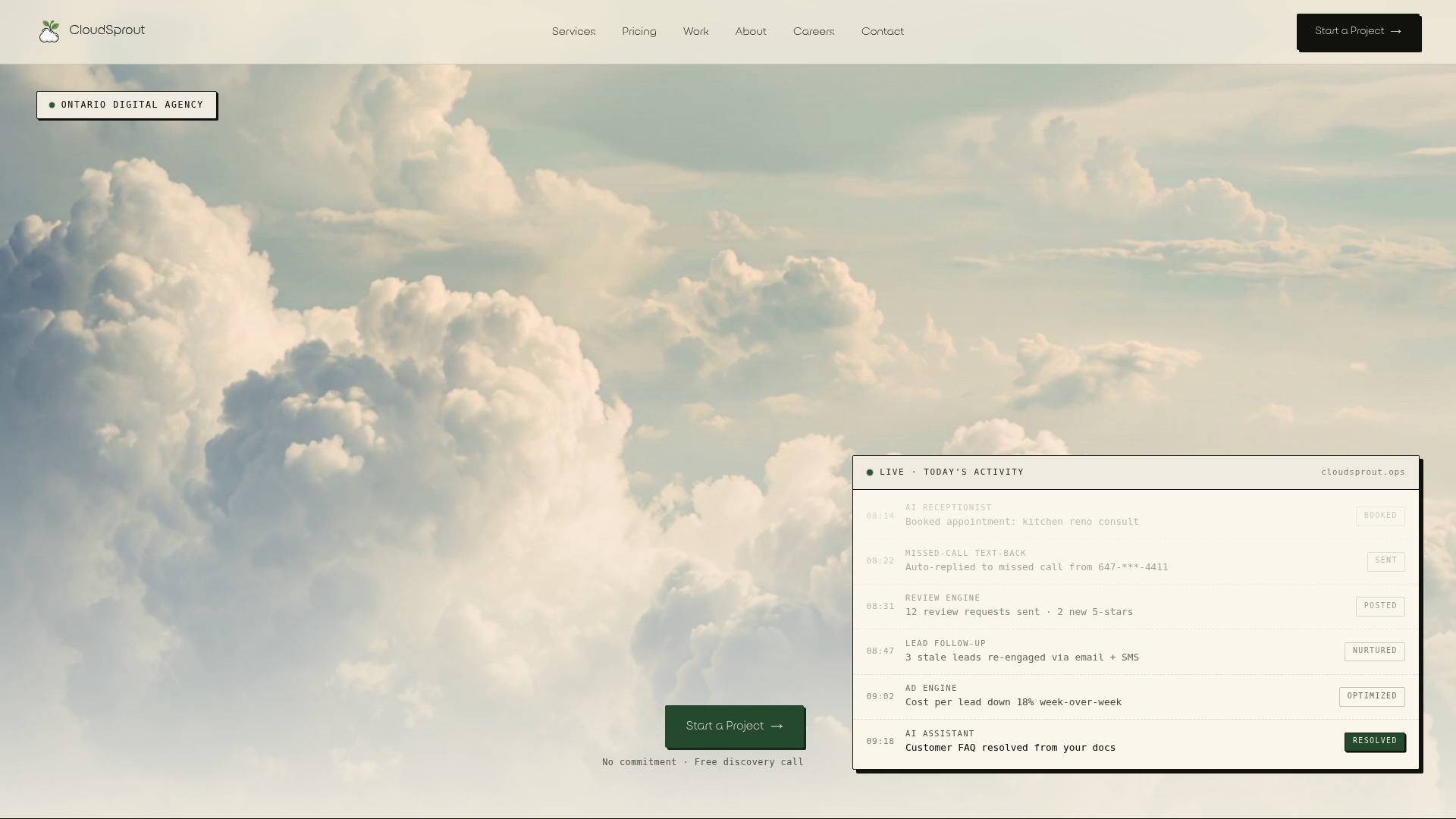
If you already have blog traffic but nothing to convert it into, start with a free SEO audit to see which posts are quietly generating interest with no offer attached. If you’re planning a promotion or a new service launch, our website development team can build the landing page around it, matched to your ad or email copy from day one. And if you want to see how a new page would actually look before committing to anything, the website preview service shows you a build with zero upfront cost. Everything is done in-house by the same team you talk to, no outsourced writers, no handoffs, no surprises on the invoice.
Sources
- Landing pages — Mailchimp marketing glossary
- Blog vs Landing Page Content: What Works Best for Lead Generation? · Froodl
- 7 landing page benefits — Landingi
- What is a landing page? And why should you care — HubSpot
FAQ
Are Blogs Still a Thing in 2026?
Yes. Blogs remain one of the most reliable ways to attract early-funnel organic traffic and build authority, especially for local service businesses competing on search rather than ad budget.
What Is the 80/20 Rule for Blogging?
Definitions vary, but the version most marketers apply is spending roughly 20% of your effort creating content, with the rest focused on promoting and routing traffic to it, meaning distribution and CTA strategy matter as much as the writing itself.
What Are the Four Types of Blogs?
Businesses typically run some mix of educational how-to posts, industry news or trend commentary, case studies or client stories, and opinion or thought-leadership pieces, each serving a different stage of reader trust.
What Is Replacing Blogging?
Nothing has fully replaced blogging for organic search visibility, though short-form video and AI-assisted search results are changing how people discover content before they ever click through to a blog post.
Can Cloudsprout Build Both a Blog and a Landing Page for My Business?
Yes. Cloudsprout handles content creation and website development in-house, so the blog strategy and the landing pages it feeds are built by the same team with shared tracking from launch.
Recommended
Less reading. More growing.
We build the systems these articles describe. Websites, AI follow-up, reviews, automation. And run them for you.
Keep reading

Small Teams: Automate Customer Onboarding in 1–4 Weeks, Keep It Human