
A digital marketing strategy is a long-term plan that defines how a business uses online channels, such as search, social media, and email, to reach specific marketing goals. For Canadian small business owners, understanding this definition is the first step toward competing online without wasting money on scattered tactics. A well-built strategy acts as a blueprint, while individual campaigns and posts are the execution. Most businesses that struggle online skip the blueprint entirely and wonder why nothing sticks.
What is a digital marketing strategy and why does it matter?
A digital marketing strategy is a 12–24 month roadmap that guides how a business uses digital channels to achieve measurable marketing goals. That time horizon matters because building search visibility, email lists, and social audiences takes sustained effort, not a single campaign. The strategy defines the “why” and “where,” while tactics define the “how.” Confusing the two is the most common reason small businesses burn their marketing budgets with nothing to show for it.
The importance of digital marketing for small businesses comes down to one fact: your customers are already online. A clear digital marketing plan lets you meet them where they are, with the right message, at the right stage of their decision. Without a plan, you end up reacting to trends instead of building momentum. Businesses that align strategy with business objectives consistently outperform those that treat digital marketing as a collection of disconnected activities.

What are the core components of a digital marketing strategy?
Every effective digital marketing strategy shares the same building blocks, regardless of business size or industry.
- SMART goals: Goals must be specific, measurable, achievable, relevant, and time-bound. “Get more website traffic” is not a goal. “Increase organic website visits by 30% in six months” is.
- Audience personas: You need a clear picture of who you are trying to reach, including their age, location, pain points, and where they spend time online. Canadian small businesses often serve tight geographic communities, which makes local persona research especially valuable.
- Channel selection: Not every platform suits every business. A trades company in Ontario gets more value from local SEO and Google Business Profile than from TikTok. Choose channels based on where your customers actually are.
- Customer journey mapping: Map how a stranger becomes a paying customer. Different channels serve different stages. SEO drives awareness. Email nurtures consideration. Retargeting ads close decisions.
- KPIs and measurement: Define your key performance indicators before you spend a dollar. Leading indicators like click-through rates and email open rates tell you what is working before revenue data catches up.
The critical distinction between strategy and tactics trips up most small business owners. Strategy answers: “Which customers do we want, and which channels will reach them?” Tactics answer: “What do we post, and when?” Both matter, but strategy must come first.
Pro Tip: Write your strategy in a single page. If you cannot summarize your goals, audience, channels, and success metrics on one page, the strategy is not clear enough to execute.
How do proven frameworks structure a digital marketing plan?
The RACE Framework, developed by Smart Insights, organizes digital marketing into four stages: Reach, Act, Convert, and Engage. Each stage maps to a part of the customer funnel and points to specific channels and tactics. This structure prevents the common mistake of investing only in awareness while ignoring retention.
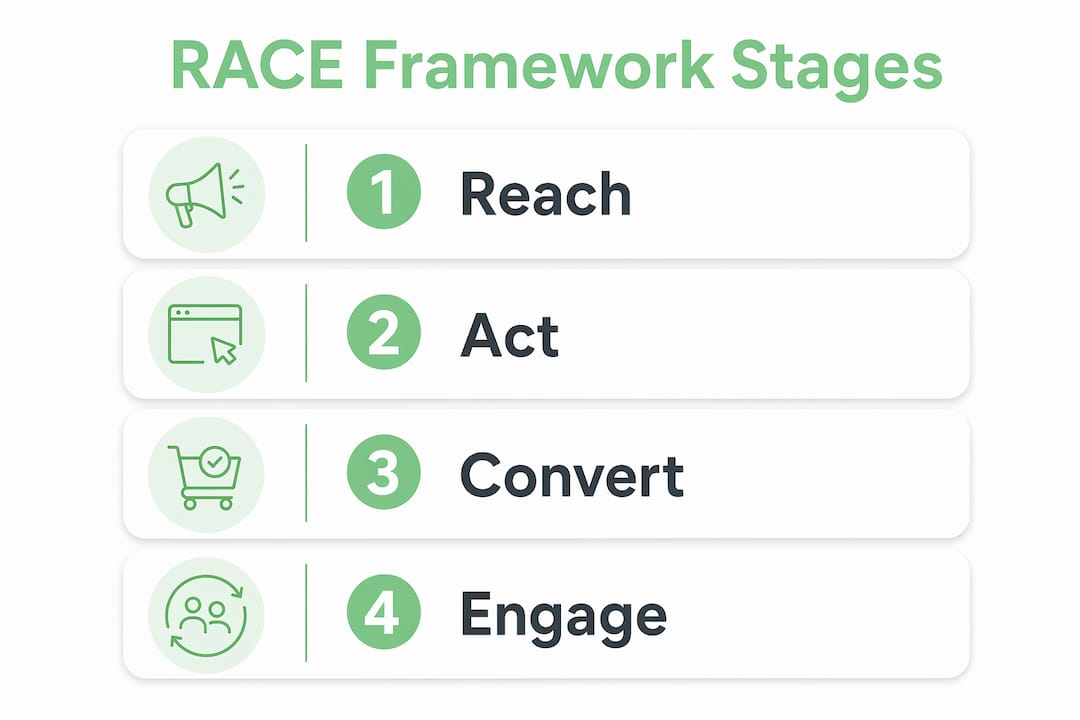
Digital marketing integrates digital media, data, and technology across every funnel stage rather than treating each channel as a standalone effort. That integration is what separates a real strategy from a list of activities.
| Funnel stage | RACE stage | Primary channels |
|---|---|---|
| Awareness | Reach | SEO, paid search, social media |
| Interest | Act | Content marketing, blog, landing pages |
| Consideration | Convert | Email, retargeting, reviews |
| Retention | Engage | Email newsletters, loyalty programs, social community |
Mapping your channels to funnel stages reveals gaps immediately. If you have strong awareness content but no email sequence to nurture leads, you will lose prospects who were interested but not yet ready to buy. Channel integration ensures that social proof on social media, for example, reinforces paid search ads and increases conversion rates. The funnel does not work when channels operate in isolation.
How should you implement and adapt your digital marketing strategy?
The recommended approach for implementation uses 90-day action cycles rather than rigid annual plans. A 90-day cycle gives you enough time to gather real data and enough flexibility to change course before a full year of budget is spent on something that is not working. Most campaigns fail when businesses skip strategy and jump directly into tactics, so the first 90 days should focus on setting up measurement before scaling spend.
A practical implementation sequence looks like this:
- Audit your current digital presence. Identify what you already have: website, social profiles, Google Business Profile, email list. Know your starting point before setting targets.
- Set your 90-day priorities. Choose two or three goals for the cycle. More than three dilutes focus and makes measurement harder.
- Assign channel ownership. Every channel needs one person responsible for it. Shared ownership means no ownership.
- Build your content calendar. Plan content at least four weeks ahead. Reactive content is fine occasionally, but planned content is what builds authority.
- Review and pivot at day 30 and day 60. Do not wait until day 90 to check results. Early data tells you whether your assumptions were right.
- Document what worked. At the end of each cycle, write down what drove results. This becomes your institutional knowledge and makes the next cycle faster.
AI tools accelerate specific tasks within this process. AI supports execution by speeding up market research, drafting content, and testing ad variations. AI does not replace the strategic decisions about which customers to target or which channels to prioritize. You retain that control.
Pro Tip: Set a recurring 60-minute monthly review meeting with whoever runs your marketing. Review three metrics: traffic, leads, and conversions. If all three are not moving in the same direction, something in the funnel is broken.
How do digital marketing strategies differ for small businesses?
Small businesses face real resource constraints that large enterprises do not. A retailer with a team of five cannot maintain a presence on six platforms and produce daily content across all of them. Spreading effort too thin produces mediocre results everywhere instead of strong results anywhere.
Want this running in your business without doing it yourself?
Book a Free Consultation →The SES Framework, which stands for Search, Email, and Social, gives small businesses a focused starting point. Concentrating on three core channels consistently outperforms trying to be everywhere at once. Each channel serves a distinct purpose: search captures demand that already exists, email builds a direct relationship you own, and social media builds brand familiarity over time.
Small Canadian businesses also have a specific advantage that large national brands cannot replicate: local trust. Key priorities for small business digital strategy include:
- Local SEO: Optimize your Google Business Profile, collect reviews, and use location-specific keywords. A plumber in Hamilton who ranks for “emergency plumber Hamilton” wins customers that a national brand cannot easily take.
- Email list ownership: Social platforms change their algorithms. Your email list belongs to you. Building it from day one protects your marketing from platform disruptions.
- Community engagement: Responding to comments, joining local Facebook groups, and partnering with neighboring businesses builds the kind of trust that paid ads cannot buy.
- Measurable ROI focus: Small businesses need every dollar to work. Track cost per lead and cost per customer from the start, not after six months of spending.
Multichannel prospecting becomes more manageable when you build it around these three core channels first, then expand only after you have proven results in each one.
Key Takeaways
A digital marketing strategy is the plan that decides which customers you pursue, which channels you use, and how you measure success before spending a single dollar on execution.
| Point | Details |
|---|---|
| Strategy before tactics | Define goals, audience, and channels before creating any content or ads. |
| Use the RACE Framework | Map your channels to Reach, Act, Convert, and Engage stages to find gaps. |
| Run 90-day cycles | Review and adapt your plan every 90 days instead of locking into annual commitments. |
| Focus on three channels | Search, Email, and Social give small businesses the best return without overextending resources. |
| Measure from day one | Set KPIs before you launch and review leading indicators monthly, not quarterly. |
The mistake I see Canadian small businesses make most often
Most small business owners I work with arrive with the same problem. They have been posting on Instagram for a year, running occasional Google ads, and sending newsletters whenever they remember. They are busy, but nothing compounds. When I ask what their strategy is, they describe their tactics.
The shift that changes everything is simple but uncomfortable: stop asking “what should I post?” and start asking “who am I trying to reach, and what do I want them to do?” That question forces clarity. It also reveals that most businesses are trying to reach everyone, which means they are reaching no one effectively.
The other pattern I see constantly is treating AI as a strategy. AI is a production tool. It writes faster, researches faster, and tests faster. But it does not know your customers, your community, or your competitive position. AI accelerates execution but requires human strategic oversight to stay effective. The businesses winning in 2026 are the ones using AI to do more of what their strategy already defined, not using AI to avoid defining a strategy in the first place.
My honest recommendation for any Canadian small business owner reading this: write a one-page strategy before your next marketing dollar is spent. Goals, audience, three channels, and three KPIs. That document will save you more money than any tool or tactic you could buy.
— Cristo
Cloudsprout helps small businesses build strategies that actually work
Building a digital marketing strategy from scratch takes time that most small business owners do not have. Cloudsprout is an Ontario-based digital agency that handles the full picture for owner-operators across Canada, from custom website development to SEO, content, social media, and CRM automation, all in-house with no outsourcing.
Every client starts with a free digital audit that maps your current online presence and identifies the highest-impact opportunities. There are no lock-in contracts and no hidden fees. You get direct access to the team doing the work, not an account manager relaying messages. If you are ready to move from scattered tactics to a plan that builds real momentum, explore Cloudsprout’s services and book your free audit today.
FAQ
What is a digital marketing strategy in simple terms?
A digital marketing strategy is a plan that defines which online channels a business will use, who it is trying to reach, and what success looks like. It typically covers a 12–24 month horizon and guides all tactical decisions.
What is the difference between a digital marketing strategy and a digital marketing plan?
A strategy defines the goals, audience, and channel priorities. A plan is the detailed schedule of actions, content, and budgets that executes the strategy. Strategy comes first; the plan follows from it.
How many channels should a small business focus on?
The SES Framework recommends focusing on three core channels: Search, Email, and Social. Concentrating on fewer channels produces stronger results than spreading effort across every available platform.
How often should a small business update its digital marketing strategy?
A 90-day review cycle is the current best practice. Short, agile planning cycles let small businesses adapt to changes in technology and consumer behavior without being locked into plans that stop working.
Does a small business need a digital marketing strategy if it already has social media?
Social media is a tactic, not a strategy. Without a strategy defining your goals and audience, social media activity produces engagement without business results. A strategy tells you what to post, why, and how to measure whether it is working.
Recommended
Less reading. More growing.
We build the systems these articles describe. Websites, AI follow-up, reviews, automation. And run them for you.
Keep reading


Small Teams: Automate Customer Onboarding in 1–4 Weeks, Keep It Human