
Website copy is the primary signal search engines use to understand what your business does, who it serves, and where to rank you. For small business owners, this means the words on your website are not decoration. They are the engine behind your organic visibility. Organic search drives over 1,000% more traffic than organic social media. That gap exists because search engines read text, not logos or photos. Understanding why website copy matters for SEO is the first step toward building a site that actually brings in customers.
Why website copy matters for SEO rankings
Search engines and AI platforms cannot interpret images or branding. Text is the only signal they can parse to determine your relevance for a given search query. A plumber in Hamilton with a beautiful website but vague copy will rank below a competitor whose page clearly states “emergency drain repair in Hamilton, Ontario.” The words make the difference.

53.3% of all website traffic comes from organic search. That number tells you where most of your potential customers start their buying process. If your copy does not match what they are searching for, they never find you.
Strong website copy works through several specific mechanisms:
- Keyword alignment: Copy that uses the same language your customers type into Google tells search engines your page answers their query.
- Structured headings: Search engines parse H1 through H6 tags as functional cues. Hierarchical headings improve crawlability and increase the chance your content gets pulled into AI-generated answers.
- Content depth: Pages with over 3,000 words generate 3x more traffic and 3.5x more backlinks than shorter pages. Depth signals authority.
- Time on page: When copy is clear and useful, visitors stay longer. Search engines treat that as a quality signal.
Here is how copy quality correlates with key SEO metrics:
| Copy quality level | Typical organic traffic impact | Backlink potential | Conversion likelihood |
|---|---|---|---|
| Vague, thin content | Low | Minimal | Poor |
| Keyword-stuffed copy | Moderate, unstable | Low | Poor |
| Clear, intent-focused copy | High | Moderate | Good |
| Structured, long-form copy | Highest | Strong | Best |
Pro Tip: Write your homepage copy as if you are answering the question “What do you do, who do you help, and why should I trust you?” in plain language. That structure aligns with both user intent and search engine logic.
How copy quality affects paid ad costs and conversions
Google’s Quality Score is a rating that determines how much you pay per click in paid search campaigns. One of its core inputs is the relevance of your landing page copy to the ad being shown. Weak or mismatched copy raises your cost per click. Strong, relevant copy lowers it.
This connection between copy and cost is direct and measurable. A business running Google Ads to a landing page full of jargon or generic claims pays more per visitor than a business whose page clearly matches the ad’s promise. The copy on your website affects your paid budget even when you are not thinking about SEO.
Beyond ad costs, copy clarity drives conversions. Design draws attention, but copy retains visitors and converts them into leads. A visitor who lands on your page and immediately understands what you offer, who you serve, and what to do next is far more likely to contact you. Leads generated through SEO-driven content close at 14.6%. That rate reflects the power of copy that matches searcher intent from the first word.
Key factors that connect copy quality to conversion:
- Clear value propositions above the fold
- Specific calls to action that match the visitor’s stage of intent
- Social proof written in plain language, not marketing speak
- Consistent messaging between your ad and your landing page
Pro Tip: Before writing any landing page, write down the exact question your ideal customer is asking. Then make sure your first paragraph answers it directly. Alignment between question and answer is what converts.
How AI search changes what your copy needs to do
AI search tools like ChatGPT and Google’s AI Overviews do not browse your website the way a human does. They extract structured text and use it to generate summaries. If your copy is vague, buried in jargon, or poorly organized, AI tools skip it. 52% of sources cited in Google AI Overviews rank in the top 10 search results. That confirms traditional SEO copy quality still drives AI visibility.
Answer-first writing and logical structure are now requirements, not preferences. Structured formatting significantly increases the chance your content gets cited in AI-generated answers. A featured snippet achieves a 42.9% click-through rate. Winning that position requires copy that answers a question directly in the first sentence of a section.
| Traditional SEO copywriting | AI-focused copywriting |
|---|---|
| Keyword density focus | Intent and question-answer structure |
| Long paragraphs acceptable | Short paragraphs, scannable format |
| Headings for navigation | Headings as query signals |
| Links for authority | Explicit, consistent terminology |
| Ranking for pages | Ranking for answers and citations |
AI search requires consistent terminology and direct, explicit content. Ambiguous language lowers your visibility in AI-powered results. If you call your service “solutions” on one page and “consulting” on another, AI tools cannot confidently summarize what you do. Pick a term and use it throughout your site.
Common mistakes small businesses make with website copy
Most small business websites underperform on search not because of technical problems, but because of copy problems. The mistakes are predictable and fixable.
Poorly written, jargon-heavy, or promotional copy confuses both users and search algorithms. A roofing company that describes itself as “a dynamic provider of exterior building envelope solutions” loses every customer who searched for “roof repair near me.” Plain language wins.
Want this running in your business without doing it yourself?
Book a Free Consultation →The five most common copy mistakes small business owners make:
- Too little content: Thin pages with fewer than 300 words give search engines almost nothing to work with.
- No clear value proposition: Visitors cannot tell within five seconds what you do or why they should choose you.
- Ignoring user questions: Copy that talks about the business instead of answering customer questions misses the point of SEO.
- Inconsistent terminology: Using different words for the same service across pages confuses search engines and AI tools.
- Writing for everyone: Copy that tries to appeal to all audiences ends up resonating with none.
Pro Tip: Read your homepage out loud. If you stumble, your visitors will too. If a sentence does not answer a real customer question, cut it or rewrite it.
Best practices for writing SEO-friendly copy that converts
Effective website copywriting for SEO is a discipline that combines business writing, UX clarity, and search intent. It is not about stuffing keywords. It is about writing what your customer is already thinking.
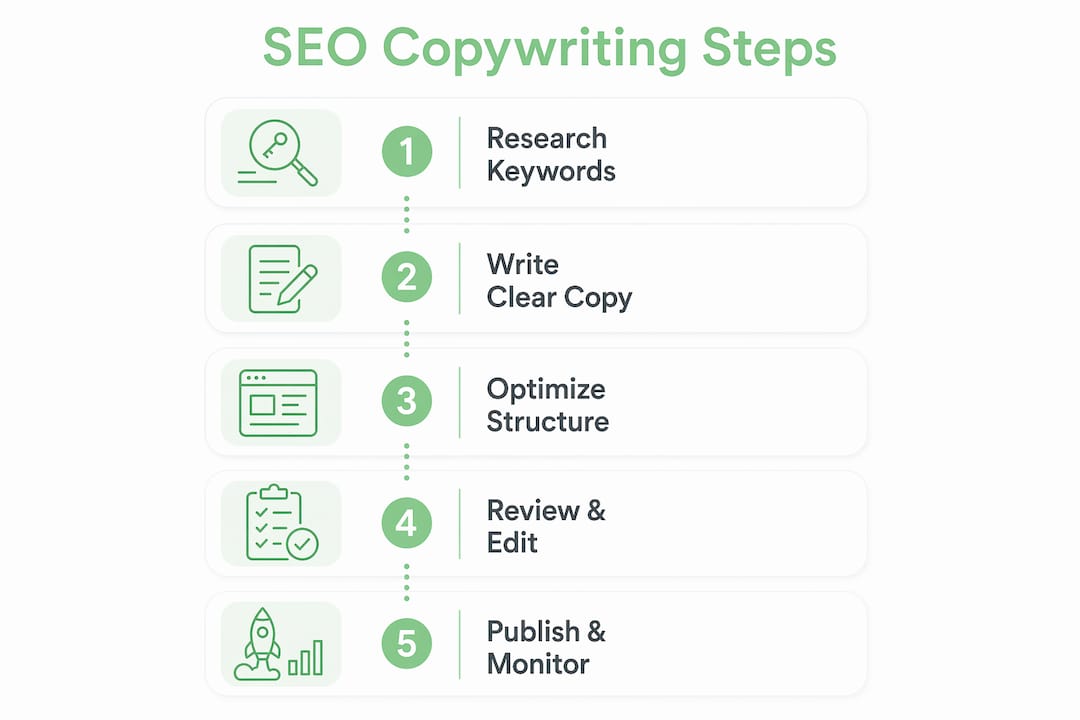
Follow these steps to build copy that ranks and converts:
- Research intent, not just keywords. Find out what question your customer is actually asking, not just what words they type. A search for “accountant Toronto” often means “I need someone to file my taxes fast.” Write to that need.
- Lead every page with a direct answer. Put your most important claim in the first sentence. Search engines and AI tools weight early content heavily.
- Use headings as questions. Structure your H2 and H3 headings as the questions your customers ask. This aligns with both featured snippet optimization and AI search behavior.
- Write short paragraphs. Three to five sentences per paragraph. White space is not wasted space. It makes copy scannable and keeps visitors reading.
- Use consistent, specific language. Name your services the same way every time. Specificity builds credibility with readers and clarity with search engines.
- Refresh copy regularly. Search intent shifts. A page that ranked well in 2024 may need updated language to stay competitive in 2026. Treat your copy as a living document.
The 2026 SEO checklist for owner-operated businesses reinforces that on-page copy quality is one of the highest-leverage activities available to small business owners. No technical fix replaces clear, intent-driven writing.
Key Takeaways
Website copy is the single most controllable factor in your SEO performance, and improving it delivers compounding returns across organic traffic, paid ad efficiency, and AI search visibility.
| Point | Details |
|---|---|
| Copy drives organic traffic | Organic search delivers over 1,000% more traffic than social media, and copy is what earns those rankings. |
| Structure matters for AI | Answer-first writing and clear headings increase citation likelihood in AI-generated search results. |
| Copy affects ad costs | Relevant landing page copy lowers your Google Ads cost per click through a higher Quality Score. |
| Consistency builds authority | Using the same terminology across all pages helps both search engines and AI tools understand your business. |
| Thin content underperforms | Pages with insufficient depth give search engines little to rank and visitors little reason to stay. |
The copy problem most small businesses do not know they have
After working with owner-operated businesses across Ontario, I have noticed the same pattern repeatedly. A business owner invests in a new website, picks a clean design, and then fills the pages with copy that sounds like a corporate brochure. “We are committed to excellence.” “Your satisfaction is our priority.” Those phrases mean nothing to a search engine and even less to a customer who found you at 9 PM looking for a specific answer.
The businesses that grow through search are the ones whose websites read like a knowledgeable friend answering a question. They name the problem. They explain the solution. They tell you exactly what to do next. That is not a writing talent. It is a discipline.
What I have seen work consistently is treating every page as a conversation starter, not a sales brochure. Write the page for one specific person with one specific problem. Then check whether a search engine could summarize your page in two sentences. If it cannot, your copy needs work.
The other thing I tell every client: do not write your copy once and forget it. Search behavior changes. The questions your customers ask in 2026 are not identical to the ones they asked in 2023. The businesses that stay visible are the ones that revisit their copy at least twice a year and update it to match how their customers actually talk. That habit alone separates the businesses that rank from the ones that wonder why they do not.
— Cristo
How Cloudsprout helps small businesses get copy and SEO right
Small business owners rarely have time to master both copywriting and SEO simultaneously. Cloudsprout’s website development services integrate SEO-focused copywriting directly into every site project. That means your pages launch with structured headings, intent-driven content, and the terminology consistency that search engines and AI tools require.
Cloudsprout works exclusively with owner-operated businesses across Ontario, handling everything in-house with no outsourcing. Every client starts with a free digital audit that identifies exactly where copy is costing you rankings. If your website is not bringing in leads, the words are usually the first place to look. Visit cloudsprout.ca to see how the team approaches copy, SEO, and site performance as one connected system.
FAQ
Why does website copy matter more than design for SEO?
Search engines cannot read images or interpret visual design. Text is the primary signal search engines and AI tools use to determine relevance and rank pages.
How long should website copy be for good SEO?
Pages with over 3,000 words generate significantly more traffic and backlinks than shorter pages, but length only helps when the content directly answers user questions and maintains quality throughout.
Does website copy affect Google Ads costs?
Yes. Google’s Quality Score factors in landing page relevance, and copy that matches your ad’s message lowers your cost per click while improving conversion rates.
How do I write copy that shows up in AI search results?
Use answer-first writing, consistent terminology, and clear headings structured as questions. 52% of AI Overview citations come from pages already ranking in the top 10, so traditional SEO copy quality remains the foundation.
What is the biggest copy mistake small businesses make?
Writing vague, jargon-heavy content that describes the business instead of answering specific customer questions. Clear, direct copy that names the problem and the solution outperforms promotional language every time.
Recommended
Less reading. More growing.
We build the systems these articles describe. Websites, AI follow-up, reviews, automation. And run them for you.
Keep reading

Small Teams: Automate Customer Onboarding in 1–4 Weeks, Keep It Human