

Technical SEO is defined as the practice of optimizing your website’s backend infrastructure so search engines can crawl, index, and rank your pages. Every other SEO effort, including content writing and link building, depends on this foundation. Without it, search engines cannot access your content, no matter how good it is. In 2026, technical SEO also determines whether AI-powered search engines like ChatGPT and Google AI Overviews will trust and cite your site. Small business owners and marketing professionals who ignore this layer are leaving organic traffic on the table.
What is technical SEO and what does it actually cover?
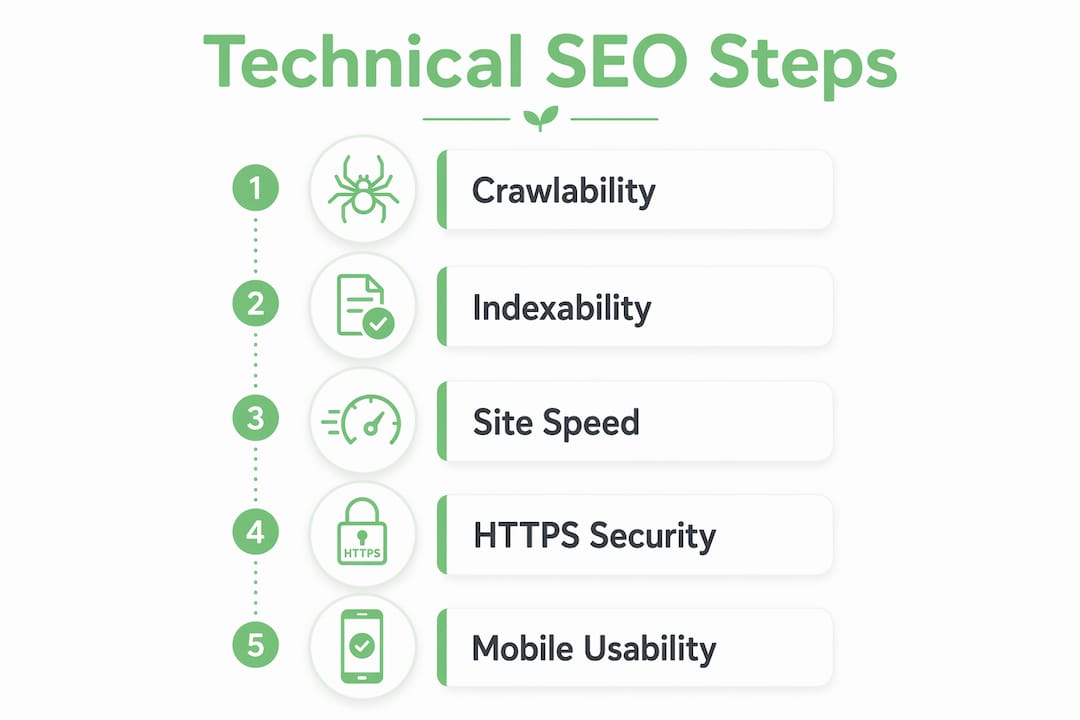
Technical SEO is the process of making your website readable and accessible to search engine bots. It covers six core pillars: crawlability, indexability, site speed, HTTPS security, mobile usability, and structured data. Each pillar addresses a different way search engines interact with your site. Miss one, and your rankings suffer regardless of your content quality or backlink count.
Crawlability
Crawlability means search engine bots can find and follow your pages. Your robots.txt file controls which pages bots are allowed to visit. A misconfigured robots.txt can accidentally block your entire site from Google. Internal linking also matters here. Pages with no internal links pointing to them are often missed entirely by crawlers.
Indexability
Indexability means your pages can be stored in a search engine’s index and returned in search results. Meta tags like noindex tell Google to skip a page. Canonical tags tell Google which version of a duplicate page to prioritize. Without correct canonicalization, you split your ranking power across multiple URLs and weaken every page.
Site speed and Core Web Vitals
Google’s Core Web Vitals measure three things: Largest Contentful Paint (LCP) for loading speed, Interaction to Next Paint (INP) for responsiveness, and Cumulative Layout Shift (CLS) for visual stability. These signals come from real Chrome user data, which means they reflect actual visitor experience. A slow site does not just frustrate users. It signals to Google that your page delivers a poor experience, and rankings drop accordingly.

HTTPS, mobile usability, and structured data
HTTPS is mandatory for any site that wants to rank. Sites without it face browser warnings and crawling limitations caused by mixed content. Google indexes the mobile version of your site first, so a poor mobile experience directly causes indexing and ranking penalties. Structured data, using Schema.org markup, helps search engines understand what your content means, not just what it says.
Pro Tip: Run your site through Google Search Console’s Coverage report before anything else. It shows exactly which pages are indexed, which are blocked, and why, giving you a prioritized list of fixes.
How does technical SEO differ from on-page and off-page SEO?
The three branches of SEO address completely different problems. Technical SEO handles your site’s infrastructure. On-page SEO focuses on content elements like keywords, headings, and meta descriptions. Off-page SEO covers external signals like backlinks and brand mentions.
| SEO type | Focus area | Example tasks |
|---|---|---|
| Technical SEO | Site infrastructure and backend | Fix crawl errors, improve page speed, add Schema markup |
| On-page SEO | Content and page elements | Optimize title tags, write keyword-rich copy, add alt text |
| Off-page SEO | External signals and authority | Build backlinks, earn brand mentions, manage reviews |
Technical SEO acts as the foundation that makes the other two work. Imagine you publish a perfectly written blog post with strong keywords and earn backlinks from reputable sites. If your page is accidentally blocked by robots.txt or loads in six seconds, none of that effort produces rankings. Without a solid technical foundation, content and backlinks cannot achieve their full ranking potential.
A real example: a local plumbing company in Ontario spent months building content and earning local citations. Their site had a noindex tag left on from development. Google never ranked a single page. One technical fix unlocked months of stalled work.
Pro Tip: Always check for leftover development settings like noindex tags or password protection before launching a new site. These are the most common and most damaging technical mistakes small businesses make.
Why is technical SEO more important than ever in 2026?
The search environment in 2026 is fundamentally different from five years ago. AI-powered search engines now answer questions directly, pulling from sites they trust. Technical barriers like slow loading or blocked pages prevent both traditional and AI search engines from accessing your content. Good content alone no longer guarantees visibility.
“Technical SEO is not just about helping Google rank traditional search results. It is about enabling AI-powered search engines to trust and cite your site using structured data and speed signals. Without this foundation, content optimization alone is ineffective.”
Google’s Core Web Vitals are collected from real users, not lab simulations. That means you cannot fake good performance. A site that loads fast for the developer but slowly for a visitor on a mobile network in rural Ontario will score poorly. Those scores directly affect where you appear in search results.
AI search engines like Google AI Overviews and ChatGPT require structured data and high site speed to consider citing a business. If your site lacks FAQ schema or HowTo markup, AI systems are less likely to pull your content into generated answers. For small businesses competing against larger brands, this is a significant disadvantage. You can review LCP, INP, and CLS benchmarks to understand what scores actually qualify as passing in 2026.
The businesses that invest in technical SEO now are building a compounding advantage. Every month their site loads faster and signals cleaner data, the gap between them and slower competitors widens.
How to implement technical SEO techniques on your website
Getting technical SEO right does not require a developer on staff. It does require a clear process and consistent follow-through.
-
Start with a technical SEO audit. A site crawl detects crawlability, indexability, status codes, and metadata issues across every URL. Tools like Screaming Frog or Google Search Console provide this data. Run the audit before making any other changes. You need to know what is broken before you can fix it.
Want this running in your business without doing it yourself?
Book a Free Consultation → -
Fix crawlability issues first. Review your
robots.txtfile and confirm it is not blocking important pages. Submit an XML sitemap to Google Search Console so bots know exactly which pages to crawl. Improve internal linking so every important page has at least one link pointing to it from another page on your site. -
Address Core Web Vitals. Compress images and serve them in next-generation formats like WebP. Eliminate render-blocking JavaScript. Use a content delivery network (CDN) to serve files from servers closer to your visitors. Each of these changes directly improves LCP and INP scores.
-
Confirm HTTPS and mobile usability. Check that every page on your site loads over HTTPS with no mixed content warnings. Test your site using Google’s Mobile-Friendly Test. Fix any tap targets that are too small, text that is too small to read, or content wider than the screen.
-
Add structured data markup. Implement Schema.org FAQ schema on pages that answer common questions. Add HowTo schema to step-by-step guides. Use Organization schema on your homepage to confirm your business name, address, and contact details to search engines. This markup directly improves your chances of appearing in rich results and AI-generated answers.
-
Monitor and maintain. Technical SEO is not a one-time task. Set a monthly reminder to check Google Search Console for new crawl errors, coverage issues, or Core Web Vitals regressions. Websites change constantly, and new technical problems appear with every update.
Pro Tip: Prioritize fixes by impact. Crawl errors on your homepage or top service pages hurt far more than errors on archived blog posts. Fix high-traffic pages first.
For a broader view of what technical SEO fits into, the owner-operated business SEO checklist covers the full picture for Canadian small businesses in 2026. Technical SEO also works best when paired with strong copy. The relationship between website copy and SEO explains why both layers must work together.
Key Takeaways
Technical SEO is the non-negotiable foundation that determines whether search engines and AI systems can find, trust, and rank your website, regardless of content quality or backlinks.
| Point | Details |
|---|---|
| Technical SEO is foundational | Without crawlability and indexability, content and backlinks produce no rankings. |
| Core Web Vitals are ranking signals | LCP, INP, and CLS scores from real users directly affect your position in Google results. |
| AI search requires clean signals | Structured data and fast load times determine whether AI engines cite your business. |
| HTTPS and mobile are non-negotiable | Missing HTTPS or poor mobile usability causes direct indexing and ranking penalties. |
| Audits come first | A site crawl reveals the specific technical problems to fix before any other SEO work begins. |
Why small businesses underestimate technical SEO
Most small business owners I work with focus on content first. They write blog posts, update their service pages, and ask about keywords. Technical SEO is almost always an afterthought, and that order of operations costs them months of ranking progress.
The uncomfortable truth is that technical SEO problems are invisible until they cause damage. A noindex tag does not throw an error. A slow page does not announce itself. You only notice when rankings stall or traffic drops, and by then the problem has been compounding for weeks or months.
What I have found works is treating a technical audit like a building inspection before renovation. You would not start painting walls before checking the foundation. The same logic applies here. Fix the crawl errors, confirm the HTTPS setup, and get Core Web Vitals into passing range before investing heavily in content or link building.
The businesses that see the fastest organic growth are not the ones with the most content. They are the ones whose sites load fast, signal clean data, and give search engines nothing to complain about. Technical SEO is where that advantage is built.
— Cristo
Cloudsprout builds websites that search engines actually rank
Small businesses in Ontario deserve websites that do more than look good. Cloudsprout builds SEO-ready websites with Core Web Vitals performance, HTTPS security, Schema.org structured data, and clean crawl architecture built in from the start. Every site we deliver passes a full technical SEO audit before launch.
If your current site has crawl errors, slow load times, or missing structured data, Cloudsprout’s team handles the diagnosis and the fixes in-house with no outsourcing. Explore our SEO services or book a free digital audit to see exactly where your site stands and what it would take to rank.
FAQ
What is technical SEO in simple terms?
Technical SEO is the process of configuring your website so search engines can find, read, and rank your pages. It covers site speed, security, mobile usability, and structured data.
How does technical SEO affect my Google rankings?
Technical SEO directly affects rankings by controlling whether Google can crawl and index your pages. A site with technical errors may never rank, even with excellent content and backlinks.
What are Core Web Vitals and why do they matter?
Core Web Vitals are three Google ranking signals: LCP (loading speed), INP (interactivity), and CLS (visual stability). These metrics come from real user data and directly influence where your site appears in search results.
Does technical SEO matter for AI search engines like ChatGPT?
Yes. AI search engines require structured data and fast load times to trust and cite a website. Without Schema.org markup and strong performance, AI systems are less likely to include your content in generated answers.
How often should I run a technical SEO audit?
Run a full technical audit at least once per quarter, and check Google Search Console monthly for new crawl errors or Core Web Vitals regressions. Websites change constantly, and new technical issues appear with every update or content addition.
Recommended
Less reading. More growing.
We build the systems these articles describe. Websites, AI follow-up, reviews, automation. And run them for you.
Keep reading


One Page Voice Chart: 8 Brand Voice Examples Small Businesses Can Use
