
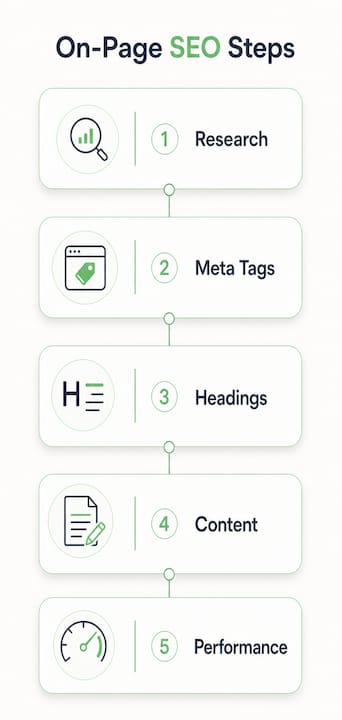
On-page SEO is the practice of optimizing every element on a webpage that you directly control to improve its visibility in search engine results. This includes your content, HTML tags, heading structure, internal links, and page performance factors. Unlike off-page SEO, which relies on external signals like backlinks, on-page SEO puts the ranking power in your hands. In 2026, that power extends beyond Google. AI-powered answer engines like ChatGPT and Perplexity now read and cite your pages too, making on-page optimization more critical than ever for small businesses and marketing professionals.
What does on-page SEO include?
On-page SEO covers 19 core factors including meta tags, heading hierarchy, schema markup, and AI-optimized formatting. Each factor signals relevance to both search engines and AI systems. The goal is to make every page as clear, trustworthy, and useful as possible for both humans and machines.
On-page SEO is distinct from two related disciplines. Off-page SEO handles external signals like backlinks and brand mentions. Technical SEO covers your site’s source code, sitemap, and security. On-page SEO sits in the middle, focused entirely on the content and HTML elements you publish. Keeping these three areas separate prevents wasted effort and helps you prioritize the right fixes.

Page titles and meta descriptions
Your page title is the single most visible on-page element in search results. It tells Google and AI engines what your page is about before they read a single word of content. Write titles between 50–60 characters, lead with your primary keyword, and make them specific enough to earn a click.
Meta descriptions do not directly affect rankings, but they drive click-through rates. A well-written meta description acts as a mini ad for your page. Keep it under 160 characters and include a clear benefit or call to action.
Heading tags and semantic structure
Heading tags (H1 through H6) create a content hierarchy that search engines use to understand your page’s structure. Your H1 should appear once and match the page’s primary topic. H2s and H3s break the content into logical sections. This structure is not just for crawlers. Readers scan headings to decide whether to stay on your page.
Body content, internal links, and URL structure
Content quality is the foundation of on-page SEO. Write for your reader first, then refine for search engines. Cover your topic thoroughly, answer the questions your audience is actually asking, and use natural language that reflects how people search.
Internal linking improves crawlability, distributes ranking authority across your site, and signals topical relevance. Link related pages using descriptive anchor text, not generic phrases like “click here.” Clean, keyword-rich URLs also help. A URL like /on-page-seo-guide outperforms /page?id=4821 every time.
Image optimization, Core Web Vitals, and schema markup
Every image on your page needs descriptive alt text. Alt text tells search engines what the image shows and improves accessibility for screen readers. Keep alt text concise and accurate, not keyword-stuffed.
Page speed, mobile usability, and Core Web Vitals are direct ranking signals. A slow page loses both rankings and visitors. Schema markup and structured data send clearer signals to search engines and unlock rich snippets in results, which improve click-through rates significantly.
Pro Tip: Use Google’s PageSpeed Insights to identify your three biggest Core Web Vitals issues before touching anything else. Speed fixes often deliver faster ranking gains than content changes.
How does on-page SEO affect search rankings and AI visibility?
On-page SEO is the primary signal search engines use to determine page relevance. Google reads your headings, content, and HTML structure to decide whether your page answers a given query. AI engines like ChatGPT and Perplexity do the same, but they also evaluate content clarity and trustworthiness before citing a source.
On-page SEO now targets AI platforms like ChatGPT and Perplexity, which assess content clarity and trustworthiness alongside traditional ranking factors. This shift changes what “good” content looks like. Keyword density matters far less than it did five years ago. Clear, direct answers matter far more.
Answer-first writing significantly improves your chances of ranking in featured snippets and AI answer boxes. State your key answer in the first sentence of each section. Then expand with evidence, examples, and context. This structure works for both Google’s featured snippets and AI-generated responses.
Formatting plays a bigger role than most small business owners realize. Search engines may skip deep content if sections exceed 300 words without clear structural breaks. Short paragraphs, bullet points, and numbered lists make your content easier for AI systems to parse and extract. The pages that get cited in AI answers are almost always the ones with the clearest structure.
| Signal type | Traditional Google ranking | AI engine citation |
|---|---|---|
| Keyword placement | High importance | Moderate importance |
| Answer-first structure | Moderate importance | High importance |
| Heading hierarchy | High importance | High importance |
| Content trustworthiness | Moderate importance | High importance |
| Schema markup | Moderate importance | High importance |
| Page speed | High importance | Low direct impact |
Practical on-page SEO techniques for small businesses
Improving your on-page SEO does not require a developer or a large budget. Most of the highest-impact changes are editorial, not technical. Here is a practical sequence to follow.
-
Audit your existing pages. Check your SEO checklist for 2026 and identify pages with missing title tags, duplicate meta descriptions, or thin content. Fix the worst offenders first.
-
Write answer-first content. Open every section with a direct answer to the question the heading poses. Readers and AI engines both reward this structure. Do not bury your main point in paragraph three.
Want this running in your business without doing it yourself?
Book a Free Consultation → -
Build a logical heading hierarchy. Use one H1 per page. Use H2s for major sections and H3s for subsections. Never skip heading levels. This structure helps Google and AI engines map your content accurately.
-
Add internal links with descriptive anchor text. Every new page you publish should link to at least two existing pages and receive at least one link from an existing page. This distributes authority and helps search engines discover new content faster.
-
Optimize every image. Write alt text that describes the image in plain language. Compress images before uploading to reduce load time. Use modern formats like WebP where your platform supports them.
-
Implement schema markup. Add FAQ schema to pages with question-and-answer content. Add LocalBusiness schema if you serve a specific geographic area. These additions unlock rich results and send clearer signals to AI systems.
-
Check mobile usability. Open your key pages on a phone. If text is too small to read or buttons are too close together, fix it. Mobile usability is a confirmed ranking factor, and most local searches happen on mobile devices.
Pro Tip: Website copy quality directly affects how AI engines evaluate your page’s trustworthiness. Write in plain, direct sentences. Avoid vague claims and unsupported superlatives.
Common on-page SEO mistakes to avoid
Small business owners and marketers repeat the same on-page SEO errors. Knowing them in advance saves months of wasted effort.
- Keyword stuffing instead of clarity. Repeating a keyword 20 times does not improve rankings. Google and AI engines now penalize unnatural repetition. Write for your reader, and use keyword variants naturally.
- Ignoring heading structure. Pages with no H2s or random heading levels are harder for search engines to interpret. A flat wall of text signals low-quality content, even if the writing is good.
- Treating on-page SEO as a one-time task. Search standards evolve. A page optimized in 2023 may underperform in 2026 because AI engine requirements have changed. Review your top pages at least twice a year.
- Confusing on-page SEO with technical SEO. Fixing broken links and improving site speed are technical SEO tasks, not on-page SEO. Mixing them up leads to misallocated effort and missed opportunities.
- Ignoring AI engines as an audience. If your content is not structured for AI extraction, you are invisible to a growing share of search traffic. Clear formatting and answer-first writing are no longer optional.
- Neglecting page speed and mobile usability. These are not purely technical issues. Slow pages and poor mobile layouts directly reduce the time visitors spend on your site, which hurts engagement signals that feed back into rankings.
Key Takeaways
On-page SEO is the most controllable ranking factor you have, and in 2026 it must serve both traditional search engines and AI-powered answer engines simultaneously.
| Point | Details |
|---|---|
| Definition is specific | On-page SEO covers content, HTML tags, heading structure, internal links, and performance factors you control directly. |
| AI engines are now part of the audience | ChatGPT and Perplexity evaluate content clarity and trustworthiness, not just keyword placement. |
| Answer-first structure wins | State your key answer at the start of each section to rank in featured snippets and AI answer boxes. |
| Formatting affects extraction | Sections over 300 words without structural breaks risk being skipped by AI systems. |
| On-page SEO requires regular updates | Search and AI standards evolve. Review your top pages at least twice a year to stay competitive. |
Why on-page SEO is the lever most small businesses underuse
I have worked with dozens of small business owners who spent months chasing backlinks while their own pages were nearly unreadable to search engines. The headings were missing. The content buried the answer on page two of a wall of text. The images had no alt text. These are not obscure technical problems. They are basic on-page issues that any business can fix without an agency.
The shift toward AI-powered search has made this even more urgent. When ChatGPT or Perplexity answers a question, it pulls from pages with clear structure and direct answers. A plumber in Hamilton with a well-structured service page can get cited in an AI answer ahead of a national brand with a cluttered, keyword-stuffed page. That is a real competitive advantage for small businesses willing to do the work.
What I find most encouraging is that on-page SEO rewards effort over budget. You do not need to outspend anyone. You need to out-clarify them. Write better answers. Structure your pages more logically. Add schema markup. These are skills and habits, not expenses. The businesses I have seen grow fastest from SEO are the ones that treat their website as a living document, not a one-time project. They update pages when search intent shifts. They add new sections when questions emerge. They check their formatting on mobile before publishing.
The digital agencies and web design firms that get results in 2026 are the ones building this discipline into every page from day one, not retrofitting it later.
— Cristo
How Cloudsprout helps small businesses get on-page SEO right
Getting on-page SEO right from the start saves months of rework later. Cloudsprout builds custom websites for small and mid-sized businesses across Ontario and Canada with on-page SEO built into every page, not added as an afterthought. That means proper heading structure, schema markup, optimized meta tags, internal linking, and mobile-ready formatting from day one.
Every Cloudsprout client starts with a full digital audit, so you know exactly where your site stands before any work begins. There are no lock-in contracts and no outsourcing. If you want a website that ranks in Google and gets cited by AI engines, explore Cloudsprout’s SEO services to see what a properly optimized site looks like in practice.
FAQ
What is on-page SEO in simple terms?
On-page SEO is the process of optimizing the content and HTML elements on a webpage to improve its ranking in search results. It includes page titles, headings, content quality, internal links, image alt text, and page speed.
Does on-page SEO affect Google rankings directly?
On-page SEO is a primary ranking signal for Google. Factors like heading structure, content relevance, Core Web Vitals, and schema markup all directly influence where your page appears in search results.
How is on-page SEO different from technical SEO?
On-page SEO focuses on the content and HTML elements visible on a page. Technical SEO covers backend factors like site speed, crawlability, sitemaps, and security. Both matter, but they require different fixes.
How often should I update on-page SEO?
Review your top-performing pages at least twice a year. Search engine standards and AI engine requirements evolve, so content that ranked well in 2023 may need structural updates to stay competitive in 2026.
Does on-page SEO help with AI search engines like ChatGPT?
Answer-first writing and clear heading structure improve your chances of being cited in AI-generated answers. AI engines like ChatGPT and Perplexity evaluate content clarity and trustworthiness, making structured formatting a critical on-page SEO factor.
Recommended
Less reading. More growing.
We build the systems these articles describe. Websites, AI follow-up, reviews, automation. And run them for you.
Keep reading
One Page Voice Chart: 8 Brand Voice Examples Small Businesses Can Use