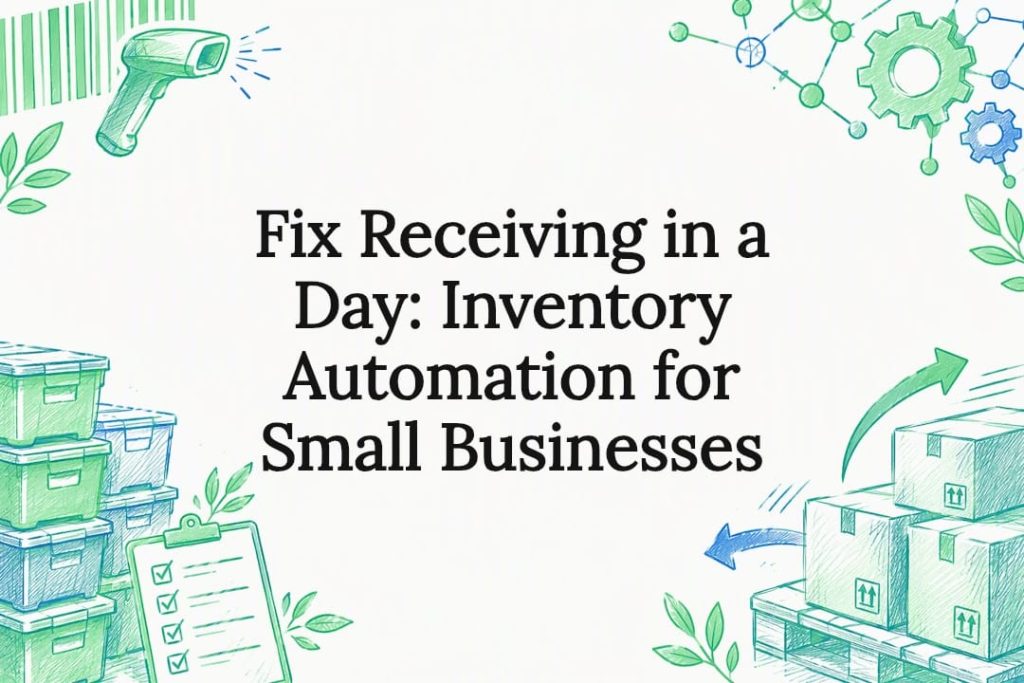
Yes, inventory automation is worth it once you cross a few basic thresholds, and it beats spreadsheets on every measure that matters: time, stockouts, and margin. Inventory typically eats up 20 to 30 percent of a small business’s assets, and one Canadian manufacturer cut replenishment admin time and carrying costs after moving to an integrated system. Start today by running the maturity checklist below and testing a one-location pilot before you buy anything.
TL;DR:
- Inventory automation is cost-effective once a business manages over 100 SKUs or experiences more than 2-3 percent monthly stock adjustments, errors, or manual update hours.
- Real-time stock updates, automated reorder points, mobile barcode scanning, and integration with POS and accounting systems are essential features for small business inventory systems.
- The optimal startup approach begins with a spreadsheet and mobile scanner, progressing to cloud platforms and full ERP systems as inventory complexity and sales channels expand.
- Starting with receiving scans and a full physical count can prevent common errors and build trust before scaling up to more advanced automation solutions.
- CloudSprout offers a free audit, tailored recommendations, and transparent monthly pricing to help small businesses implement and scale inventory automation effectively.
Table of Contents
- What Is Inventory Automation and Why Does It Matter for Small Business?
- What Features Should Small Businesses Look for in Automated Inventory Systems?
- How Do You Know When It’s Time to Automate?
- How to Implement Inventory Automation Step by Step
- What’s the Cheapest Way to Start, and How Do You Scale Up?
- How CloudSprout Helps Small Businesses Automate Inventory
- Prioritization Advice for Owner-Operators
- Get a Free Inventory Audit Before You Buy Anything
- Sources
- FAQ
What Is Inventory Automation and Why Does It Matter for Small Business?
Inventory automation means using software, barcode scanners, or connected point-of-sale systems to track stock levels, trigger reorders, and update counts without someone manually typing numbers into a spreadsheet. For a small business, that usually replaces three tasks: counting shelves by hand, guessing when to reorder, and reconciling sales channels at the end of the month.
The financial case is not abstract. Inventory represents a large chunk of what a small business owns, and mismanaging it is expensive.
Inventory accounts for 20 to 30 percent of a small business’s total assets, and poor inventory management can cost a meaningful percentage of annual revenue — Workday
That’s not a rounding error for a shop running on thin margins. A retailer doing $500,000 in annual revenue could be losing $40,000 to $60,000 a year to overstock, stockouts, shrinkage, and the labor spent fixing avoidable mistakes.
The NRC case study on ERP adoption backs this up from the operations side: a Canadian manufacturer that integrated its inventory and manufacturing systems saw reductions in replenishment administration time and carrying costs, because staff stopped chasing numbers across disconnected tools.
Three concrete benefits show up almost immediately once a small business automates:
Fewer stockouts. When your system knows real stock levels in real time, it can flag low inventory before a customer asks for something you don’t have. Stockouts drive customers to walk out and buy from a competitor instead, often permanently.
Lower carrying costs. You stop tying up cash in slow-moving stock because reorder points are based on actual sales velocity, not gut feel.
Faster fulfillment. Barcode scanning at receiving and shipping cuts the manual data entry that causes shipping delays and mispicks.

What Features Should Small Businesses Look for in Automated Inventory Systems?
Not every inventory tool is built the same way, and small businesses waste money buying enterprise features they’ll never touch. Before comparing software or vendor proposals, map your receiving-to-shipping workflow and the exact integrations you need. Skipping that step is how businesses end up paying for feature bloat they never use.
Here’s what actually matters for a small operation:
- Real-time stock updates across every location. If you sell from a storefront and online, the system needs to show the same number in both places the moment something sells.
- Automated reorder points and purchase order generation. The software should flag low stock and draft a purchase order automatically, not just send you an alert to act on manually.
- Mobile barcode or camera scanning. Your phone or a handheld scanner should be able to receive, move, and count stock without anyone typing SKU numbers by hand.
- Blind cycle count support. Staff should be able to count a section without seeing the system’s expected quantity first, which keeps counts honest.
- POS, e-commerce, and accounting integrations. Your inventory system needs to talk to your point-of-sale, your online store, and your bookkeeping software, including how it handles GST/HST on sales and returns.
- API access or scheduled sync. Ask how often data syncs between systems. Real-time is ideal; anything slower than hourly can create phantom stock.
- Reporting dashboards. You need a clear view of turnover rate, dead stock, and shrinkage without exporting three spreadsheets and merging them by hand.
- Vendor support that matches your team. A one-person shop needs different support than a 40-employee operation with a dedicated inventory clerk. Ask what support actually looks like before you sign anything.
Pro Tip: Ask any vendor to show you exactly how their system handles a return that came in through a different channel than the original sale. This single question exposes more integration gaps than any feature list.
How Do You Know When It’s Time to Automate?
Automation isn’t right for every business on day one, and buying a system too early just adds a subscription fee to a problem spreadsheets could still handle. The right moment usually announces itself through a handful of measurable signals.
Run through this checklist:
- SKU count. Once you’re managing more than roughly 100 to 150 active SKUs across all channels, manual tracking starts producing errors that cost real money.
- Error and adjustment rates. If your monthly stock adjustments (the gap between what your records say and what you actually count) run above 2 to 3 percent of inventory value, that’s a signal, not a coincidence.
- Hours spent on manual updates. Track how many hours a week someone spends updating spreadsheets, reconciling counts, or hunting for missing stock. Ten or more hours a week is a strong case for automating.
- Multi-channel complexity. Selling in a physical store plus one or two online marketplaces multiplies the chance of overselling something that’s already gone.
If two or more of these apply, a pilot is worth the time investment. If none apply yet, a spreadsheet paired with a mobile scanner may still serve you fine, and that’s discussed in the next section.
The risk of waiting too long isn’t dramatic, it’s slow. Margin erodes a little every month from dead stock nobody notices and reorders that arrive late because nobody was watching the numbers closely enough. Small, invisible losses compound faster than most owners expect.
How to Implement Inventory Automation Step by Step
Rolling out automation without a plan is how small businesses end up with a system nobody trusts by month three. Follow a sequence that protects your daily operations while you make the switch.
- Clean up your data first. Standardize SKU names, fix duplicate product entries, and settle on consistent units of measure (each, case, box) before any of it touches new software. Migrating messy data into a new system just automates the mess.
- Do a full physical count before go-live. You need a trustworthy starting number. Guessing here undermines every report the new system produces for months afterward.
- Scope a pilot to one location or one product category. Test the system on a manageable slice of your business, not everything at once.
- Define acceptance criteria before you start. Decide in advance what “working” looks like: accuracy above a target percentage, reorder alerts firing correctly, no double counts during the pilot window.
- Set up cycle counting using ABC analysis. Classify products into A (high value or high turnover), B (moderate), and C (low priority) groups. Count A-items weekly, B-items monthly, and C-items quarterly. This is how small teams reach high accuracy without shutting down for a full annual count.
- Use blind counts, not confirmed counts. Staff should count without seeing the system’s expected number first. Blind counts remove the bias that causes people to just confirm whatever the screen already says.
- Connect your scanner at every movement point. Receiving, transfers, and shipping should all involve a scan, not a typed entry. This single habit eliminates most transcription errors.
- Map every integration before go-live. Confirm how the system syncs with your POS, your online store, and your accounting software, including how GST/HST is calculated on sales, returns, and inter-provincial shipments, since rates and rules vary by province.
- Train staff and track three KPIs for 90 days. Watch inventory accuracy, order fulfillment time, and the number of manual adjustments. If accuracy isn’t improving by day 60, something in the setup needs fixing before you scale further.
A few pitfalls show up again and again. Businesses skip the physical count and wonder why nothing matches. Others train staff once and never again, so bad habits creep back in within weeks. And some try to automate everything in one weekend instead of piloting first, which means any mistake affects the whole business instead of one aisle.
Want this running in your business without doing it yourself?
Book a Free Consultation →Pro Tip: Run your pilot during a slower sales week, not your busiest one. You want room to catch mistakes, not a crisis on top of a system nobody has learned yet.
If you want a more detailed, week-by-week rollout built specifically for retail, the 90-day retail inventory plan walks through the same sequence with more granular milestones.

What’s the Cheapest Way to Start, and How Do You Scale Up?
You don’t need enterprise software to get most of the benefit. Inventory automation scales in tiers, and most small businesses should move up only when their current tier is genuinely holding them back, not because a vendor made a system sound impressive.
- Tier 1: Spreadsheet plus mobile scanner. A shared spreadsheet combined with a basic barcode scanner app on a phone can carry a business with a small, single-location catalog surprisingly far. Treat automation as a tiered investment: smaller catalogs can hit strong accuracy this way without paying for anything more.
- Tier 2: Point-of-sale with built-in inventory. Once you’re running consistent daily sales through one register or online store, a POS system with native inventory tracking removes the need to manually update a spreadsheet after every sale.
- Tier 3: Cloud inventory platforms. These handle multiple locations, automated reorder points, and basic reporting dashboards. This tier fits businesses selling across two or three channels with a few hundred SKUs.
- Tier 4: Integrated inventory or warehouse management systems, or full ERP. This is where manufacturing, multi-warehouse logistics, and complex supply chains need scheduled count tasks, marketplace sync, and deeper financial integration, the kind of setup the NRC case study describes.
Before jumping a tier, test whether your current tools are actually the bottleneck. If your spreadsheet is failing because nobody updates it consistently, that’s a training problem, not a software problem. If it’s failing because you have 300 SKUs across four sales channels, that’s a genuine signal to move up.
Each upgrade should also unlock a specific capability you’re currently missing: real-time multi-location visibility, automated purchase orders, or API-based sync with your accounting software. If the new tier doesn’t solve a problem you can name, you’re probably not ready for it yet, or you don’t need it at all.
How CloudSprout Helps Small Businesses Automate Inventory
Cloudsprout builds the automation layer that connects your inventory data to the rest of your business, including CRM and ERP automation, workflow automation, and the digital audit that shows exactly where manual work is costing you time. Every engagement starts with a free audit and trial, so you see the gaps before committing to anything.
A typical rollout follows the same sequence covered above: audit your current process, pilot the fix on one location or channel, roll it out fully, then measure results against accuracy, fulfillment time, and hours saved. Cloudsprout handles the technical build in-house, so the same team that audits your workflow is the team wiring up the integrations.
For readers who want a deeper, retail-specific rollout plan, the 90-day retail inventory plan breaks the same process into weekly milestones with KPIs attached to each phase.
Prioritization Advice for Owner-Operators
If you only fix one thing this quarter, scan at receiving. Every unit that enters your business through a scanner instead of a keyboard is one less chance for a transcription error to snowball into a stockout three weeks later. It’s the single cheapest change that protects both your time and your margin, and it takes about a day to train a new hire on.
Picture this for a video: side-by-side footage of someone typing a SKU number into a spreadsheet versus scanning a box in two seconds. That visual sells the point faster than any paragraph could.
— Cristo
Get a Free Inventory Audit Before You Buy Anything
Cloudsprout is the alternative to guessing which inventory tool to buy: instead of researching software for weeks, you get a free digital audit that maps your exact workflow gaps first, then a straight recommendation on whether you need a scanner app or a full integrated system.
Every engagement runs on transparent, month-to-month pricing with no lock-in contract, starting at the Sprout plan for $300 per month, with setup handled by the same in-house team doing the work, not an outsourced contractor. Cloudsprout also builds the CRM and workflow automation that connects your inventory system to your point-of-sale, your books, and your online store, so the numbers actually match across every channel. Book your free audit through the services page and find out exactly where your current process is leaking time and money.
Sources
Key sources: Workday’s inventory research, the NRC ERP case study, and Retail Council of Canada’s loss prevention research.
- How Inventory Management Software Drives Small Business Growth — Workday
- Building a digital backbone with ERP: case study — NRC Publications
- Stock-outs cause walkouts — Harvard Business Review
FAQ
What Is the Best Inventory Software for Small Businesses?
There isn’t one universal best option. The right choice depends on your SKU count, sales channels, and budget: a small single-location shop may only need a POS with built-in inventory, while a multichannel seller needs a cloud platform with automated reorder points and API sync.
What Is the 80/20 Rule in Inventory?
The ABC analysis holds that roughly 20 percent of your products (your A-items) typically drive most of your sales value. Small businesses use this to count high-value items weekly and low-priority items only monthly or quarterly, which keeps cycle counting manageable without full shutdowns.
How Do Small Businesses Keep Track of Inventory?
Most small businesses start with a spreadsheet and a mobile barcode scanner, then move to a point-of-sale system with built-in inventory tracking as sales volume grows. The businesses with the highest accuracy scan every item at receiving and use blind cycle counts instead of relying on memory or year-end counts alone.
What Is the Best Inventory Scanner System for a Small Business?
A basic setup pairs a smartphone barcode scanning app with cloud inventory software that updates stock in real time as items are scanned. For businesses ready to formalize the process, Cloudsprout can audit your current receiving workflow and recommend whether a phone-based scanner or dedicated hardware fits your volume better.
How Much Does Inventory Automation Cost for a Small Business?
Costs range widely depending on scope, from a free spreadsheet-and-scanner setup to a few hundred dollars a month for a cloud platform. Cloudsprout’s implementation support starts with a free audit, and ongoing service plans run from $300 per month on the Sprout plan, with exact scope and setup fees confirmed after that audit.
Recommended
Less reading. More growing.
We build the systems these articles describe. Websites, AI follow-up, reviews, automation. And run them for you.
Keep reading