Choosing a digital agency comes down to four moves: define your top one or two business outcomes before you take a single sales call, shortlist candidates against five weighted criteria, run each finalist through a structured set of questions, and commit to a 60 to 90 day trial before signing anything longer. Skip the audit checklist and case-study requests, and you’ll end up choosing based on whoever gave the slickest pitch deck.
TL;DR:
- Most businesses fail to define clear outcomes and KPIs before engaging an agency, risking mismatched services like influencer campaigns instead of local search improvements.
- Building a weighted scoring grid across strategy, experience, execution, reporting, pricing, team continuity, and compliance helps objectively compare agency proposals beyond pitch charisma.
- Asking specific questions about team staffing, data ownership, privacy policies, and onboarding processes ensures alignment and minimizes hidden risks before signing a contract.
- A structured RFI/RFP process spread over three months streamlines agency selection, with clear scope, KPIs, budget, and compliance requirements to avoid protracted negotiations.
- Using in-house agencies like Cloudsprout eliminates subcontractor risk, providing direct access to a dedicated team with transparent, month-to-month pricing and a free digital audit.
Table of Contents
- How Do You Choose a Digital Agency That Actually Fits Your Business?
- Build a Scoring Grid Before You Talk to a Single Agency
- The 25 Questions That Separate Real Agencies From Good Talkers
- Running an RFI/RFP Without Losing Three Months
- Privacy, Data Handling, and Canadian Compliance Checks
- What a Good Onboarding Actually Looks Like in the First 90 Days
- What Most Business Owners Get Wrong When They Choose a Digital Agency
- Cloudsprout: A Direct Way to Get All of This Done In-House
- Sources
- FAQ
How Do You Choose a Digital Agency That Actually Fits Your Business?
Before you contact a single agency, spend 15 to 30 minutes writing down what you actually need. Most business owners skip this step and end up hiring based on a good pitch instead of a good fit. That’s how a plumbing company in Barrie ends up paying for influencer campaigns when what it actually needed was three more phone calls a week from local search.
Start by naming two or three primary outcomes you want from the engagement. Every outcome needs a matching key performance indicator, whether that’s cost per lead, conversion rate on your booking page, or repeat purchase rate. If you can’t state the outcome in one sentence, you’re not ready to call an agency yet.
Next, figure out whether you need a specialist or a full-service shop. A single tactical gap, like your Google Business Profile is a mess or your Instagram has gone quiet, might only need a specialist. But if you’re trying to grow the whole online presence at once, a full-service agency saves you from managing four separate vendors who don’t talk to each other.
Budget structure matters as much as budget size. Consider these three shapes:
- Project-based pricing works for a one-time build, like a new website or a brand refresh, where the scope is fixed and finite.
- Monthly retainers fit ongoing work like SEO, content, and social media, where results compound over months, not weeks.
- Performance-based pricing ties fees to results like leads or sales, which sounds appealing but often pushes agencies toward short-term tactics over durable growth.
Finally, decide who signs off. In a five-person shop, that might be the owner alone. In a 40-person company, you need marketing, ops, and finance in the room before the first call, because a Grow-tier retainer decision made without finance buy-in tends to get killed at renewal. Cloudsprout’s guide to small-business digital marketing priorities walks through how to rank these outcomes if you’re starting from zero.
Build a Scoring Grid Before You Talk to a Single Agency
Every agency pitch sounds confident. A scoring grid strips out the charisma and forces an apples-to-apples comparison across the traits that actually predict results.

Seven pillars belong on that grid: strategy, relevant experience, execution capability, measurement and reporting, pricing transparency, team continuity, and compliance. Weight them before you see a single proposal, not after, because scoring proposals against fixed weights early reduces the bias that creeps in when one agency shows up with a genuinely clever creative concept, according to the Canadian Marketing Association’s Agency Search Toolkit.
A reasonable starting weight for most small and mid-sized businesses looks like this:
- Strategy and diagnostic approach: 25%. Can they explain why they’d approach your specific problem this way, not just recite a generic process?
- Relevant experience: 20%. Have they worked with businesses your size, in your category, with your budget range?
- Execution capability: 20%. Do they build in-house, or is your account quietly outsourced to a subcontractor you’ll never meet?
- Measurement and reporting: 15%. What dashboard will you actually see, and how often?
- Pricing transparency: 10%. Is the quote itemized, or one lump number with vague inclusions?
- Team continuity: 5%. Will the person pitching you be the person managing your account in six months?
- Compliance and data handling: 5%. Do they have a real answer for privacy obligations, or a shrug?
Shift these weights depending on the job. A reputation-repair engagement leans harder on measurement and continuity, since you need to see the trend line every week and you can’t afford a staff turnover mid-crisis.
Here’s a simplified version of what that grid looks like once you start scoring real proposals, using a 1 to 5 scale per pillar:
| Pillar | Weight | Agency A | Agency B |
|---|---|---|---|
| Strategy | 25% | 4 | 3 |
| Experience | 20% | 3 | 5 |
| Execution | 20% | 5 | 3 |
| Reporting | 15% | 4 | 4 |
| Pricing transparency | 10% | 3 | 5 |
| Team continuity | 5% | 5 | 2 |
| Compliance | 5% | 4 | 3 |
Multiply each score by its weight, add the totals, and you have a defensible number instead of a gut feeling. It also gives you something concrete to bring back to a business partner or finance lead who wasn’t in the room for the pitch.
The 25 Questions That Separate Real Agencies From Good Talkers
Group your questions into six conversations, and you’ll cover everything that matters in about 45 minutes per agency.
Team and accountability
- Who exactly will work on my account day to day, by name and title?
- How many other accounts does that person currently manage?
- What happens if that person leaves the agency?
- How much senior staff time is guaranteed versus junior staff time?
Strategy and measurement
5. Walk me through your diagnostic process before you recommend tactics.
6. What would you test first on my account, and why?
7. Which KPIs will you report against, and do they match my stated outcomes?
8. How do you handle a strategy that isn’t working after 60 days?
Operations and onboarding
9. What tools and platforms do you use, and do I keep access if we part ways?
10. What does the first 30 days look like, step by step?
11. What’s your standard response time for questions or urgent requests?
12. How often do we meet, and in what format?
Pricing and transparency
13. What exactly is included in the quoted price, and what’s billed separately?
14. Are there third-party costs, like ad spend or software licenses, on top of your fee?
15. Is there a minimum contract length, and what’s the exit process?
16. What triggers a price increase?
Exit and ownership
17. Who owns the analytics accounts, ad accounts, and creative files, me or you?
18. If we end the relationship, how quickly do I get full access transferred?
19. Do you retain any rights to content or creative you produce for me?
20. What’s your typical offboarding timeline?
Proof and fit
21. Can I speak directly with two current clients, not just read testimonials?
22. Show me a case study with a business my size, and what specifically changed.
23. What’s a project you turned down or fired a client from, and why?
24. How do you handle disagreement when I push back on your recommendation?
25. What does a bad month look like, and how do you communicate that to me?
Both the TrinityP3 selection methodology and PickanAgency’s question guide build their frameworks around this same idea: the goal isn’t to trap anyone, it’s to see whether the team that’s pitching you is the team that will actually do the work.
Pro Tip: Ask question 1 and question 17 in the same call. If an agency is vague about who’s staffing your account but eager to talk about the creative concepts, that mismatch is worth noting on your scoring grid.
Watch for answers that dodge specifics. “We use a proprietary methodology” with no follow-up detail, or “our team collaborates closely” without a name attached, are both soft red flags worth writing down.
Running an RFI/RFP Without Losing Three Months
A defensible selection process runs in five stages: request for information, shortlist, chemistry call, request for proposal, and final presentations with negotiation.

Want this running in your business without doing it yourself?
Book a Free Consultation →Start with a short RFI sent to eight or ten candidates, asking for basic qualification information: relevant experience, team structure, rough pricing model, and current client load. That narrows your list to three to five agencies worth a real conversation, based on the stage flow the CMA’s Agency Search Toolkit recommends for media and digital agency searches.
A workable three-month calendar looks like this:
- Weeks 1 to 2: Finalize internal goals, send the RFI to eight to ten agencies.
- Weeks 3 to 4: Review RFI responses, shortlist to three to five, schedule chemistry calls.
- Weeks 5 to 6: Send the full RFP to your shortlist with scope, KPIs, budget band, and compliance requirements spelled out.
- Weeks 7 to 9: Agencies prepare and present proposals; you score each against your weighted grid.
- Weeks 10 to 12: Negotiate terms with your top choice, finalize contract, set the onboarding date.
Smaller engagements, like a single website build or a three-month social media push, can compress this into three or four weeks by skipping the formal RFI and going straight to a shortlist of three agencies you’ve already vetted informally.
Your RFP itself needs to spell out scope of work, the KPIs you’ll measure against, your evaluation criteria and their weights, any data handling or compliance requirements, and a realistic budget band, not a blank field that invites lowball quotes. If you’re selecting an agency for a large account or a sensitive category like healthcare or finance, an independent selection consultant or auditor can add real value by removing internal politics from the final decision.
Privacy, Data Handling, and Canadian Compliance Checks
Your business stays legally accountable for personal information even after an agency starts handling your customer data. That’s the core principle under Canada’s private-sector privacy law, and it doesn’t disappear just because you signed a services agreement.
Before signing with any agency, assess their privacy practices the same way you’d assess a financial reference, since organizations are expected to evaluate a third party’s privacy practices before contracting their services under PIPEDA guidance from the Office of the Privacy Commissioner of Canada.
Roughly a third of small Canadian businesses that outsource marketing never confirm in writing who’s legally responsible if customer data is mishandled, according to PIPEDA and CASL guidance for agencies working with foreign partners, leaving them exposed if a breach traces back to a subcontractor they never vetted.
Build these into your contract before you sign, not after:
- Written breach notification timelines and procedures.
- Data portability clauses, so you can export your customer lists and analytics history on exit.
- A named privacy contact at the agency, not a generic support inbox.
- Explicit terms on where data is stored and processed, especially if any work is delivered offshore.
- CASL-compliant consent handling for any email or SMS marketing sent on your behalf.
If an agency delivers work through offshore teams, ask directly how time-zone gaps affect response time and who has operational authority over your data day to day. Neither answer is automatically disqualifying, but vague answers to either question are a real warning sign. An agency that can’t name its data storage location or dodges the breach notification question hasn’t thought this through, and neither should you sign until they have.
What a Good Onboarding Actually Looks Like in the First 90 Days
The first 90 days tell you more about an agency than the pitch deck ever will. A well-run onboarding follows five stages: confirm, collect, kickoff, set up, and deliver a first win, a sequence that shortens time to value when it’s followed properly, according to Agiled’s breakdown of agency onboarding.
Here’s what each stage should actually deliver, and roughly when:
- Confirm (days 1 to 3): Signed agreement, scope recap, and a single point of contact assigned on both sides.
- Collect (days 3 to 10): Access to analytics, ad accounts, brand assets, and any existing customer data needed to start work.
- Kickoff (days 7 to 14): A live call covering goals, KPIs, reporting cadence, and communication expectations.
- Set up (days 10 to 30): Tracking installed, dashboards built, first campaigns or content drafted.
- First win (days 30 to 90): A concrete, measurable result, whether that’s a ranking improvement, a completed website launch, or the first month of qualified leads.
You should have direct access to your own analytics from day one, not a screenshot emailed to you monthly. A reporting cadence should be set in writing during kickoff, and if week six arrives with no update and no explanation, that’s your early warning sign that onboarding has stalled.
Cloudsprout runs this same five-stage structure for every new client, built around a model with a few specific differences worth naming: every service, from website development to SEO to automation, is delivered in-house with no subcontracted work, pricing is month-to-month with no long-term lock-in, and every engagement starts with a free digital audit so you can see what needs fixing before you commit to a dollar.
Pro Tip: Ask any agency you’re considering to show you what their onboarding checklist actually looks like on paper. An agency that can’t produce one probably doesn’t have one.
What Most Business Owners Get Wrong When They Choose a Digital Agency
The most common mistake I see is picking an agency off the strength of one great creative idea in the pitch meeting. A sharp tagline or a clever campaign concept feels like proof of competence, but it tells you nothing about whether that agency answers emails on time or reports honestly when a campaign underperforms.
The second mistake is ignoring team continuity entirely. Business owners ask about pricing and process in detail, then never ask who’s actually staffing the account or whether that person will still be there in four months.
My rule of thumb: never sign a 12-month contract as your first commitment. Ask for a 60 to 90 day trial with two or three clearly defined KPIs, and treat month-to-month flexibility as a feature you’re paying for, not a compromise. An agency confident in its own work has no reason to insist on a long lock-in period to prove it.
— Cristo
Cloudsprout: A Direct Way to Get All of This Done In-House
Everything in this checklist, the questions, the weighting, the privacy clauses, exists because most agencies outsource pieces of your account to subcontractors you’ll never meet, then charge you a markup to manage the handoff. Cloudsprout runs every service under one roof instead: website development, SEO and local search, content and social, branding, CRM and ERP automation, and custom AI employee systems, built by the same in-house team from strategy through execution.
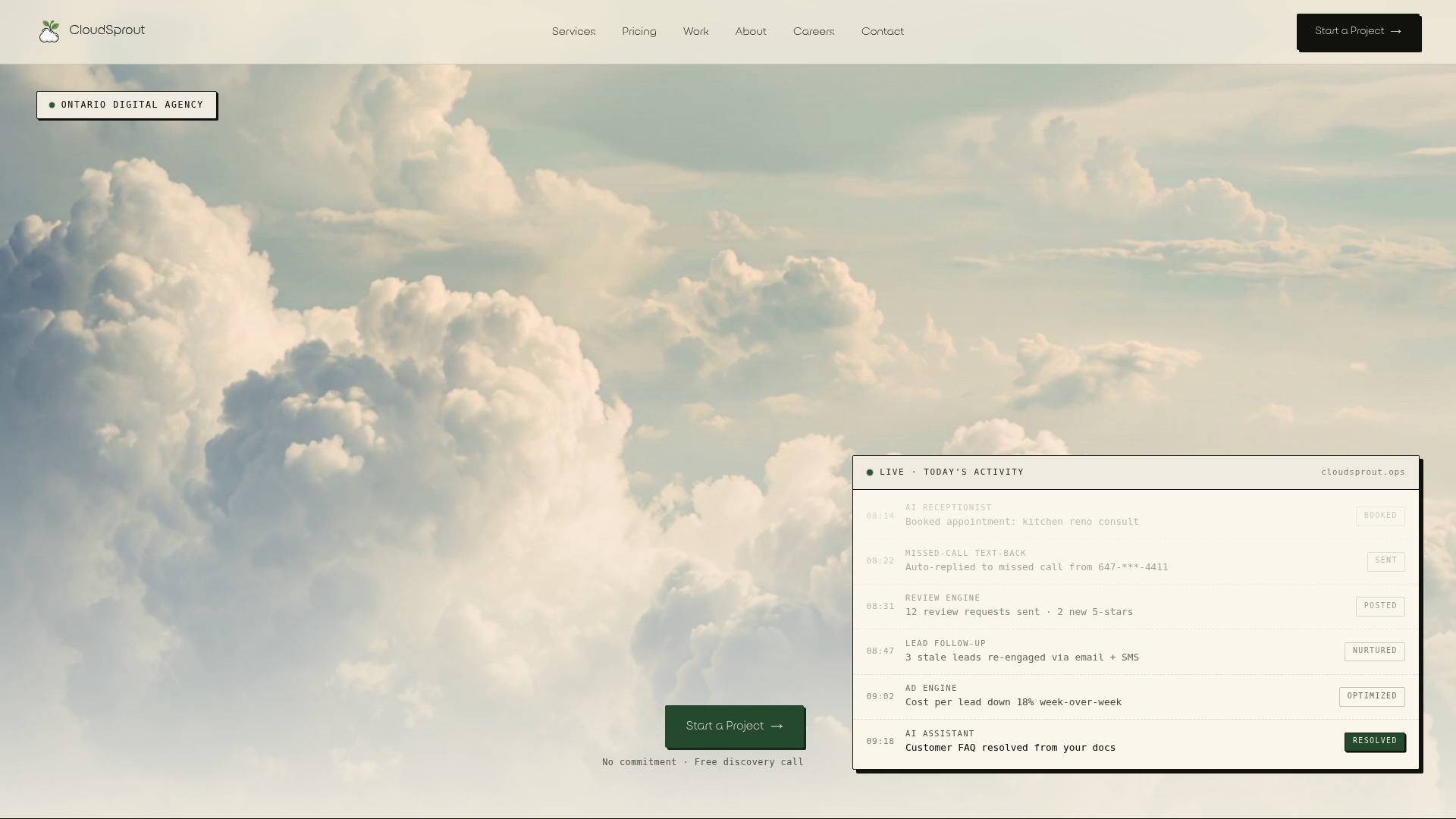
That structure matters most for owner-operators and small teams who want to talk to the person actually doing the work, not an account manager relaying messages to a subcontractor three time zones away. Pricing runs month-to-month with no long-term lock-in, and plans are published openly: Sprout at $300 CAD/month, Grow at $600 CAD/month, and Scale at $1,200 CAD/month, each with its own setup fee depending on scope.
If you’re mid-checklist and want to see where your own site and marketing actually stand before you commit to anyone, start with a free digital audit. It’s the same first step Cloudsprout runs with every new client, and it costs you nothing to find out what’s broken.
Sources
- Guidance on assessing third-party service providers — Office of the Privacy Commissioner of Canada
- CMA Agency Search Toolkit — Canadian Marketing Association
- Questions to ask marketing agency — TrinityP3
- 25 questions to ask a marketing agency — PickanAgency
- The client onboarding process: a 5-stage system for agencies — Agiled
FAQ
How do I choose a digital marketing agency?
Define your top one or two business outcomes and their KPIs first, then score candidates against weighted criteria covering strategy, experience, execution, reporting, pricing, and team continuity. Run your finalist through a structured question set before signing, and start with a 60 to 90 day trial rather than a long contract.
What are some of the best digital agencies in Canada?
The right agency depends on your size, budget, and whether you need a specialist or full-service support. Cloudsprout serves owner-operators and small to mid-sized businesses across trades, food service, professional services, and e-commerce with in-house delivery and transparent monthly pricing, which fits businesses that want direct access to the people doing the work.
What does a digital agency do?
A digital agency handles some or all of a business’s online marketing and technology needs, which can include website development, SEO, content and social media, branding, paid advertising, and automation. Full-service agencies like Cloudsprout combine these under one team, while specialist agencies focus on a single discipline.
What is the 3-3-3 rule for marketing?
Definitions of this rule vary across marketing circles, and there’s no single agreed-upon standard. Rather than guess at a specific framework, focus on the fundamentals covered here: clear outcomes, weighted evaluation criteria, and a defined trial period before committing to any agency long-term.
Recommended
Less reading. More growing.
We build the systems these articles describe. Websites, AI follow-up, reviews, automation. And run them for you.
Keep reading