
What is digital marketing and why does it matter for Canadian small businesses?
Digital marketing is the use of online tools, including websites, social media, email, and paid ads, to reach customers, build trust, and grow sales. For Canadian small businesses, it’s the most cost-effective way to compete with larger players without matching their ad budgets.
The core benefits are hard to argue with:
- Reach beyond your neighborhood. A well-run Google Business Profile or Instagram account puts you in front of customers in Kelowna, Kitchener, or across the country.
- 24/7 visibility. Your website works while you sleep. A plumber in Hamilton who ranks on Google at 11 PM captures jobs that a business with no web presence simply never sees.
- Measurable results. Unlike a flyer drop, digital channels tell you exactly what’s working and what isn’t.
- Cost efficiency. Email marketing and organic social cost a fraction of print or radio, with better targeting.
- Local trust signals. Reviews, local SEO, and community-focused content build the kind of credibility that drives repeat business.
One regulatory reality every Canadian business owner needs to know: Canada’s Anti-Spam Legislation (CASL) governs how you collect consent and send commercial emails. Violating it carries real penalties. Build compliance into your email setup from day one, not as an afterthought.
A practical digital marketing strategy doesn’t require a big team or a big budget. It requires focus, consistency, and a clear understanding of who you’re trying to reach.
How do you build a website and SEO foundation that actually works in Canada?
Your website is your most valuable digital asset, and many Canadian small businesses still don’t have one, or have one that’s outdated and hard to find. That’s a missed opportunity every single day.

Affordable platforms like Squarespace, Shopify, and Wix make it possible to launch a professional site for under $30 CAD per month. You don’t need a developer to get started. What you do need is a site that loads fast, looks clean on mobile, and clearly tells visitors what you do and where you operate.
Local SEO is where most small businesses leave the most money on the table. Here’s what to prioritize:
- Claim and complete your Google Business Profile. Add photos, accurate hours, your service area, and respond to every review. This is the single highest-impact free tool for location-based businesses.
- Use location-specific keywords. “Electrician in Mississauga” beats “electrician” every time for local intent searches.
- Get listed in Canadian directories. YellowPages.ca, Yelp Canada, and industry-specific directories all feed local authority signals to Google.
- Earn reviews consistently. Ask satisfied customers directly. Reviews affect both your ranking and your conversion rate.
- Make your site mobile-first. Google indexes the mobile version of your site. A slow or broken mobile experience tanks your rankings.
For a deeper look at the technical side, the Canadian business SEO basics guide covers keyword research, site structure, and on-page fundamentals specific to the Canadian market.
Pro Tip: Register a .CA domain. It signals to Canadian customers and search engines that you operate locally, which can give you a small but real edge in local search results.
Which social media platforms work best for Canadian small businesses?
The biggest mistake small business owners make on social media is trying to be everywhere at once. Picking one or two platforms that match your audience and budget consistently outperforms spreading thin across five channels you can’t keep up with.
Here’s how the main platforms break down for Canadian SMBs:
- Facebook remains the strongest platform for local service businesses, community groups, and older demographics. If you run a restaurant, landscaping company, or home services business, Facebook’s local groups and event features are genuinely useful.
- Instagram suits visual businesses: food, retail, trades with before-and-after work, fitness, and beauty. Short-form video (Reels) gets the most organic reach right now.
- LinkedIn is the right choice for B2B businesses, consultants, accountants, and professional services targeting other business owners.
A few tactics that work specifically in the Canadian context:
- Post in both English and French if you serve Quebec or bilingual communities. Even a simple translated caption shows respect for your local audience.
- Feature local partnerships, community events, and neighborhood references. Canadians respond to businesses that feel genuinely local, not like a corporate template.
- Use short video. Tools like Canva and CapCut are free or low-cost and produce content that performs far better than static images in most feeds.
The real role of social media for small businesses isn’t going viral. It’s staying visible and trustworthy to the people already in your community.

How do content marketing and email marketing help you grow a loyal customer base?
Content marketing works because it answers real questions before customers are ready to buy, which means they already trust you when they are. A Thunder Bay electrician who posts “5 signs your panel needs upgrading” on their blog doesn’t just get traffic. They get calls from people who already believe the business knows what it’s talking about.
Locally relevant content builds community trust faster than any ad. Behind-the-scenes posts, staff spotlights, customer stories (with permission), and practical tips tied to your region all outperform generic promotional content. The goal is to be useful to your specific audience, not to produce content that could belong to any business anywhere.
Email marketing is the most direct and cost-effective channel most small businesses underuse. Best practices for Canadian businesses:
- Collect consent explicitly. CASL requires express or implied consent before sending commercial emails. Use a clear opt-in checkbox, never pre-checked.
- Segment your list early. Even a simple split between “new leads” and “existing customers” lets you send more relevant messages.
- Send consistently but not constantly. A monthly newsletter beats a daily blast that gets ignored or unsubscribed.
- Include a clear call to action. Every email should have one thing you want the reader to do: book a call, visit the site, claim an offer.
- Track open rates and click rates. These tell you which subject lines and content types your audience actually responds to.
For a full breakdown of content strategy, the content marketing guide for small businesses covers formats, frequency, and how to repurpose content across channels without doubling your workload.
What do Canadian small businesses need to know about paid advertising?
Paid ads accelerate what organic marketing builds slowly. For most Canadian small businesses, Google Ads and Meta (Facebook and Instagram) ads are the two platforms worth starting with.
Google Ads puts your business in front of people actively searching for what you sell. A roofing company in Calgary bidding on “roof repair Calgary” captures high-intent traffic that’s ready to call. The key is tight geographic targeting and a focused keyword list. Broad match keywords on a small budget burn through money fast with little to show for it. A Canada small business Google Ads approach works best when you start narrow and expand only after you see what converts.
Meta ads work differently. They interrupt people who aren’t actively searching, so they’re better for awareness, retargeting, and promotions. A local bakery running a “weekend special” ad to a 10 km radius around their location is a good use of a small Meta budget.
Key principles for paid advertising on any Canadian SMB budget:
Want this running in your business without doing it yourself?
Book a Free Consultation →- Set a hard monthly cap before you launch. It’s easy to overspend when campaigns are running.
- Track conversions, not just clicks. A click that doesn’t become a lead or sale is just a cost.
- Use location targeting aggressively. Most small businesses only need to reach people within a specific city or region.
- Comply with Canadian advertising standards. The Ad Standards Canada guidelines apply to digital ads, including truthfulness and disclosure requirements.
- Test one variable at a time. Change the headline or the image, not both, so you know what actually moved the needle.
Paid ads work best as a complement to a solid organic foundation, not a substitute for it.
Why does branding matter so much for Ontario and Canadian small businesses?
Strong branding is what makes a customer choose you over the business two blocks away with the same service and similar pricing. For small businesses across Ontario and Canada, it’s often the deciding factor.
According to BDC, the most common branding mistake is defaulting to generic claims like “best value for the price.” Those statements are neither memorable nor provable. The businesses that build lasting reputations identify three or four specific attributes that genuinely set them apart and that their customers actually care about, then build every touchpoint around those attributes.
Customer personas are the starting point. Before you design a logo or write a tagline, you need a clear picture of who your best customer is: their age, their concerns, what they value, and why they chose you over someone else. That profile shapes everything from your website copy to how you answer the phone.
For Ontario trades businesses specifically, branding often comes down to trust signals: uniforms, vehicle wraps, consistent review profiles, and a website that looks like the business takes itself seriously. A Brampton HVAC company with a clean logo, a Google rating above 4.5, and a website that loads in under three seconds reads as more professional than a competitor with none of those things, even if the work quality is identical.
- Define your brand promise around provable, specific strengths.
- Build a consistent visual identity: colors, fonts, and logo used the same way everywhere.
- Let your personality show. Authenticity in branding is not a soft concept. Customers can tell when a small business is being genuine versus performing.
- Seek outside perspective. BDC notes that an outside consultant or agency often surfaces blind spots the owner can’t see from inside the business.
Pro Tip: Your .CA domain name is part of your brand. Keep it short, memorable, and matched to your business name. Registering alternate spellings protects you from competitors or copycats.
Explore branding best practices for Canadian small businesses to see how consistent identity translates into real customer trust.
How do you measure whether your digital marketing is actually working?
Vanity metrics, meaning follower counts, likes, and impressions, tell you almost nothing about business health. The metrics that matter are the ones tied directly to customer acquisition and retention.
Focus on these KPIs:
- New email signups per month. A growing list of real, opted-in contacts is a more reliable growth signal than any social metric.
- Customer referral rate. Ask every new customer how they found you. Track it in a simple spreadsheet. If referrals are growing, your reputation is working.
- Google review volume and rating. Both affect your local search ranking and your conversion rate from profile views to calls.
- Website traffic quality. Google Analytics 4 is free and shows you which pages visitors land on, how long they stay, and where they drop off. Time on page and pages per session matter more than raw visitor counts.
- Conversion rate. Of the people who visit your site or see your ad, what percentage take the action you want? Even a small improvement here compounds over time.
The simplest measurement system for a small business: pick three metrics, check them monthly, and ask one question each time. Is this number moving in the right direction? If not, what changed? That discipline, repeated consistently, beats any sophisticated analytics setup you never actually use.
How do you build a digital marketing strategy step by step?
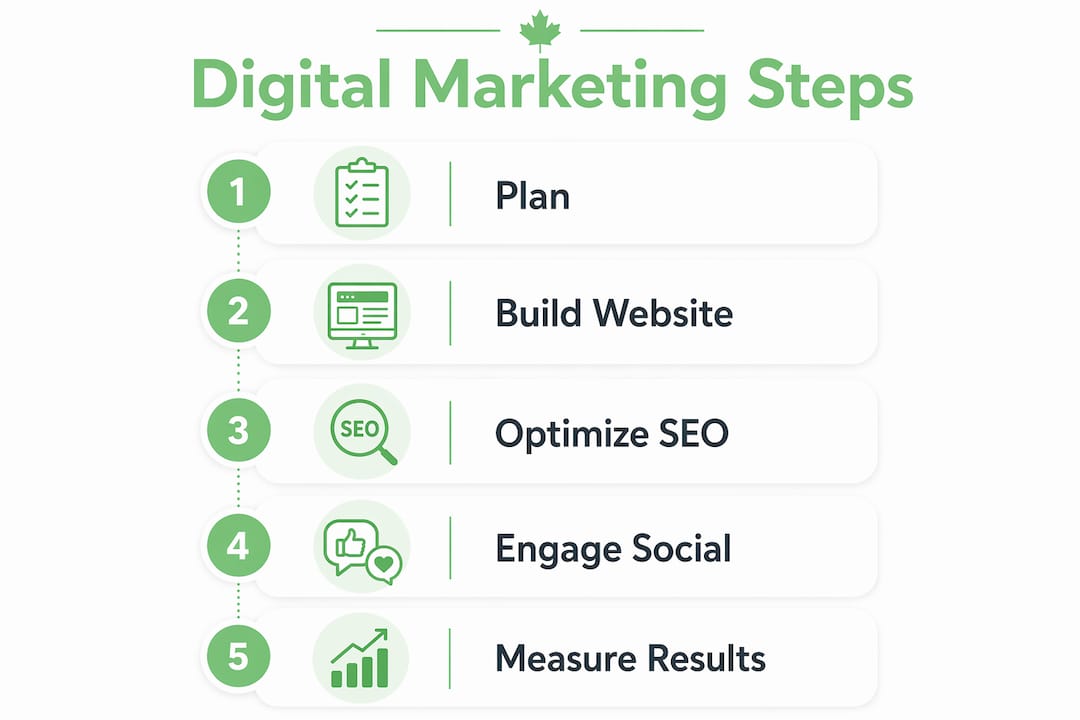
A stepwise approach reduces wasted spending and keeps small teams focused. Here’s a practical sequence:
- Research your market and audience. Use Google Trends (set the region to Canada), Statistics Canada’s business condition surveys, and local Facebook groups to understand what your customers are actually asking for. Free tools are enough at this stage.
- Define your brand promise. Before you spend a dollar on ads or content, know what makes you different and who you’re talking to.
- Build your owned assets first. Website, Google Business Profile, and email list. These are yours regardless of what any platform algorithm does.
- Choose one or two channels. Match the platform to your audience. Start there and do it well before adding more.
- Create content that answers real questions. Tie it to your local context. A Winnipeg landscaper writing about spring lawn prep for Manitoba’s climate serves their audience better than generic gardening tips.
- Launch paid ads only after organic is working. Ads amplify what’s already converting. They don’t fix a broken offer or a confusing website.
- Measure monthly and adjust. Use the three-metric system from the previous section. Iterate based on what the data shows, not what you assumed would work.
This sequence applies whether you’re a solo operator in Prince Edward Island or a 20-person shop in the Greater Toronto Area. The tools scale; the logic doesn’t change.
How much should Canadian small businesses budget for digital marketing?
There’s no universal number, but there are useful benchmarks. Most marketing advisors suggest small businesses allocate roughly 5%–10% of gross revenue to marketing, with a larger share going digital as traditional channels decline in effectiveness. For a business doing $500,000 CAD in annual revenue, that’s $25,000–$50,000 per year, or roughly $2,000–$4,000 per month.
The split matters as much as the total. A reasonable starting allocation for a Canadian SMB might look like this: website maintenance and hosting as the fixed base, a modest Google Ads budget for high-intent search terms, email marketing software (most platforms are affordable at small list sizes), and either organic social time or a small paid social budget for awareness.
Good bookkeeping practices make it much easier to track what you’re actually spending on marketing versus what you planned to spend. Many small business owners discover they’re either underspending on channels that work or overspending on ones that don’t, simply because they never separated marketing costs clearly in their accounts.
One practical rule: never put money into paid ads until your website converts. A $1,000 monthly Google Ads budget sent to a slow, confusing website is money gone. Fix the destination first.
Real examples of Canadian small business digital marketing that worked
The most instructive Canadian digital marketing wins tend to be unglamorous. A Kingston food shop that launched a text-only Instagram account saw almost no engagement. Three months later, after switching to a low-budget “day in the life” video series showing the owners, the kitchen, and the sourcing story, foot traffic increased 37% in a single quarter. The product didn’t change. The story did.
A common pattern among Ontario trades businesses that grow through digital marketing: they start with Google Business Profile, collect reviews aggressively, and rank in the local map pack within six months. No paid ads, no content strategy. Just a complete profile, consistent review requests, and accurate information. For location-based businesses with strong word-of-mouth, this alone can double inbound inquiry volume.
The lesson across both examples is the same. Authenticity and consistency beat production value and ad spend at the small business level. Customers in Saskatoon, Saint John, and Sudbury are not looking for polished corporate content. They’re looking for a business that feels real, local, and trustworthy. The businesses that show up that way, consistently, tend to win.
For tax planning considerations tied to your marketing spend, a CPA familiar with Canadian small business rules can help you categorize and deduct eligible marketing expenses correctly.
Cloudsprout gives Ontario small businesses a full digital team without agency overhead
Canadian small business owners who want real digital marketing results without a long-term agency contract have a direct alternative in Cloudsprout.
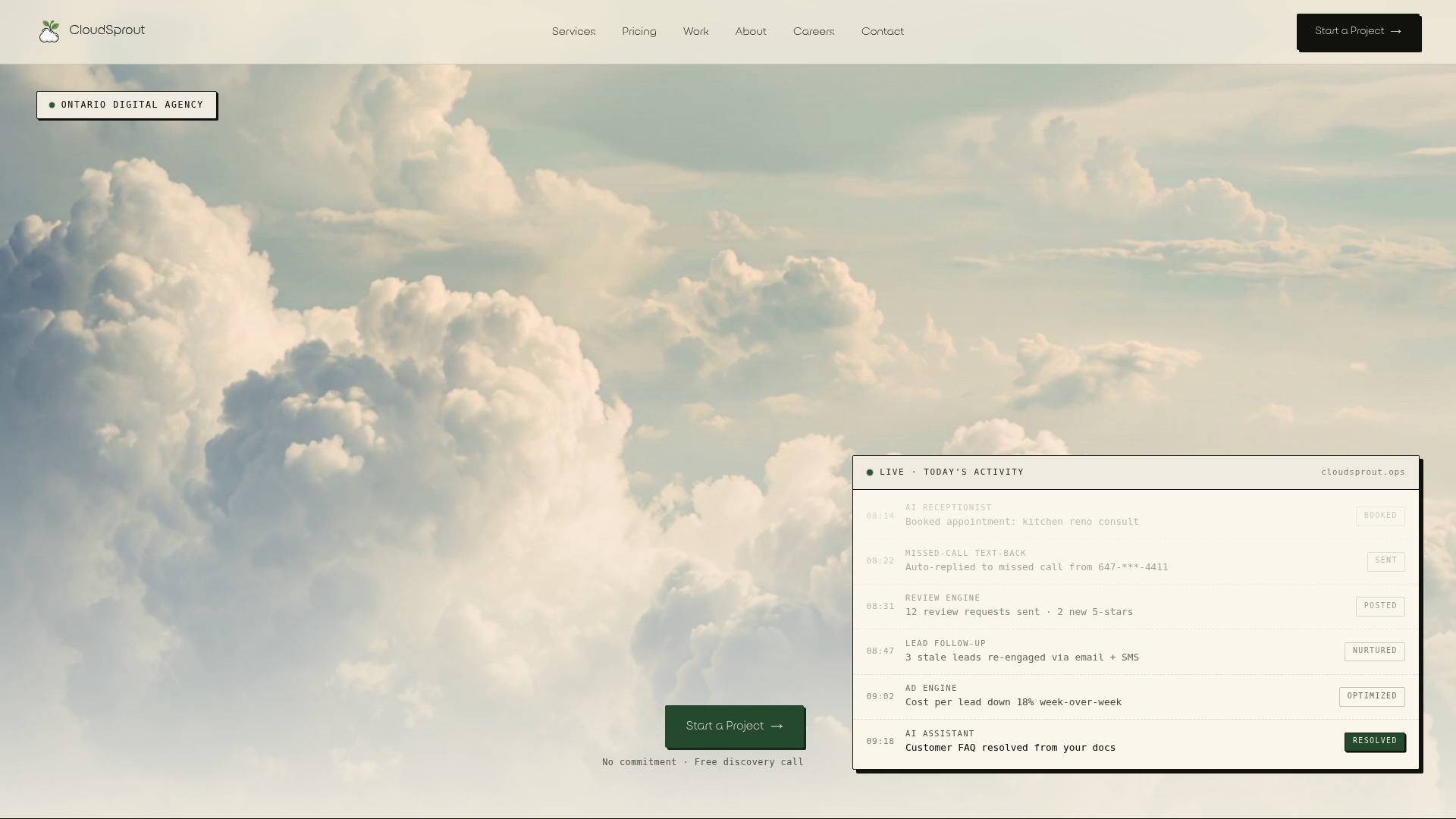
Cloudsprout is an Ontario-based agency built specifically for owner-operators: trades, food service, professional services, non-profits, and e-commerce businesses with 1–50 employees. Every service, from custom website development to SEO, content marketing, social media, branding, and CRM automation, is handled in-house with zero outsourcing. You get direct access to the team doing the actual work, transparent month-to-month pricing, and no lock-in contracts. New clients start with a free digital audit so you know exactly where you stand before spending anything. If you’re ready to build a full digital marketing presence that fits a small business budget and a Canadian market, Cloudsprout is worth a conversation.
Key Takeaways
Canadian small businesses that build owned digital assets first, stay CASL-compliant, and measure real conversion metrics consistently outperform those chasing follower counts and ad spend without a foundation.
| Point | Details |
|---|---|
| Own your digital assets | Website, Google Business Profile, and email list are the foundation; social platforms are secondary. |
| CASL compliance is mandatory | Collect explicit consent before sending commercial emails to avoid penalties under Canadian law. |
| Brand on provable specifics | BDC research shows generic claims fail; build your brand promise on three or four attributes you can actually prove. |
| Measure conversions, not vanity | Track email signups, referral rates, and review growth rather than likes or follower counts. |
| Cloudsprout for Canadian SMBs | Ontario-based, in-house team offering month-to-month digital marketing with a free audit to start. |
Recommended
Less reading. More growing.
We build the systems these articles describe. Websites, AI follow-up, reviews, automation. And run them for you.
Keep reading


Small Teams: Automate Customer Onboarding in 1–4 Weeks, Keep It Human