The fastest way to generate quality leads on LinkedIn right now is to pair Sponsored Content with Lead Gen Forms for scale, and layer in targeted outreach plus useful content for a steady pipeline underneath. Start small: launch one Lead Gen Form campaign around a single high-value offer, such as a gated guide or a webinar, and budget a few weeks before judging results.
TL;DR:
- Targeting decision-makers with precise filters like job title, seniority, and company size increases lead quality and reduces wasted ad impressions.
- Using Lead Gen Forms attached to Sponsored Content or Message Ads significantly improves submission rates due to pre-filled profile data, especially when matching the gated offer to the format.
- Launching small, focused campaigns around high-value offers and monitoring early CPL and lead quality helps prevent budget waste and improves overall performance.
- Combining paid campaigns with organic content, outreach, and profile optimization creates a steady pipeline of qualified leads over time.
- Achieving a working LinkedIn lead system in under two months is realistic by following a structured setup, testing creative variables, and integrating lead routing into CRM processes.
Table of Contents
- Why LinkedIn Lead Generation Beats Other Channels for B2B
- Which LinkedIn Ad Format Should You Use?
- How Do You Target the Right Audience on LinkedIn?
- Turning Content Into a Real Lead Pipeline
- Setting Up a Campaign in Campaign Manager Without Wasting Budget
- What Should You Track to Improve Lead Quality?
- CloudSprout’s Playbook for Getting LinkedIn Leads Fast
- What a Realistic First 90 Days Actually Looks Like
- How CloudSprout Gets Your LinkedIn Leads Actually Converting
- Where to Check the Details Yourself
- Sources
- FAQ
Why LinkedIn Lead Generation Beats Other Channels for B2B
LinkedIn concentrates decision-makers in a way almost no other platform can match. People log in with their job title, seniority, and company attached, which means every ad and every message lands with built-in context that other social platforms simply don’t have. That context is what makes LinkedIn B2B leads different from a Facebook lead or a cold email list.
The targeting precision is the real advantage. You can filter by job title, seniority, company size, and industry before you spend a single dollar, which cuts wasted impressions dramatically compared to broader platforms. LinkedIn’s own lead generation resources walk through exactly how Campaign Manager applies these filters at the ad level.
Paid and organic serve different jobs in this system:
- Paid campaigns (Sponsored Content, Lead Gen Forms) generate volume fast and let you test offers quickly.
- Organic posts and profile content build trust before someone ever sees an ad, which raises conversion rates when the two work together.
- Sales Navigator outreach fills the gap for accounts too small to justify ad spend but too valuable to ignore.
None of these channels replace the others. A LinkedIn outreach strategy without any content behind it reads as cold; ads without a warmed-up profile waste budget on skepticism.
Which LinkedIn Ad Format Should You Use?
Format choice depends entirely on what you’re asking someone to do. Match the ask the format, not the other way around.
- Sponsored Content works best for top-of-funnel awareness: case studies, thought-leadership posts, and offers that don’t require an immediate decision; for faster creative development, consider using the LinkedIn Ad Generator for Sponsored Content.
- Message Ads land directly in someone’s inbox and suit time-sensitive offers, like an event registration deadline, but they wear out fast if overused.
- Conversation Ads let a prospect choose their own path through button options, which works well for multi-offer campaigns (demo vs. content download vs. pricing).
- Lead Gen Forms, attached to any of the above, consistently outperform sending traffic to an external landing page because LinkedIn pre-fills the form with the person’s profile data, removing the biggest source of drop-off: typing. LinkedIn documents this pre-fill mechanism directly in its ad setup guidance.
Keep forms short. Name, work email, company, and job title cover most qualification needs. One optional qualifying question (budget range, team size, timeline) helps sales prioritize without tanking your submit rate, and a clear consent line for how you’ll use the data keeps you honest and compliant.
Pro Tip: Match your gated asset to the format. A dense industry report fits Sponsored Content; a fast “book a 15 minute call” offer fits Message Ads, where people expect brevity.
How Do You Target the Right Audience on LinkedIn?
Start with your ideal customer profile, then translate it into filters, not guesswork. If your ICP is “operations managers at trades businesses with 10 to 50 employees in Ontario,” that sentence becomes a job title filter, a seniority filter, a company size filter, and a location filter inside Campaign Manager or Sales Navigator.
Sales Navigator is where the real precision lives:
- Saved searches let you track new people who match your ICP as they change jobs or get promoted.
- Alerts flag buying-committee members inside target accounts, not just the one contact you already know.
- Lead filters combine seniority, function, and years in role to separate decision-makers from researchers.
For account-based approaches, Matched Audiences lets you upload a list of target company names and serve ads only to employees at those accounts, which is the closest thing LinkedIn offers to a direct-mail list for B2B.
The signal that actually moves the needle is freshness. Operator playbooks consistently find that outreach tied to a recent trigger, a new hire, a funding round, a product launch, gets meaningfully higher acceptance and reply rates than a generic connection request. A message that references “congrats on the new VP of Ops role” beats a template pitch nearly every time.
Turning Content Into a Real Lead Pipeline
Ads get attention. Content and a decent outreach sequence turn that attention into a pipeline that doesn’t dry up the moment you pause spend.
Your profile is the first filter. Fix these before anything else:
- Headline that states who you help and how, not just your job title.
- About section written in second person, ending with a clear call to action (book a call, download a guide).
- Featured section linking your best case study or lead magnet.
From there, cadence matters more than perfection. Three to five posts a week, mixing short text posts, carousels, and the occasional short video, keeps you visible without burning out your creative team.
The outreach flow that works: comment genuinely on a prospect’s post, send a connection request referencing that comment, then message with a specific value point, not a pitch. Webinars, case studies, and gated guides give you a legitimate reason to follow up and a way to qualify who’s actually interested versus who’s just being polite.

Pro Tip: Repurpose one long-form asset into a week of content: pull three stats for text posts, one client outcome for a carousel, and one talking point for video. It cuts content production time in half.
Want this running in your business without doing it yourself?
Book a Free Consultation →Setting Up a Campaign in Campaign Manager Without Wasting Budget
- Pick the right objective first. If you want names and emails without leaving LinkedIn, choose Lead Gen Forms. If you’re sending people to a detailed pricing page or tool, choose website conversions instead.
- Set a realistic daily budget. LinkedIn ad costs run higher than most social platforms, so smaller daily budgets need tighter, smaller audiences to spend efficiently, while broader campaigns need more room to gather data.
- Let LinkedIn’s bidding do its job. Automated bidding usually outperforms manual bids early on because the algorithm needs data to optimize toward, and manual bidding starves it.
- Check audience size before launch. A narrow audience under a few thousand people drives up CPL fast, since you’re bidding against yourself with limited reach.
- Run a pre-launch checklist: confirm the Insight Tag is installed, form fields match your CRM fields, and UTM parameters are set so reporting doesn’t fall apart later.
Skipping step five is the most common way small teams torch a week of budget without a single usable answer about what worked.
What Should You Track to Improve Lead Quality?
Cost per lead tells you almost nothing on its own. Track it alongside qualified leads, conversion rate from lead to opportunity, and pipeline velocity, how fast a lead actually moves toward a closed deal, to get the real picture.
- Qualified leads: the number that pass your sales team’s basic fit check, not just form submissions.
- CPL: total spend divided by leads, useful for budget planning but misleading without a quality filter attached.
- Conversion rate: leads that become opportunities, the number that actually predicts revenue.
- Pipeline velocity: time from lead capture to first meaningful sales conversation.
Get leads out of LinkedIn and into your CRM immediately. LinkedIn supports native CRM integrations, webhooks, and manual CSV export for Lead Gen Forms, but research on Lead Gen Forms performance notes that forms which convert well can still produce lower-intent leads if nobody follows up fast. A tool built for automated lead routing closes that gap by tagging and assigning leads the moment they submit.
Run a simple test matrix: swap one creative variable at a time (headline, image, form length), let each version run long enough to gather real data, and pause anything burning budget without qualified leads after a reasonable sample size.
CloudSprout’s Playbook for Getting LinkedIn Leads Fast
Most small businesses don’t need a six-month LinkedIn strategy. They need a working system in under two months.
A realistic build looks like this:
- Weeks 1 to 2: audit current profile, page, and any past campaign data; define the ICP and offer.
- Weeks 3 to 4: build the audience lists, draft ad creative, and set up the Lead Gen Form.
- Weeks 5 to 6: launch the campaign, monitor early CPL, and adjust targeting.
- Weeks 7 to 8: connect lead routing into the CRM so no submission sits untouched.
Automated routing itself typically takes two to four weeks to fully configure and test against real lead volume. Businesses juggling a lean team and no dedicated marketing hire tend to benefit most from handing this off entirely; businesses with in-house marketing capacity often just need the automation and targeting built once, then run it themselves.
What a Realistic First 90 Days Actually Looks Like
Weeks one and two: fix your profile and audit whatever’s already posted. Weeks three through six: post consistently and run one small paid test, nothing bigger. Weeks seven through ten: ramp outreach using fresh signals, not templates. Weeks eleven through thirteen: measure, cut what’s not converting, double down on what is.
The most common early mistake is scaling ad spend before the form and follow-up process actually work. A visual quick win for a short video: screen record a Lead Gen Form auto-filling in real time. It looks like magic, and it explains the whole tactic in eight seconds.
— Cristo
How CloudSprout Gets Your LinkedIn Leads Actually Converting
Most agencies hand you a campaign report and call it done. Cloudsprout builds the whole chain, the ad, the form, the CRM routing, the follow-up content, in-house with no outsourcing, so leads don’t stall out between departments that don’t talk to each other.
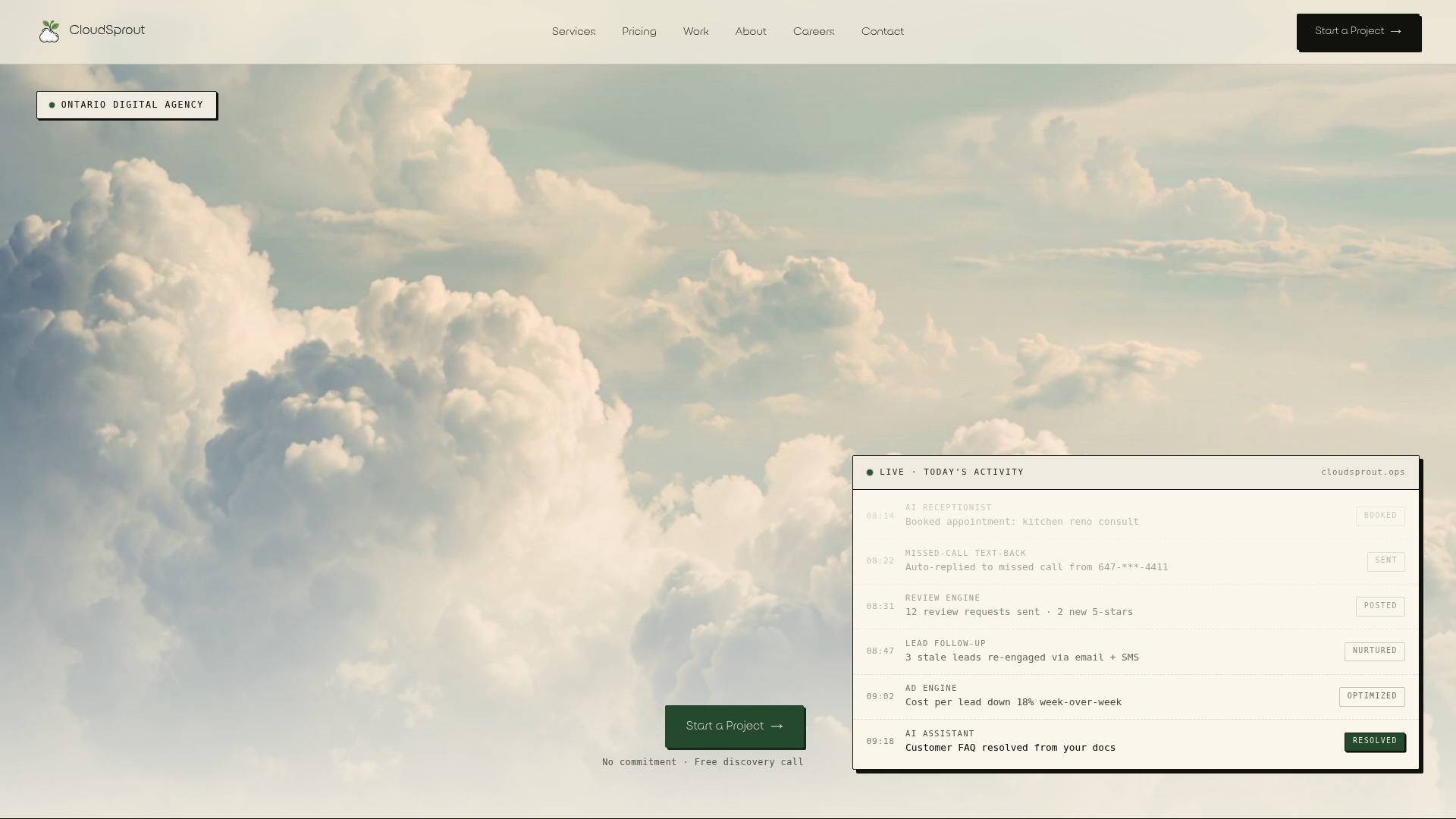
If you’re running a trades business, a professional services firm, or a small e-commerce brand and you don’t have the internal bandwidth to manage Campaign Manager, build Sales Navigator lists, and route leads into a CRM at the same time, that’s exactly the gap Cloudsprout’s Ads Management service is built to close. Pair that with CRM automation so every Lead Gen Form submission gets tagged and assigned automatically, and a content cadence that keeps your profile and page warm between campaigns.
The easiest way to see where you stand is a free full digital audit, which looks at your current LinkedIn presence, website, and lead flow before anything gets built. Plans run month to month with no lock-in contracts, starting with Sprout at $300 CAD per month. Book the audit and see what a working LinkedIn lead system would actually look like for your business.
Where to Check the Details Yourself
For the technical setup itself, LinkedIn’s Lead Generation Ads guide covers targeting and Campaign Manager mechanics directly from the source. For benchmark comparisons and signal-based outreach tactics, the 2026 operator playbook on LinkedIn strategy and the step-by-step B2B lead generation guide from PhantomBuster are worth bookmarking before you scale spend.
Sources
- Lead Generation | LinkedIn Marketing Solutions
- LinkedIn Lead Gen Forms | LinkedIn Marketing Solutions
- LinkedIn Lead Generation: The Complete Guide for B2B Companies in 2026 – Speedwork
- LinkedIn lead generation strategies: the 2026 operator playbook
FAQ
How Do You Generate Leads on LinkedIn?
Combine Sponsored Content or Message Ads with Lead Gen Forms for paid volume, and pair that with a consistent posting cadence and signal-based outreach through Sales Navigator for organic pipeline. Neither works as well alone as the two together.
How Much Does a LinkedIn Lead Gen Form Cost?
There’s no separate fee for the form itself. It’s included in your ad spend, and total cost depends on your daily budget, targeting tightness, and bidding, with Ads Management support available; please visit the pricing page for current fees.
Is LinkedIn Good for Lead Generation?
Yes, particularly for B2B. Its targeting by job title, seniority, and company size cuts down wasted spend, and LinkedIn’s own resources confirm Lead Gen Forms are built specifically to reduce submission friction versus external landing pages.
What Is the 5 3 2 Rule on LinkedIn?
Definitions of this rule vary across sources, and no consistent standard version appears in LinkedIn’s own documentation, so treat any specific breakdown you see elsewhere with some skepticism. The safer approach is the content mix already covered here: a few posts per week split between short updates, richer formats like carousels or video, and the occasional direct offer.
What’s the Difference Between Campaign Manager and Sales Navigator?
Campaign Manager runs your paid ads, budgets, and Lead Gen Forms. Sales Navigator is a prospecting tool for building targeted lists and tracking buying-committee members, and LinkedIn positions the two as complementary rather than interchangeable.
Recommended
Less reading. More growing.
We build the systems these articles describe. Websites, AI follow-up, reviews, automation. And run them for you.
Keep reading

Small Teams: Automate Customer Onboarding in 1–4 Weeks, Keep It Human