
For Ontario small businesses, the most effective social media marketing approach comes down to three decisions made early: which one or two platforms your local customers actually use, what kind of content builds trust fast, and whether your website and Google Business Profile are ready to convert the traffic you send them. Get those right, and social media stops being a time sink and starts generating real leads.
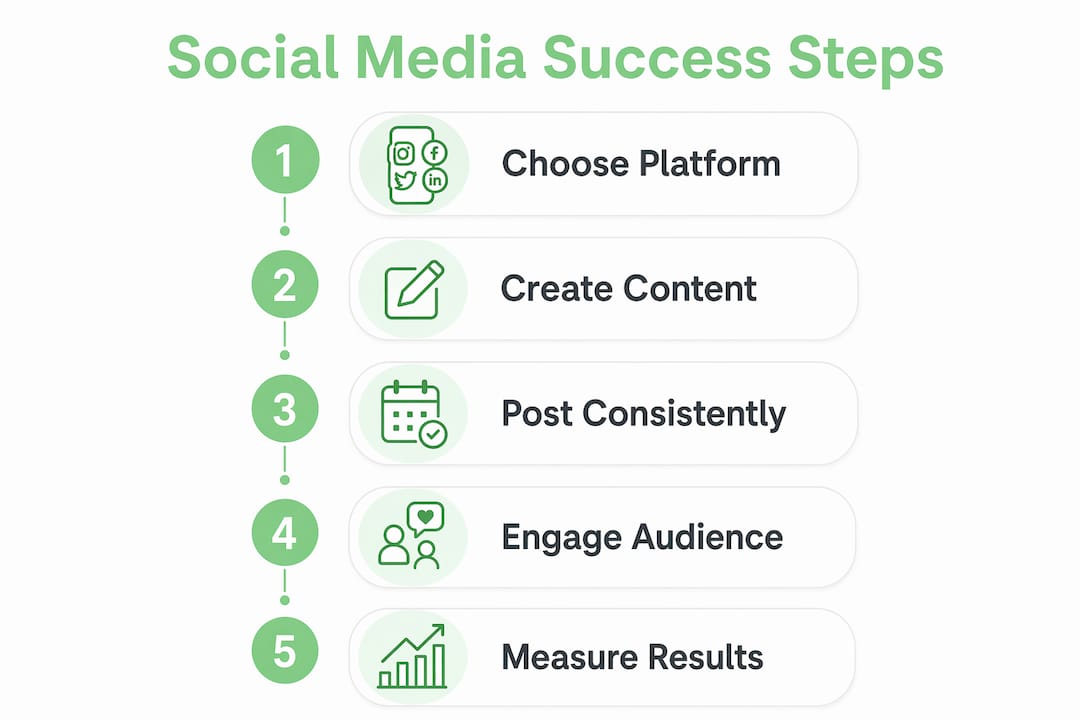
Here is what works, starting now:
- Pick one or two platforms based on your business type (Instagram and Facebook for food, retail, and trades; LinkedIn for professional services)
- Post several times per week at a pace you can sustain without burning out
- Lead with local relevance: community events, customer stories, and behind-the-scenes content outperform generic promotional posts
- Connect every post to a clear next step, whether that is booking a call, visiting your Google Business Profile, or claiming a local offer
- Hold off on paid ads until your website converts and your Google Business Profile is complete
- Measure leads and booked consultations, not follower counts
That sequence is not arbitrary. Ontario’s market is competitive, and social media success hinges on repeatable processes that drive conversions, not just visibility.
Which social media platforms should Ontario small businesses use?
Choosing the right platform for social media marketing as an Ontario small business owner is less about what is trending and more about where your specific customers spend time. Focusing on 1–2 platforms based on your audience and business category improves both visibility and efficiency.
Here is how that breaks down by sector:
- Food service and retail: Instagram and Facebook dominate. Instagram and Google Maps are the primary discovery tools for Ontario restaurants and cafes. People browse visually, then click for directions. Your Google Business Profile photos need to be current and professional, and your Instagram should show the experience, not just the menu.
- Trades and home services: Facebook remains the strongest platform for referrals and community groups. Google Business Profile paired with Facebook reviews creates a trust loop that drives calls.
- Professional services: LinkedIn outperforms every other platform for accountants, lawyers, consultants, and B2B services. Two to three posts per week with a personal perspective, not corporate announcements, builds the kind of credibility that generates referrals.
- E-commerce and lifestyle brands: Instagram and TikTok together reach younger Ontario buyers effectively, especially in the GTA.
The biggest mistake Ontario small business owners make is spreading across four or five platforms and doing none of them well. One platform done consistently beats five platforms done sporadically, every time. Pair your social presence with a well-optimized local SEO foundation so that the traffic you generate has somewhere to land.
What content actually works for local Ontario businesses on social media?
Content that performs for Ontario small businesses shares one trait: it feels local. Generic stock-photo posts about “quality service” get ignored. A photo from your booth at the Burlington Farmers’ Market, or a short video of your team at a Mississauga community event, earns attention because it is specific and real.
The content types that consistently drive engagement and leads for local Ontario businesses include:
- Customer stories and testimonials: Real outcomes from real local customers build trust faster than any promotional copy. Name the neighborhood when you can.
- Behind-the-scenes content: Show your process, your team, your workspace. People buy from people they feel they know.
- Question-based and interactive posts: Polls, quizzes, and “which would you choose” posts outperform static content in algorithm-driven feeds because they hold attention longer and signal genuine engagement.
- Local event tie-ins: Align your content calendar with Ontario seasonal cycles, local festivals, and community milestones. A Hamilton bakery posting about Supercrawl, or a Barrie retailer referencing the local hockey season, connects with the community in a way that a generic post never could.
- Educational content with a local angle: Answer the questions your Ontario customers actually ask. “What should I look for in a licensed electrician in Ontario?” performs better than “5 tips for hiring an electrician.”
Balance matters. A rough guide that works well is a balanced mix of educational, trust-building (stories, behind-the-scenes, community), and promotional content. Flood your feed with offers and people tune out. Give them value first, and the promotional posts land harder when they appear.
Pro Tip: Build a simple content calendar in Google Sheets tied to Ontario’s seasonal business cycles. Map out key dates like the Ontario long weekends, back-to-school, and local festivals three months in advance. Batching content around these anchors means you are never scrambling for ideas on a Tuesday morning.

Why consistency beats perfection in your posting schedule
Posting 3–4 times per week on one or two platforms consistently outperforms sporadic high-effort posts for Ontario small businesses. The algorithm rewards regularity. More importantly, your local audience starts to recognize you, and recognition is what drives the call or the visit.
The perfectionism trap is real and common. A business owner spends three weeks crafting the “perfect” launch post, publishes it, gets decent engagement, then goes quiet for a month. That silence costs more than the post earned. Consistency builds brand recall in a way that one great post simply cannot.
Scheduling tools like Buffer, Later, or Meta Business Suite let you batch a week’s worth of content in one sitting. Spend two hours on a Sunday afternoon writing captions and selecting images, schedule everything, and your social presence runs itself for the week. That is a sustainable system. Trying to post in real time every day is not.
Adapt based on what your analytics tell you, not on what you think should work. If your Thursday evening posts consistently get three times the engagement of your Monday morning ones, shift your schedule. The data will tell you what your Ontario audience responds to, but only if you post often enough to generate meaningful data.
How should Ontario small businesses approach paid social advertising?
Paid social ads work well for Ontario small businesses, but only after the foundation is solid. Optimizing your Google Business Profile and ensuring your website converts before running ads is the single most important sequencing decision you can make. Sending paid traffic to a slow, unclear, or unconvincing website is the fastest way to burn through a budget with nothing to show for it.
Once your foundation is ready, here is how to approach paid social:
- Start with a budget of $200–$500/month. This is a realistic starting point for local Ontario SMBs running geo-targeted campaigns. It is enough to generate data and test what works without overcommitting.
- Use geo-targeting tightly. Target your city, your neighborhood, or a specific radius around your location. Ontario is a big province, and a Guelph plumber has no use paying to reach someone in Thunder Bay.
- Lead magnets convert better than direct promotional ads. A free estimate, a downloadable guide, or a “book a free 15-minute call” offer gives people a low-risk reason to click. Pair the ad with a dedicated landing page, not your homepage.
- Boost posts that are already performing organically. If a post is getting strong organic engagement, putting $50–$100 behind it amplifies something you already know works.
- Align paid campaigns with your organic content. Running ads for a service you have not posted about organically creates a disconnect. Your audience should recognize your brand voice when they see the ad.
Ontario’s privacy laws, including the Personal Information Protection and Electronic Documents Act (PIPEDA), apply to how you collect and use data from ad campaigns. If you are running lead-generation ads that capture email addresses or phone numbers, you need a clear privacy policy on your site and explicit consent language in your forms.
What metrics actually matter for measuring social media success?
The metrics that matter for Ontario small businesses are the ones tied to revenue, not reach. Focusing on leads and conversions rather than vanity metrics like follower counts drives sustainable growth. A business with 400 engaged local followers who book appointments beats one with 10,000 followers who never buy anything.
Want this running in your business without doing it yourself?
Book a Free Consultation →Track these instead:
- Leads generated through social channels: How many people clicked through to your contact form, booked a call, or sent a direct message asking about your services?
- Landing page conversion rate: If you are running paid ads or linking to a specific page, what percentage of visitors take the desired action?
- Engagement rate on posts: Comments and shares signal genuine audience connection far better than likes. A post with 10 comments from local customers is more valuable than one with 200 likes from accounts you do not recognize.
- Response time to inquiries: Contacting new leads within two hours dramatically improves conversion rates. A CRM workflow that triggers an automatic follow-up the moment a lead comes in through social gives Ontario small businesses a real competitive edge.
Use the native analytics tools on each platform alongside Google Analytics to track which social channels actually send converting traffic to your site. Most Ontario small business owners are surprised to find that one platform drives almost all their real leads, while the others generate noise. That insight alone is worth the effort of setting up proper tracking.
Who is your Ontario audience, and how do you target them?
Ontario is not one market. The Greater Toronto Area alone has over 400,000 active businesses and a population of 6.4 million, with demographic profiles that shift significantly between Toronto proper, Mississauga, Brampton, Markham, and the outer suburbs. A social media strategy that works in downtown Toronto may need real adjustment for a business serving Sudbury or Windsor.
A few targeting realities worth knowing:
Age and platform skew: Younger Ontario consumers (18–34) are heaviest on Instagram and TikTok. Facebook skews older, with strong penetration among homeowners and parents in suburban Ontario, which makes it particularly effective for trades, home services, and family-oriented businesses. LinkedIn’s Ontario user base is concentrated in professional services, finance, and tech, primarily in the GTA and Ottawa.
Language and cultural diversity: The GTA is one of the most multicultural regions in North America. Depending on your neighborhood, content that acknowledges local cultural events or is available in a second language can meaningfully expand your reach. This is especially relevant for food service businesses in areas like Markham, Brampton, or Scarborough.
Urban vs. small-town dynamics: In smaller Ontario cities like Peterborough, Sault Ste. Marie, or Chatham-Kent, community Facebook groups often drive more local business than any paid campaign. Showing up authentically in those spaces, answering questions and participating in local conversations, builds the kind of trust that advertising cannot buy.
Tailor your content to the specific Ontario community you serve. Generic “local business” messaging reads as hollow. Specific references to your city, your neighborhood, and your customers’ actual lives do not.
How do community partnerships and local influencers help Ontario small businesses?
Local influencers and community partnerships are among the most cost-effective tools available for Ontario small businesses, and they are consistently underused. The key distinction from national influencer marketing is scale: you are not looking for someone with a million followers. You want someone with 2,000 to 15,000 engaged local followers who your customers already trust.

A Kitchener fitness studio partnering with a local nutritionist for a joint Instagram Live, or a Hamilton restaurant collaborating with a local food blogger for a behind-the-scenes post, generates authentic reach that paid ads rarely replicate. The trust transfer is immediate because the audience already has a relationship with the person making the recommendation.
Strategic business partnerships work the same way. A mortgage broker who partners with a local real estate agent for co-branded content reaches an audience that is already in the buying mindset. A landscaping company that cross-promotes with a local garden center reaches homeowners at exactly the right moment. These partnerships cost nothing beyond time and goodwill, and they generate the kind of warm leads that convert faster than cold ad traffic.
When approaching local influencers or partners, be specific about what you are offering and what you are asking for. A clear, mutual value exchange works far better than a vague “let’s collaborate” message. Offer a free service, a product sample, or a revenue share, and make the ask concrete.
Should you manage social media in-house or hire an Ontario agency?
The honest answer depends on your time, your budget, and how central social media is to your growth plan. Both paths work. Neither is automatically better.
Managing in-house makes sense when:
- You or a team member genuinely enjoys creating content and has time to do it consistently
- Your business has a strong visual or personality-driven brand that benefits from an authentic, unfiltered voice
- Your budget is tight and you can commit to learning the tools and tracking the metrics yourself
Hiring an Ontario-based agency or freelancer makes sense when:
- You are posting sporadically because you run out of time, and you know it is costing you leads
- You need paid ad management, content strategy, and analytics reporting handled together
- You want someone who understands Ontario’s local market, not a generic offshore content farm
If you go the agency route, ask these questions before signing anything: Do they work in-house or outsource content creation? Can they show you results from other Ontario small businesses in your sector? Do they offer month-to-month pricing, or are you locked into a long contract? A good agency should be able to answer all three without hesitation.
Cloudsprout works exclusively with Ontario small and mid-sized businesses, handling social media, SEO, content, and digital marketing under one roof with no outsourcing and no lock-in contracts. Every client starts with a free digital audit so you know exactly where you stand before spending a dollar.
If you are ready to stop guessing and start building a social media presence that actually generates leads, Cloudsprout’s social media services are built for exactly this. Month-to-month, transparent, and done by the same team you talk to.
Key Takeaways
Effective social media marketing for Ontario small businesses requires the right platform, consistent posting, and a clear path from content to conversion.
| Point | Details |
|---|---|
| Platform selection | Focus on 1–2 platforms matched to your business type and Ontario audience for maximum efficiency. |
| Posting consistency | A cadence of several posts per week outperforms sporadic high-effort posts for building local brand recall. |
| Paid ad sequencing | Start paid social ads only after your Google Business Profile and website are optimized to convert traffic. |
| Lead-focused metrics | Track leads generated and landing page conversions, not follower counts or likes. |
| Lead follow-up speed | Contacting new leads within two hours using a CRM workflow significantly improves conversion rates. |
Recommended
Less reading. More growing.
We build the systems these articles describe. Websites, AI follow-up, reviews, automation. And run them for you.
Keep reading


Small Teams: Automate Customer Onboarding in 1–4 Weeks, Keep It Human