
Content is the primary driver of SEO because search engines need useful pages to match user queries to results. Without it, Google has nothing to analyze, index, or rank. Content directly controls three signals that determine whether your pages show up: relevance to search intent, user engagement (how long people stay and click), and your ability to earn backlinks from other sites. Google’s E‑E‑A‑T framework (Experience, Expertise, Authoritativeness, Trustworthiness) is built entirely on what your content says and how it says it. For a small business in Ontario, that means a well-written service page or FAQ can connect your business to the exact question a local buyer typed into Google this morning.
Right now, you can:
- Open Google Search Console and check which queries are generating impressions but few clicks on your top pages.
- Identify your single most-visited page and compare it against the top 3 Google results for its target query.
- Run a one-page content audit using the checklist in Section 11 of this guide.
- Note any service you offer that has no dedicated page yet — that gap is a missed ranking opportunity.
Table of Contents
- What counts as SEO content?
- Why does content matter so much for SEO?
- What do search engines actually look for in your content?
- Which content types actually help your SEO?
- How do you create content that actually improves your SEO?
- How do you measure whether your content is working?
- How do you build topical authority and E‑E‑A‑T?
- Common content mistakes that are quietly killing your rankings
- How long before your content actually moves the needle?
- Run this content audit checklist on one page right now
- Key Takeaways
- Why most small businesses get content strategy backwards
- Ready to see what your content is actually doing?
- Useful sources and tools
- FAQ
What counts as SEO content?
SEO content is any page or asset created to match a user’s search intent and deliver a helpful answer while serving a business goal. That definition matters because it separates content built for search from marketing copy written purely for brand voice.
Formats that qualify include:
- Pillar pages: Broad, authoritative guides covering a topic in depth (e.g., “Complete Guide to HVAC Maintenance”).
- Blog posts and how-to articles: Specific answers to common questions (“How often should you service a furnace?”).
- FAQ pages: Short, direct answers to high-frequency queries, ideally marked up with FAQ schema.
- Service and product pages: Pages that match transactional intent (“emergency plumber Toronto”).
- Local and location pages: Pages targeting geographic queries (“electrician Barrie ON”). Location pages are often the fastest win for Ontario trades businesses.
- Data studies and original research: Assets that earn backlinks because they contain information no one else published.
- Video with transcripts: Video content becomes indexable text when you add a transcript or closed captions.
Where marketing copy and SEO overlap: meta titles, meta descriptions, heading tags, and structured data (schema) are technical containers, but the words inside them are content decisions. A meta description that matches what a searcher expects to find is a content choice, not just a technical one.
Why does content matter so much for SEO?
Quality content improves findability, trust signals, and user satisfaction — and all three feed directly into how ranking systems evaluate your pages. The causal chain is worth understanding because it explains why publishing one thin page rarely moves anything, but a focused cluster of well-written pages often lifts an entire topic.
Three core SEO outcomes content drives:
- Visibility: Google analyzes page content to decide which queries a page should appear for. No content, no indexing signal. Thin content, weak ranking.
- Engagement: When a page matches what the searcher expected, they stay longer, click through, and sometimes return. Those behavioral signals tell Google the page was useful.
- Authority: Content informs search engines and earns backlinks when other sites find it worth citing. Backlinks remain one of the strongest ranking signals in Google’s algorithm.
The compounding effect is the part most small-business owners miss. When you publish a pillar page and link related blog posts to it, you build topical authority — Google starts to treat your site as a credible source on that subject, which lifts rankings across the whole cluster, not just the one page you optimized.
Promotion matters too. A well-researched article left unpromoted rarely earns links on its own. Sharing it with industry contacts, posting it in relevant communities, and pitching it to local media or trade publications is what turns good content into a link-earning asset.

What do search engines actually look for in your content?
Search engines evaluate content on relevance, usefulness, credibility, and experience signals. That’s the short answer. Here’s what each factor means in practice, prioritized for a small-business owner with limited time.
The factors that matter most:
- User intent match: Does your page answer the query the way the searcher expected? Check the top 5 results for your target keyword. If they’re all how-to guides and your page is a product listing, you have an intent mismatch.
- Topical depth: Covering a subject thoroughly — including related questions and subtopics — signals expertise. A single 300-word page rarely competes with a well-structured 1,200-word guide on the same topic.
- E‑E‑A‑T: Google’s helpful content guidance emphasizes first-hand knowledge, original reporting, and demonstrated expertise. For a local plumber, that means real job photos, named technicians, and specific service areas — not generic copy.
- Originality: Don’t rehash what’s already published. Add something only you can say: a local statistic, a client outcome, a specific process your team uses.
- On-page structure: Clear H1 and H2 headings, short paragraphs, and schema markup help both users and crawlers navigate your content. On-page SEO is where structure and content intersect.
- Freshness: For time-sensitive topics (tax deadlines, product availability, local regulations), stale content loses rankings fast. For evergreen topics, freshness matters less than depth.
- Internal and external links: Internal links distribute authority across your site and help Google understand topic relationships. External links to credible sources add context and trust.
- Engagement signals: CTR (click-through rate from search results) and time on page are indirect signals. A page with a strong title and meta description earns more clicks, which reinforces its ranking.
- Technical compatibility: A page that loads slowly or breaks on mobile loses users before they read a word. Speed and mobile rendering are prerequisites, not bonuses.
For small businesses, fix these first: intent match, the basics of E‑E‑A‑T (author name, real credentials, local proof), and internal linking between your service pages and supporting blog posts. Those three changes produce the most visible ranking movement for the least effort.
Pro Tip: To spot an intent mismatch fast, Google your target keyword and read the “People Also Ask” box. If those questions aren’t answered somewhere on your page, you’re leaving relevance signals on the table.

Which content types actually help your SEO?
Match the format to the intent and the stage in the buyer’s journey. Broad topic awareness calls for a pillar page. A specific how-to question calls for a blog post or FAQ. High-trust decisions (hiring a contractor, choosing a service provider) call for case studies or data-backed guides. Local queries call for location pages.
Common formats and when to use them:
- Pillar pages: Best for broad, high-volume topics. Typically 1,500–3,000 words with clear H2 sections. Link all related cluster posts back to this page. Production note: include a table of contents and internal anchor links.
- Blog posts / how-to articles: Best for specific questions and long-tail queries. Aim for depth over length — cover the question completely, then stop. Production note: add FAQ schema to any post that answers a direct question.
- FAQ pages: Best for high-frequency short queries. Keep answers under 60 words each. Always add FAQ schema markup so Google can pull answers into featured snippets.
- Service and product pages: Best for transactional intent. Include the service name, location, process, pricing signals, and a clear call to action. Website copy on these pages does double duty: it converts visitors and ranks for local queries.
- Location pages: Best for businesses serving multiple cities or neighborhoods. Each page should be unique — not a copy-paste with the city name swapped.
- Data studies and original research: Best for earning backlinks. A local survey, an analysis of regional pricing, or an original dataset gives other sites a reason to cite you.
- Video with transcripts: Video ranks in YouTube search and can appear in Google video carousels. Without a transcript, the content is invisible to text-based crawlers. Add one.
One research asset can stretch across formats: write the article first, pull three key findings for a short video script, then condense the most common question into an FAQ entry. That’s three pieces of content from one research session. For eCommerce businesses managing content at scale, outsourcing support workflows can free up internal time for higher-value content production.
How do you create content that actually improves your SEO?
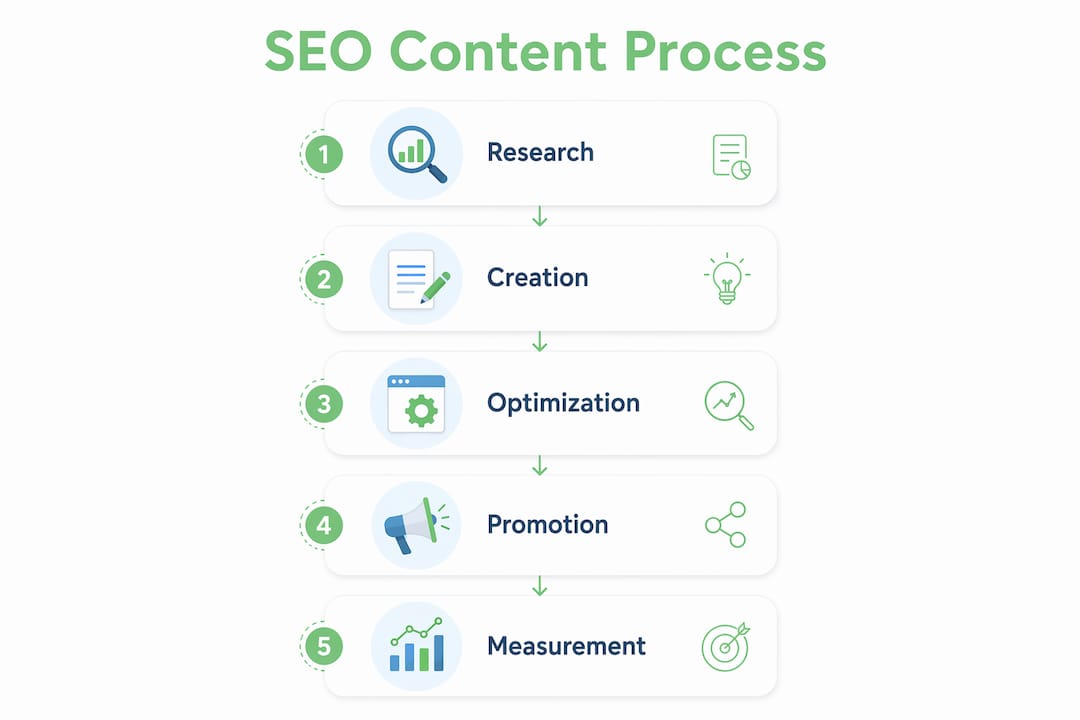
Follow a repeatable workflow that starts with intent research and ends with promotion and measurement. Skipping either end of that process is why most content underperforms.
Step-by-step workflow:
- Research intent and keywords. Use Google Search Console to find queries you already rank for but haven’t fully addressed. Use Semrush or Ahrefs to find related questions and estimate competition. Start with queries where you have some existing authority.
- Map to your audience. Who is searching this? A homeowner comparing quotes, or a property manager with an urgent repair? The answer changes the tone, depth, and call to action.
- Write a content brief. Define the target query, required H2 sections, internal links to include, and the one action you want the reader to take. A brief takes 15 minutes and prevents rewrites.
- Draft with people-first language. Write for the reader, not the algorithm. Use the words your customers actually say. Answer the question directly in the first paragraph.
- Optimize on-page elements. Before publishing, check this list:
- SEO title includes the target keyword and stays under 60 characters.
- H1 matches the page’s topic and the searcher’s expectation.
- Meta description is unique, under 160 characters, and includes a reason to click.
- 1–3 internal links to related pages with descriptive anchor text.
- Alt text on every image.
- FAQ or HowTo schema where applicable.
- Sitemap submitted or pinged in Google Search Console after publishing.
- Publish and distribute. Share the page with your email list, post it on your social channels, and identify 2–3 relevant sites or communities where the topic fits naturally. Promotion is what turns a published page into a linked page.
- Measure and update. Check GSC impressions and clicks at 30, 60, and 90 days. If impressions are growing but CTR is low, rewrite the title and meta. If impressions are flat, the page may need more depth or better internal links pointing to it.
Pro Tip: The fastest way to add original proof to any page: call one recent customer, ask them one specific question about the job, and quote their answer (with permission). Add one local statistic from a government or industry source. That combination takes under 30 minutes and immediately strengthens E‑E‑A‑T.
For a one-person owner-operator, the minimum viable process is: one new page per month, one content update per month, and a 15-minute GSC check every two weeks. That cadence, sustained for six months, produces measurable results for most local service businesses.
How do you measure whether your content is working?
Measure discovery, engagement, quality outcomes, and authority signals. Vanity metrics like total page views tell you almost nothing about SEO performance. These four categories tell you everything.
| Metric | Where to find it | What a change likely means |
|---|---|---|
| Impressions | Google Search Console | Rising = Google is indexing and showing the page more; flat = content or authority gap |
| CTR (click-through rate) | Google Search Console | Low CTR on high impressions = title or meta description needs rewriting |
| Average position | Google Search Console | Dropping = a competitor updated their content or earned new links |
| Organic sessions | GA4 (Acquisition > Traffic) | Rising = content is driving real visits; flat despite impressions = CTR problem |
| Time on page / engagement rate | GA4 | Low engagement = content isn’t matching what the visitor expected |
| Conversions / goal completions | GA4 (Conversions) | The only metric that connects content to business outcomes |
| Backlinks | Semrush or Ahrefs | New links = content earned authority; lost links = check for broken URLs |
Recommended tools:
- Google Search Console: Best for query-level data — which searches trigger your pages, impressions, clicks, and position. Free and essential.
- GA4: Best for on-site behavior — sessions, engagement rate, conversions, and traffic sources.
- Semrush or Ahrefs: Best for competitive research, backlink tracking, and keyword gap analysis. Both have paid tiers; Semrush has a limited free plan.
- Screaming Frog: Best for technical audits — crawl your site to find broken links, missing meta tags, duplicate titles, and thin pages. Free up to 500 URLs.
Quick interpretation rules: If a page has strong impressions but low CTR, the problem is the title or meta description, not the content itself. If impressions are flat after 90 days, the page likely needs more depth, more internal links pointing to it, or both. When a page ranks in positions 5–15 and has solid engagement, a targeted content update (adding a new section, refreshing data, adding schema) often moves it into the top 5 faster than building a new page from scratch.
Want this running in your business without doing it yourself?
Book a Free Consultation →How do you build topical authority and E‑E‑A‑T?
Topical authority is built by deliberate coverage, linked clusters, and repeated original contributions — data, commentary, named experts. It’s not about publishing more; it’s about publishing connected content that proves you know a subject deeply.
Concrete practices that build authority:
- Pillar-and-cluster architecture: Write one comprehensive pillar page per core topic, then publish supporting cluster posts that each address one specific subtopic. Link every cluster post back to the pillar. This structure signals to Google that your site covers the topic from multiple angles. A focused cluster strategy consistently outperforms a collection of unconnected posts.
- Author bios with real credentials: Every article should show who wrote it, what their background is, and how to contact them. For a trades business, that means the technician’s license number and years of experience. For a professional services firm, it means certifications and client outcomes.
- First-hand evidence: Local examples, real project photos, specific outcomes (“we reduced this client’s energy bill by replacing X with Y”) are things no competitor can copy. They’re also exactly what Google’s helpful content guidance asks for.
- Regular content audits: Every six months, review your top 20 pages. Update outdated information, add new internal links, and consolidate any pages that overlap in topic. Reviews and trust signals also feed E‑E‑A‑T — link to your review page from relevant service content.
- Schema for authorship and organization: Add
Personschema to author bios andOrganizationschema to your homepage and contact page. These structured signals help Google verify your entity.
For small businesses, E‑E‑A‑T doesn’t require a media budget. It requires transparency: real names, real credentials, real outcomes, and a site that looks like it’s run by people who actually do the work. A month-to-month content map with two to four new or updated pages per month, sustained for a year, builds the kind of topical depth that compounds into durable rankings.
Common content mistakes that are quietly killing your rankings
Many sites fail because they publish content that doesn’t match intent, duplicates other pages, or gets published and forgotten. These are fixable in a single CMS session.
- Intent mismatch: Your page is a product listing but the searcher wanted a comparison guide. Fix: rewrite the page structure to match what the top 5 results are doing for that query.
- Thin pages: A 200-word service page with no specifics, no proof, and no internal links. Fix: expand with your process, a real example, and links to related pages. Merge pages that cover the same topic.
- Keyword stuffing: Repeating the same phrase in every paragraph. Google’s spam policies flag this, and it reads terribly. Fix: write naturally, use synonyms, and let the topic guide the language.
- No internal linking: Publishing pages in isolation means Google can’t understand how your content relates. Fix: every new page should link to at least two existing pages, and at least one existing page should link back to it.
- Ignoring analytics: Publishing without checking performance means you never know what’s working. Fix: set one KPI per page (impressions, CTR, or conversions) and check it at 30 and 90 days.
- No promotion plan: Great content that nobody sees earns no links and no engagement signals. Fix: build a two-step distribution habit — share on social, then email one relevant contact who might find it useful.
How long before your content actually moves the needle?
Typical visible ranking or traffic movement ranges from 4–12 weeks for low-competition queries, and 3–9+ months for competitive topics. The actual timeline depends on your site’s existing authority, the competition level of the target query, and how aggressively you promote the content after publishing.
Rough timeline by content type:
- FAQ updates on existing pages: Often the fastest win. Adding a well-structured FAQ section to a page that already ranks can produce featured snippet appearances within a few weeks.
- New blog posts targeting long-tail queries: Expect 6–12 weeks for initial ranking movement on a site with some existing authority.
- Topical cluster builds: 3–6 months before the cluster effect lifts multiple pages. The pillar page usually moves first.
- Data studies designed to earn links: Months to a year. The content has to be discovered, cited, and linked by other sites — that process takes time and outreach.
What accelerates results:
- Existing domain authority (older sites with backlinks rank new content faster).
- Active promotion and outreach immediately after publishing.
- Strong internal linking from high-traffic pages to the new content.
- Clean technical health (fast load times, no crawl errors, mobile-friendly layout).
- Frequent updates that signal freshness to Google’s crawlers.
When to be patient vs. when to change strategy: if a page has been live for 90 days, has impressions in GSC, but ranks below position 20, it usually needs more depth or more internal links, not a complete rewrite. If a page has zero impressions after 90 days, the problem is likely technical (not indexed, blocked by robots.txt) or the target query has no search volume. Check GSC’s Coverage report and the URL Inspection tool before assuming the content is the problem.
Run this content audit checklist on one page right now
Run these checks in order and fix the top 3 failures first. You don’t need a tool subscription to complete this — GSC, GA4, and a browser are enough.
- Intent match: Google your target keyword. Does your page match the format and angle of the top 5 results? If not, restructure before anything else.
- Headline and meta alignment: Does your H1 match what the page actually delivers? Does the meta description give a clear reason to click?
- H2 structure: Are your subheadings answering the questions a searcher would have? Do they follow a logical order?
- Original proof: Does the page contain at least one piece of information only you could publish — a real example, a local statistic, a named outcome?
- Author bio and credentials: Is there a named author with a brief credential line? For service pages, is the team member’s name and role visible?
- Internal linking: Does the page link to at least two related pages on your site? Does at least one other page link back to it?
- Schema markup: Does the page have appropriate schema (FAQ, HowTo, LocalBusiness, Article)? Use Google’s Rich Results Test to check.
- Page speed: Run the URL through Google PageSpeed Insights. Fix any “Opportunities” flagged as high impact.
- Mobile rendering: Open the page on your phone. Does it load cleanly, with readable text and no broken layout?
- Promotion plan: After publishing or updating, did you share it somewhere? Did you notify anyone who might link to it?
- Measurement tags: Is the page tracked in GA4? Is the site’s sitemap current in GSC?
Example application: Take your main service page. Check item 1 — if the top results for your target query are all “how to choose a [service]” guides and your page is a straight sales pitch, that’s the first fix. Reframe the page to answer the comparison question, then add your service as the recommended answer. Add one real client outcome (item 4). Add a link to your FAQ page and your blog (item 6). Submit the updated URL in GSC. That sequence typically produces measurable impression growth within 30–60 days.
Pro Tip: To add original proof in under 30 minutes: text one recent customer, ask “What was the one thing that made you choose us?”, and quote their answer on the page. Pair it with one local statistic from Statistics Canada or a regional industry association. Two additions, under 100 words total, and your E‑E‑A‑T score on that page just jumped.
Key Takeaways
Content is the mechanism search engines use to match your pages to queries, and every ranking signal — intent match, engagement, backlinks, E‑E‑A‑T — flows from the quality and structure of what you publish.
| Point | Details |
|---|---|
| Match intent first | Rewrite any page whose format doesn’t match what the top 5 search results are doing for that query. |
| Add original proof | Include at least one piece of content only you can publish: a real client outcome, a local example, or a named credential. |
| Build linked clusters | Connect related pages with internal links; a focused cluster lifts rankings across the whole topic, not just one page. |
| Measure with GSC and GA4 | Track impressions, CTR, and conversions — not just page views — to make update decisions based on real data. |
| Promote after publishing | Share every new page with at least one relevant audience; unpromoted content rarely earns the links that move rankings. |
Why most small businesses get content strategy backwards
Most small-business owners think about content as something they do after the “real” SEO work is done. They’ll fix their meta tags, submit a sitemap, and then wonder why nothing moved. The truth is that technical SEO creates the conditions for content to rank — it doesn’t replace it. A fast, well-structured site with nothing useful on it is still invisible.
What actually works for local service businesses is almost the opposite of what most SEO guides recommend. Forget chasing high-volume keywords with 10,000 monthly searches. A plumber in Barrie, Ontario doesn’t need to rank for “plumbing” nationally. They need to rank for “emergency pipe repair Barrie” and “water heater replacement Innisfil.” Those queries have lower volume, lower competition, and much higher buyer intent. One well-written local service page with a real technician’s name, a specific service area, and two client outcomes will outperform a generic 2,000-word guide every time in that context.
The other thing most guides underweight is the maintenance loop. Publishing is the beginning, not the end. The businesses that compound their SEO results over 12–24 months are the ones running quarterly audits, updating their top pages with new data, and adding internal links as their content library grows. That’s not glamorous work. But it’s what separates a site that ranks from a site that used to rank.
If you’re running a small team or operating solo, the owner-operated SEO checklist is a practical place to apply these principles to your specific situation. Cloudsprout’s SEO services are built around exactly this approach — intent-first content, original local proof, and a measurement loop that tells you what to do next.
Ready to see what your content is actually doing?
If you’ve read this far and you’re not sure whether your current pages are matching intent, earning clicks, or building authority, the fastest next step is a professional audit. Cloudsprout offers a free SEO audit that covers content gaps, technical health, and local visibility — no commitment required.
Your site’s content is either working for you around the clock or it isn’t. The audit tells you which.
Useful sources and tools
Short list of the primary references and tools used in this guide, with a note on what each one gives you.
Reference sources:
- Google Search Central: How Search Works — Google’s own explanation of how pages are analyzed and matched to queries; the authoritative starting point for any content strategy.
- Google: Create Helpful, Reliable, People-First Content — The source document for E‑E‑A‑T guidance; read this before writing any new page.
- Google SEO Starter Guide — Covers the fundamentals of content, links, and structure from Google’s perspective; useful for onboarding anyone new to SEO.
- Semrush: Importance of Content in SEO — Practical breakdown of how content drives visibility, CTR, backlinks, and conversions, with tool recommendations.
- Search Engine Journal: Why Content Is Important for SEO — Frames content as the core of the SEO relationship and explains user satisfaction signals.
- Search Engine Land: How to Build a Helpful Content Strategy — Covers adapting content strategy for both traditional and AI-driven search, with emphasis on originality and structure.
- The SEO Company: Content Strategy for SEO — Practical guide to pillar-and-cluster architecture, content mapping, and the maintenance loop.
Tools:
- Google Search Console (free) — Query data, impressions, CTR, index coverage, and URL inspection. Start here.
- GA4 (free) — On-site behavior, engagement rate, conversions, and traffic source breakdown.
- Semrush or Ahrefs (paid, limited free tiers) — Keyword research, backlink tracking, and competitive gap analysis.
- Screaming Frog (free up to 500 URLs) — Site crawl for broken links, missing meta tags, duplicate content, and thin pages.
- Google PageSpeed Insights (free) — Page-level speed and Core Web Vitals diagnostics.
- Google Rich Results Test (free) — Validates schema markup before you publish.
FAQ
What is the role of content in SEO?
Content is the primary mechanism search engines use to match pages to user queries. Without useful, relevant content, a page cannot rank — regardless of how technically sound the site is.
How long does it take for new content to rank?
Low-competition queries can show ranking movement in 4–12 weeks. Competitive topics typically take 3–9+ months, depending on your site’s existing authority, the quality of the content, and how actively you promote it after publishing.
What makes content high quality for SEO?
High-quality SEO content matches the searcher’s intent, covers the topic with genuine depth, includes original proof (real examples, named authors, first-hand data), and is structured clearly with headings and schema where applicable.
Does content length affect SEO rankings?
Google’s own documentation states there is no minimum or maximum word count for ranking. Length matters only insofar as it reflects genuine depth — a brief page that fully answers a specific question can outrank a much longer page that doesn’t.
How does content help small businesses compete in local search?
Local service pages that name specific service areas, include real team members, and answer the exact questions local buyers search for consistently outperform generic pages. Original local proof — client outcomes, neighborhood references, regional data — is the fastest way to build E‑E‑A‑T for a local business.
Recommended
Less reading. More growing.
We build the systems these articles describe. Websites, AI follow-up, reviews, automation. And run them for you.
Keep reading
One Page Voice Chart: 8 Brand Voice Examples Small Businesses Can Use