

Here is a test that takes 30 seconds. Ask a customer who just hired you to describe your business to a friend, then record what they say. If it sounds nothing like your website, you have a messaging problem, not a design problem. A brand messaging framework is the fix: a one-page document that says who you help, what you promise, why anyone should believe you, and how you sound when you say it.
This guide shows you how to build one in an afternoon, with a fill-in template, Canadian examples and a proof check so your claims hold up. It is written for owner-operators, the electrician, the café owner, the bookkeeper, the non-profit director, who are the marketing department and the sales team at once.
TL;DR
- A brand messaging framework is a short reference document that keeps every word you publish saying the same thing: website, quotes, social posts, emails and the way your team answers the phone.
- It has six parts: audience, positioning statement, value proposition, message pillars, proof points, and voice.
- Every claim needs proof. In Canada, performance claims in advertising must be backed up, and a testimonial alone usually does not count.
- Fill it in with real customer words, test it with the 30-second recall test, and revisit it when your customers or services change.
Table of Contents
- What a brand messaging framework actually is
- The signs you need one
- The six parts of a framework
- A fill-in template you can copy
- How to build it in an afternoon
- Brand messaging examples that work
- Same message, different customers
- Where to use it (and where people forget)
- Keep your claims honest
- Review it twice a year
- A short video version of all this
- Perspective: what we see when we audit small business messaging
- Want help turning the framework into a site that brings calls?
- FAQ
- Sources
What a brand messaging framework actually is
Brand messaging is what you say and how you say it. A framework is the structure that stops it drifting. Asana’s guide describes it as bringing together components such as a value proposition, target audience and brand pillars so messaging stays consistent across channels. Think of it as a recipe card. Anyone in your business, or any freelancer you hire, can pick it up and cook the same dish.
A framework is not a tagline, and it is not a mission statement you frame in the lobby. It is a working tool. If a sentence on your website, a Facebook post or a quote email cannot be traced back to it, either the sentence is off-message or the framework is missing something.
Why does this matter at your size? Because you probably have more touchpoints than you think. BDC, the Business Development Bank of Canada, says a brand includes the customer experience, the customer relationship and public perception, and that your positioning, customer service, website, signage and other marketing materials should all project the same image and message. A van wrap that promises “fast” and a website that takes a week to answer a form are two messages fighting each other.
The signs you need one
Most owners do not wake up wanting a framework. They notice symptoms:
- You explain your business differently every time someone asks, and nobody quite gets it.
- Your website says “quality service you can trust,” which is also what every competitor’s website says.
- You get leads, but they are the wrong kind: price shoppers, or jobs outside your specialty.
- Different people post for you (you, a spouse, a part-timer) and the tone jumps around.
- You are not sure what to write in a social post, so you skip a week, then post three discount graphics.
If two or more sound familiar, the problem sits upstream of any ad, website or post. Fixing it there costs a few hours. Fixing it downstream costs money every month.
The six parts of a framework
The pages that rank for this topic differ in details, but they agree on a core. Asana’s list includes a positioning statement, value proposition, target audience, brand voice and tone, key message pillars and proof points. Here is each part in plain words, with what to write.
1. Who you are talking to
Write one paragraph about your best customer, not “homeowners aged 25 to 65.” A real one. What triggered the call? What were they worried about? What words did they use?
Example for a Hamilton plumber: “Homeowners with an older house who just found a leak, are anxious about the cost, and have been burned by a contractor who did not show up.”
Use their words. Pull them from your reviews, your inbox and the questions people ask on the phone. Those phrases are free, tested copy.
2. Your positioning statement
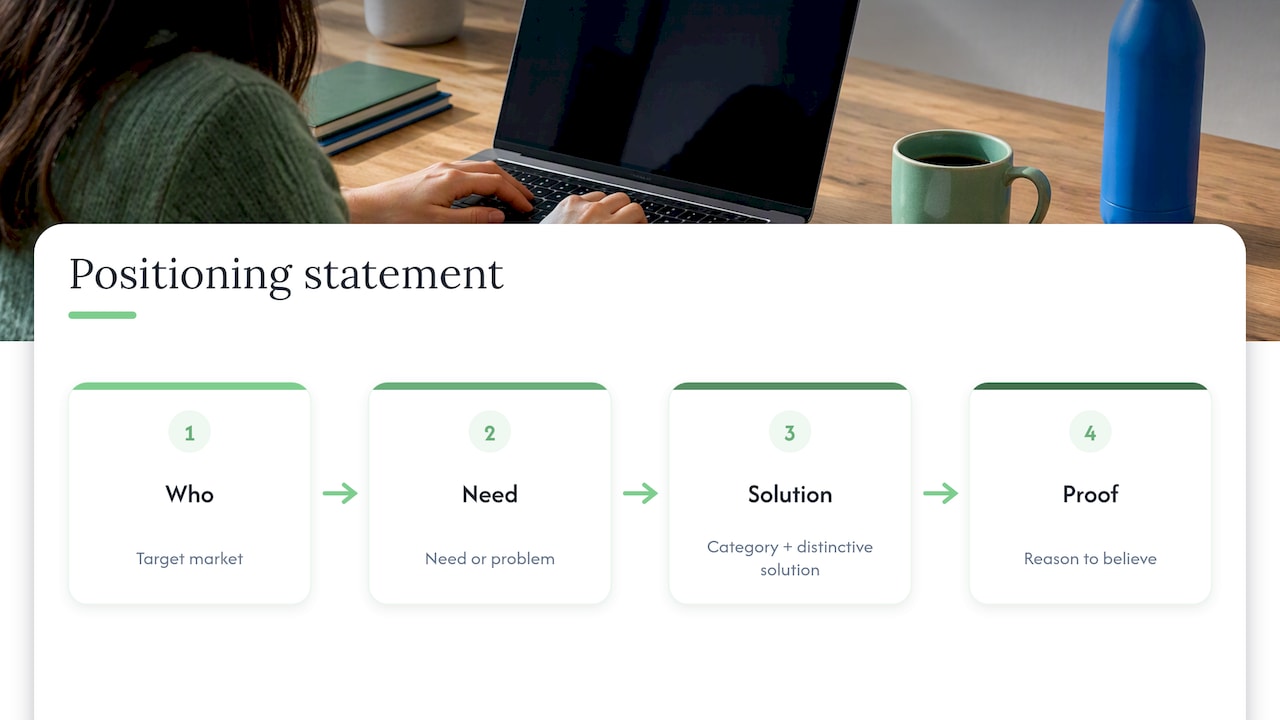
This is an internal sentence. You will not publish it as is. CIRA, which runs the .CA domain registry, offers a template that frames positioning around the target market, the need or problem, your distinctive solution, and a proof point or reason to believe. As a fill-in:
For [who], who [need or problem], [business name] is the [category] that [distinctive solution], because [proof].
Example for a Mississauga bookkeeper: “For owner-run trades businesses that dread tax season, Ledger & Lane is the bookkeeping service that sends you a one-page money summary every month, because we only work with trades and know what a truck lease and a holdback look like.” (A made-up business, to show the shape.)
If you cannot finish the “because,” you have found a gap worth fixing before you write anything public.
3. Your value proposition
The value proposition is the public version: the one or two sentences at the top of your homepage. It names the result the customer gets, not the thing you do. “We install heat pumps” is a task. “Stay warm in February without the surprise hydro bill” is a result. Then the plain description follows underneath so nobody has to guess what you sell.
4. Three message pillars
Pillars are the three or four themes you come back to. They keep you from saying fifteen things at once. For a restaurant they might be “local ingredients,” “ready in 10 minutes,” and “family-run since the first day.” Each pillar needs a one-line version, a longer explanation, and proof.
Pillars also solve the “what do I post?” problem. Each pillar becomes a recurring theme for posts, which is the same idea we cover in our guide to social media content pillars.
5. Proof points
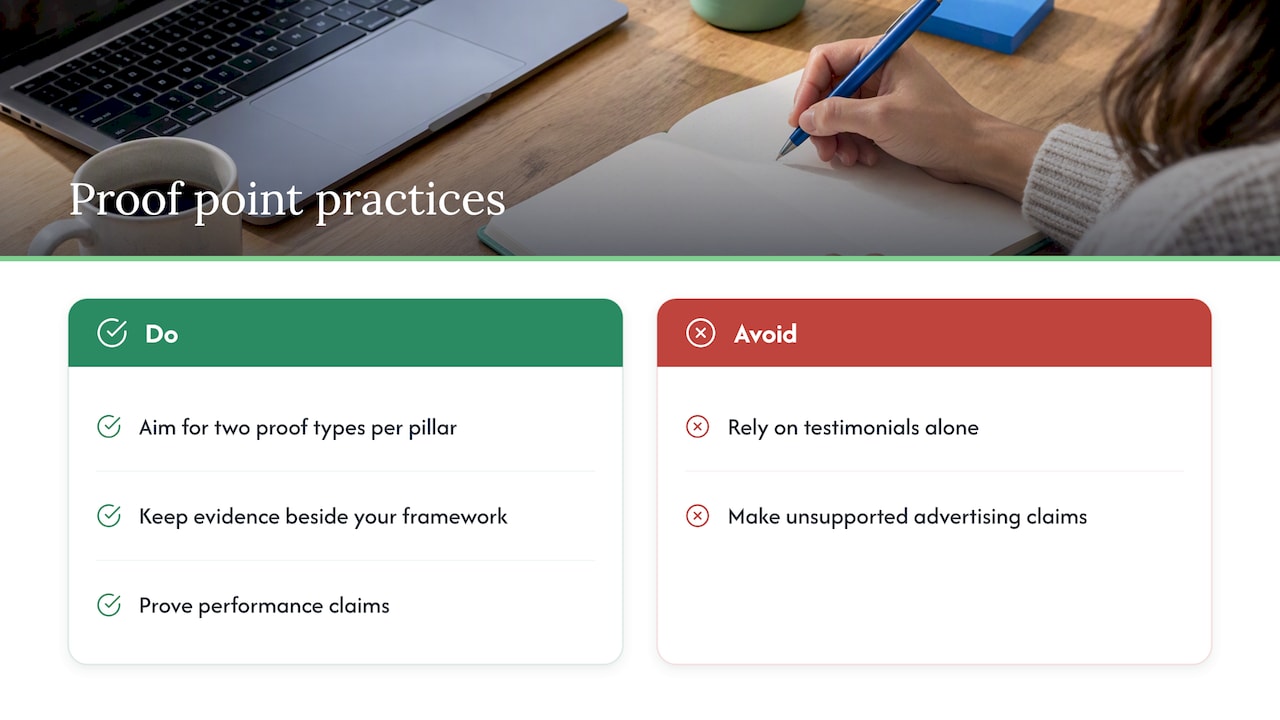
A claim without proof is just a mood. Proof can be numbers (years in business, jobs completed, response time), named customers with permission, certifications, photos of finished work, guarantees, or a process people can see. A good rule: aim for at least two types of proof per pillar, because different buyers weigh evidence differently.
In Canada this is also a legal matter, not just a trust matter. The Competition Bureau says performance claims in advertising must be proven, and testimonials usually do not amount to adequate proof. So “we cut your energy bill by 40%” needs real testing or data behind it. A happy customer saying it is not enough on its own. Keep the evidence in a folder next to your framework.
6. Voice and tone
Voice is your personality in words; tone is how it flexes. You sound the same at a funeral and a barbecue, but not identical. Pick three adjectives and write a “we are / we are not” line for each: “Plain-spoken, not blunt. Friendly, not jokey. Confident, not pushy.” We built a full one-page voice chart with eight examples for exactly this step.
A fill-in template you can copy
Open a blank document and answer these. Keep every answer short enough to say out loud.
| Part | Your question | Your answer |
|---|---|---|
| Audience | Who is my best customer and what just happened to them? | |
| Positioning | For who, who need, we are the, that, because | |
| Value proposition | What result do they get, in their words? | |
| Pillar 1 | The theme, in one line | |
| Pillar 2 | The theme, in one line | |
| Pillar 3 | The theme, in one line | |
| Proof | Two types of evidence per pillar | |
| Voice | Three adjectives and what we never say | |
| Words to use / avoid | Phrases customers use; jargon we drop |
One page is the target. If it spills onto three, you are writing a brand book, not a framework.
How to build it in an afternoon
- Collect real language (45 minutes). Read your last 20 reviews and customer emails. Highlight repeated words. Call two happy customers and ask: why did you pick us, and what almost stopped you?
- Look at what competitors claim (30 minutes). Open the websites of three businesses like yours. Write down the promises. If all four of you say “reliable and affordable,” those words are worth nothing, and you need a different angle.
- Find the difference a customer could verify (30 minutes). Not “better.” Something you can show: response within two hours, a flat quote before work starts, a single person who answers the phone.
- Write the positioning sentence and value proposition (30 minutes). Use the templates above. Read them aloud to someone outside your business.
- Choose pillars and attach proof (45 minutes). Three pillars, two proof types each. Mark any claim you cannot prove yet and either gather proof or soften the claim.
- Set the voice (20 minutes). Three adjectives, plus a short list of banned phrases.
- Run the recall test (ongoing). Show your homepage to five people for 10 seconds. Ask what you do and who you do it for. If three of five get it right, you are in decent shape.
CIRA’s guidance follows a similar order: define the brand story, target audience, competitors, positioning, and personality and voice, then allow the brand to evolve.
Brand messaging examples that work
The point of an example is not to copy the words but to see the logic.
A name that carries the message
Green Beaver, an Ontario natural personal care company, picked “Green” to express the purity of its products and “Beaver” to signal its Canadian origin. According to the Canadian Intellectual Property Office, that helped it stand out in a market dominated by American and European competitors. The lesson for a small business: a message is strongest when it is already in the first thing a customer sees, and when it names something your bigger rivals cannot claim.
A promise short enough to repeat
Uncle Studios, a Canadian clothing brand, built around the idea of “the clothes you live in.” Shopify’s write-up reports that its white T-shirt sold more than 3,000 units on quality alone. Seven words, one clear picture of the customer’s daily life. Any employee can say it, and any product decision can be checked against it.
What this looks like for a local service business
Here is a made-up before and after, for illustration only. A Barrie landscaper starts with: “Quality landscaping at competitive prices.” After the exercise, the audience is busy homeowners who hate chasing contractors. The new line becomes: “One crew, one price, one text when we finish. Your yard done without you managing it.” The pillars are: fixed quotes, same crew every visit, photos on completion. The proof: a sample quote, crew names on the website, and a gallery of before and after photos from real jobs.
The second version is more specific, easier to prove, and gives the owner a month of social content: introduce the crew, show a quote, post a finished job.
Same message, different customers
Most businesses have more than one kind of customer. A café may serve office catering clients and walk-in regulars. You do not need two frameworks. Keep the positioning and voice fixed, and change which value and which proof you lead with. A simple audience matrix maps each group to the pillars and proof that matter to them.
| Audience | Lead with | Best proof |
|---|---|---|
| Office manager ordering catering | Reliable on-time delivery, easy invoicing | Repeat orders, a delivery guarantee, sample menu |
| Walk-in regular | Fresh, local, friendly | Photos of the kitchen, supplier names, reviews |
| Event planner | Custom menus without stress | Past event photos, a clear quote process |
Same café, same voice, three emphases.
Where to use it (and where people forget)
A framework sitting in a drawer is worthless. Put it to work in these places first:
- Homepage headline and first paragraph. Your value proposition goes here. If you want help turning it into a site that gets calls, see our website development work.
- Google Business Profile and social bios. Same promise, same proof.
- Quotes and email signatures. The place where most owners accidentally sound like a different company.
- Case studies. One customer story can feed your homepage, social posts and emails. Our case study format shows how to turn a single interview into four assets.
- Visual rules. Colours, fonts and logo usage belong in a brand style guide, which sits beside your messaging framework.
- Onboarding. Give the one page to every new hire and freelancer. Asana’s advice is to coordinate it across marketing, sales and leadership, which at your size may mean you, your office manager and whoever answers the phone.
Keep your claims honest
The fastest way to turn a good message into a liability is to overpromise. Three habits keep you safe:
- Check every “guarantee,” “best,” “fastest” or percentage against real evidence you could hand over if asked. The Competition Bureau’s position is that performance claims must be proven.
- Do not rely on fine print to fix a big claim. The same guidance says fine-print disclaimers often fail to change the general impression of an ad, and that the overall impression must not be misleading. If the headline needs an asterisk to be true, rewrite the headline.
- Date your proof. “Rated 4.9 by 112 customers” needs a date in your internal notes so you know when to refresh it.
If you are unsure whether a specific claim in your industry is acceptable, ask a lawyer or check with the Competition Bureau directly before you print it on a truck.
Review it twice a year
Businesses change: a new service, a new neighbourhood, a competitor that copies your line. Asana recommends updating messaging when customers or the business change. The federal government’s small business guidance likewise says marketing plans should be revisited regularly to stay current with market trends and changes in business activities.
A practical rhythm: a 30-minute check each spring and fall. Ask whether the audience is still right, whether the proof is current, and whether the recall test still passes. Change one thing at a time so you can see what moved.
A short video version of all this
If you want to turn this into a 30 to 60 second video, here is the shape that works. Hook: “Ask your last customer to describe your business. Then compare it to your website.” Visual: split screen, their words on one side, your homepage on the other. Example: the landscaper rewrite above. Takeaway: write one sentence that finishes “For [who] who [problem], we [result] because [proof].” Say it out loud. If it makes someone ask “how?”, you have a message.
Perspective: what we see when we audit small business messaging
We work with owner-operators in trades, food service, professional services, non-profits and e-commerce, and the pattern repeats. The business is good. The message is vague. Owners describe their work in the language of tasks, but customers buy outcomes and relief.
Our view is simple: messaging comes before design, SEO and ads. A beautiful site with a fuzzy promise is a prettier way to lose leads. That is why our free trial starts with a full digital audit, and why we do the work in-house with the team you actually talk to: the person writing your homepage should have heard your customer calls. We would rather you spend an afternoon on a one-page framework than pay for a redesign that repeats the same vague line.
— Cristo
Want help turning the framework into a site that brings calls?
If you have your one page and want it on a homepage, a Google profile and a content plan, we can build that. Our monthly plans are Sprout at $300 per month, Grow at $600 per month and Scale at $1,200 per month, with one-off setup fees of $500 to $1,500, $1,500 to $3,500 and $3,500 to $7,500 respectively. Pricing is month to month with no lock-in contract. See the plans and pricing, browse everything we do, or start with the free audit from our home page.
FAQ
What is a brand messaging framework in simple terms?
It is a one-page guide that records who you serve, what you promise, the proof behind it and how you sound. Everyone who writes or speaks for your business uses it so customers hear one consistent story.
How long should a brand messaging framework be?
For a small business, one page is enough, with perhaps a second page of customer quotes and proof. If it grows longer, people stop using it. Keep every answer short enough to say out loud.
What is the difference between a brand voice and brand messaging?
Messaging is what you say: your promise, pillars and proof. Voice is how you say it: your personality and word choices. A framework includes both. For ideas on the voice side, see our brand voice examples.
Do I need proof for every message?
Yes, as far as you can manage. In Canada, the Competition Bureau says performance claims must be proven and testimonials usually are not adequate proof on their own. Gather at least two kinds of evidence for each pillar, such as figures, photos, certifications or process details.
How often should I update it?
Check it twice a year, and any time you add a service, change your customer base or notice a competitor using your line. Small edits are normal. A full rewrite is rare.
Sources
- Brand Messaging Framework: Components + 6-Step Guide (Asana)
- Marketing Your Business: Essential Read for Entrepreneurs (BDC)
- Seven steps to creating a strong brand identity (CIRA)
- False or Misleading Representations and Deceptive Marketing Practices (Competition Bureau Canada)
- Messaging Framework Template
- Brand Messaging Framework: From Value Prop to Ad Copy
- Green Beaver’s natural ingredient to success (CIPO)
- Brand Promise: Definition, Examples, and How to Write One (Shopify Canada)
- Marketing plan outline (Government of Canada, FedDev Ontario)