

Your best marketers may already be on your payroll. Employee advocacy on social media means your team shares your business, your work and your news on their own profiles, in their own words. Done well, a plumber’s apprentice posting a finished bathroom, or a bookkeeper explaining a tax deadline, will be trusted more than a polished post from your business page. This guide shows how a Canadian small business can set up a simple employee advocacy program, what to post, how to keep it voluntary and legal, and how to tell if it works.
TL;DR
- Employee advocacy is staff sharing your business on their personal accounts. A program just gives them ideas, permission and an easy way to do it.
- Start with three to five willing people, not the whole team. Voluntary beats mandatory every time.
- Give staff real stories to share (jobs finished, lessons learned, hiring news), not scripts to copy.
- In Canada, employees who promote your business must disclose the connection. Put it in a one-page policy.
- Track a few simple numbers: profile visits, enquiries that mention a post, and applications.
Table of Contents
- Why would anyone trust my employees more than my business page?
- What is an employee advocacy program, really?
- What can employees actually post?
- How do I get my team to do it without it feeling forced?
- What do Canadian rules say about employees promoting the business?
- How do I set up a simple program in a month?
- How do I know if it’s working?
- Common mistakes to avoid
- Perspective: what we see working for small teams
- Want help building the content side?
- FAQ
- Sources
Why would anyone trust my employees more than my business page?
People believe people. A company page is, to most readers, an ad. A real person who works there, with a face and a history, reads as a witness.
Here is a visual idea you can test in thirty seconds. Open your business page and scroll the last ten posts. Now open your most social employee’s profile and scroll their last ten. Count how many have a real face, a real job site, a real kitchen or a real desk. The business page usually loses.
The common claims you will read online are big: that employee-shared content gets several times the engagement of brand posts. Those numbers come from software vendors who sell advocacy tools, so treat them as directional, not guaranteed. What you can count on is the logic behind them. A personal account usually has a smaller, warmer audience of neighbours, former colleagues, suppliers and friends. Those are exactly the people who refer small businesses.
For an Ontario HVAC company, a restaurant or a three-person accounting firm, that warm audience is the whole market. Your crew’s networks overlap with your customers’ networks more than you think.
What is an employee advocacy program, really?
Employee advocacy is the organic practice of staff speaking well of their employer. A program is what you build to make that easier: ideas, a bit of training, shareable content and a way to say thanks. Marketing platforms describe it as formalizing something that already happens, which is the right way to see it.
For a company with 5 to 50 people, you do not need software. You need:
- A short list of what you would like shared.
- A simple channel (a group chat works) to drop ideas and photos.
- A policy that says what is fine, what is not, and what must be disclosed.
- Someone who spends 30 minutes a week keeping it going.
That is it. Dedicated advocacy platforms exist, and they can help once you have dozens of participants and want reporting. Under about 20 people, they are usually more machinery than you need.
What can employees actually post?
The worry owners raise first is, “What would they even say?” The answer is: more than you expect, if you give them categories instead of scripts. Typical shareable content includes blog posts, job listings, industry insights, product launches and original posts.
Here is how that looks in trades, food service and professional services.
| Business type | Easy post for staff | Why it works |
|---|---|---|
| Electrician or plumber | Before and after photo of a finished job (with the customer’s OK) | Proof of real work, which is what buyers search for |
| Restaurant or café | A new menu item being plated, or the morning prep | Visual, short, shareable as a Reel |
| Accounting or law firm | A plain-language tip on a deadline or a common mistake | Shows expertise without selling |
| Non-profit | A volunteer’s reason for showing up | Recruits donors and helpers |
| E-commerce | Packing an order, or a staff pick | Puts faces behind the shop |
| Any of the above | “We’re hiring” with a real description of the work | Reaches people who know your team |
If you are not sure what your business should talk about, a content plan helps. Our guides on social media content pillars and a Canadian social media content plan give you themes your staff can pull from, so every post does not start from a blank page.
The 30-second video test
The best employee posts are often a short video. A good rule: if it cannot be told in 30 to 60 seconds with one surprising visual, it is not ready. “Watch us rebuild this furnace in 40 seconds” beats “Proud to be part of this amazing team” every time. Ask your team to film what they already do, not a performance.

How do I get my team to do it without it feeling forced?
You cannot order enthusiasm. Hootsuite’s guidance says plainly that compulsion defeats the purpose of advocacy, because real advocacy comes from wanting the company to do well. In a small business, there is a second reason: your staff can see through a boss who says “optional” and then counts who posted.
What works instead:
- Ask, don’t assign. Invite two to five people who already post. Let it grow by word of mouth.
- Make it about them too. A technician who posts a great job builds their own reputation. A well-run profile helps a person’s career, and that is a fair trade. If you want to give your team a framework, a piece on building a personal brand is worth sharing with them.
- Let them use their own words. Copy-pasted captions are easy to spot and the algorithm does not reward them.
- Say thanks in public. A shout-out at the Monday huddle costs nothing.
- Respect the “no”. Someone who keeps their personal profile private has made a reasonable choice. Their work is still valued.
- Pay for work time. If you want posts made during the workday, say so. Posting on personal time as an unspoken expectation can cause real resentment.
What do Canadian rules say about employees promoting the business?
This is the part most U.S.-written guides skip. Three Canadian points matter for a small business.
Disclose the connection
The Competition Bureau has warned that when employees post reviews about their own company or its competitors, they must disclose every connection to the business, even if the opinion is honest. The same notice says this covers testimonials on social media, and that businesses can be liable for misleading reviews.
For your team, that means a staff member should never post a five-star review of your business on Google without saying they work there. The simplest rule for your policy: no employee reviews of the business, or of competitors, at all. Share stories and work instead.
For promotional posts, the Bureau’s guidance on influencers says material connections must be disclosed in a way that is prominent, clear and visible without clicking a button. Employees are not influencers in the usual sense, but a plain line such as “I work at [business]” in the post, not buried in a profile, keeps you safe. The Bureau’s own digest tells advertisers to leave nothing to chance on disclosure, and that is a good habit to adopt.
Don’t overreach on privacy
The Office of the Privacy Commissioner says a good policy should state whether the employer monitors social media, and that employees should know workplace-related posts may be collected and used, including off-duty posts about workplace issues. Note that PIPEDA applies to employee information mainly in federally regulated businesses, so check with a lawyer or your provincial rules for how it applies to your Ontario business.
On the other side of the line, the Commissioner says employers would likely go too far by asking for passwords to employees’ social accounts. Never ask for logins, even to “help schedule posts”. The same guidance says that because of the power gap between boss and worker, consent should be clear, informed and voluntary. That fits the voluntary approach above.
If your program touches customer photos or names, also read our privacy policy checklist for Canadian small businesses. Get permission before a customer’s home, face or name appears in a staff post.
Put it in one page
Your policy does not need to be long. Cover these points:
- Participation is voluntary.
- Say that you work for the business when promoting it.
- No posting customer information, prices quoted to named clients, or job-site addresses without consent.
- No reviews of the business or competitors.
- Don’t criticize competitors by name.
- Who to ask if unsure.
- Whether and how the business monitors public posts.
If employment law questions come up, such as posting during work hours or rules on off-duty conduct, talk to an Ontario employment lawyer. This article is not legal advice.
How do I set up a simple program in a month?
The steps most guides recommend are goals, leadership buy-in, enthusiastic advocates, training, shareable content and a feedback loop. Scaled down for a small team, here is a realistic month.
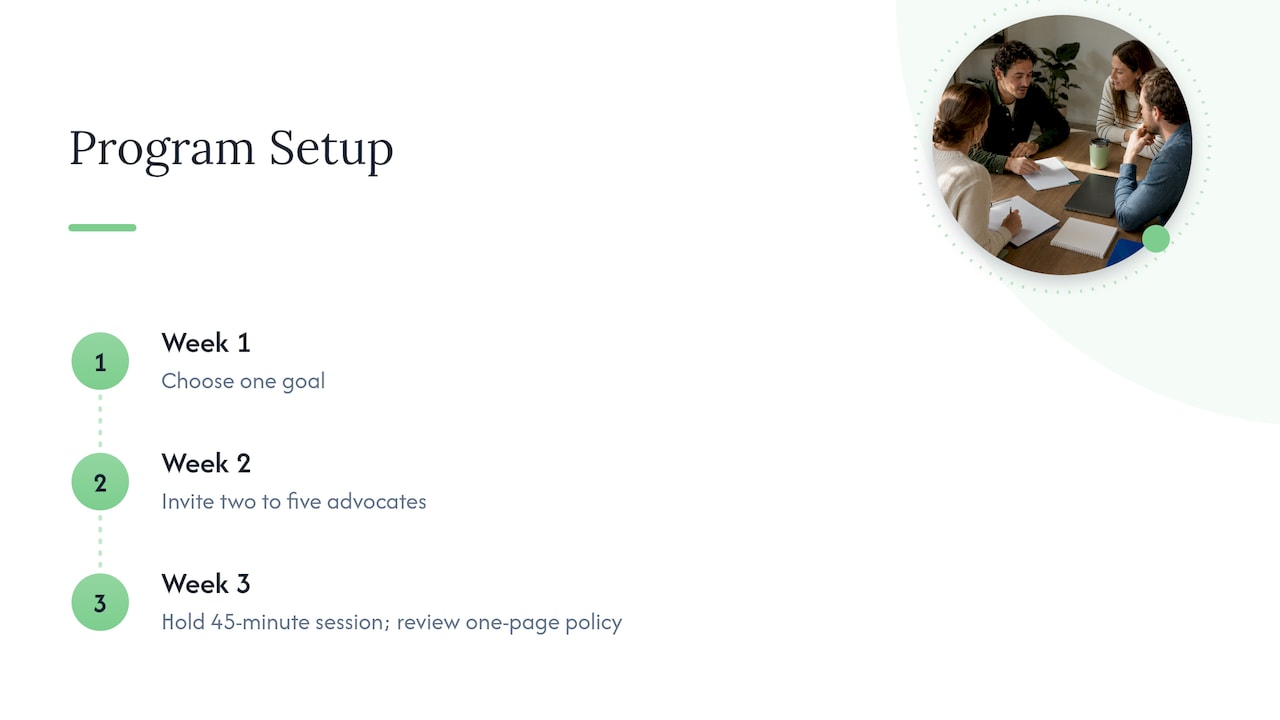
Week 1: Pick one goal. Choose one: more enquiries, more job applicants, or more local recognition. A restaurant might want kitchen applicants. A renovation firm might want quote requests. One goal keeps the content focused.
Week 2: Choose your first advocates. Talk with two to five people one-on-one. Show them what you have in mind. Ask what they would be comfortable posting. Make sure the owner takes part too, since a program that the boss skips does not last.
Week 3: Run a 45-minute session. Cover what to post, how to say you work for the business, what not to share, and how to tidy a LinkedIn or Facebook profile. Write the one-page policy and go through it together.
Week 4: Launch and collect. Create a group chat or shared folder for ideas, photos and short videos. Post two or three times as a group, and let the team suggest the next batch. A feedback loop where employees suggest their own content is what keeps it alive past the first month.
A simple weekly rhythm
- Monday: the owner or manager shares one or two story ideas in the group chat.
- Midweek: staff post what they like, in their own words.
- Friday: 10 minutes to reshare the best ones from the business page and say thanks.
That is about 30 minutes of management time a week. If that sounds like too much alongside running the business, it is the kind of routine we can run with you, or for you.
How do I know if it’s working?
Track a few numbers, not twenty. Hootsuite suggests reach, engagement, website traffic and leads, along with qualitative feedback. For a small business, translate that into plain habits:
| What to watch | How to check it | Simple signal of success |
|---|---|---|
| Reach and profile visits | Each person’s post analytics, once a month | Visits to your business page go up |
| Enquiries | Ask every new customer “How did you hear about us?” | Someone names a staff member’s post |
| Website traffic | Add a tracking link in the post and check your analytics | Visits from social media rise |
| Hiring | Count applications and where they came from | Applicants say they saw a post from a current employee |
| Team feedback | A five-minute chat each month | People still want to take part |
Give it 90 days before you judge it. Referral-style marketing is slow, then it compounds. If nothing has moved by then, the usual fixes are better content (more visual, more specific), not more pressure.
Common mistakes to avoid
- Scripts. If every post sounds the same, readers notice and so does the platform.
- Starting with everyone. A big launch with a mandatory email fails. Start small.
- Only posting links. A photo or short video of real work will beat a link to your homepage.
- Ignoring the business page. Advocacy supports your own channels, it does not replace them. If you want to manage your own channels well, our guide to running social media without an agency is a good start.
- Skipping the policy. A one-page agreement protects both sides.
Perspective: what we see working for small teams
We work with owner-operators in trades, food service, professional services, non-profits and e-commerce, and the pattern is consistent. The businesses that get traction on social media are rarely the ones with the most polished feed. They are the ones where someone shows the actual work and the actual people.
That is why we do not push advocacy as a tool or a tactic. We see it as a result of a business your team is proud of, plus a bit of structure. If your staff are not proud to say they work there, no program will fix that, and the better investment is in how you run things. If they are proud, the thing holding them back is usually not knowing what to post or whether it is okay. A simple list of ideas and a clear one-page policy fix most of that.
Our advice for a team of under 20: pick two enthusiastic people, one clear goal, and one month. Measure by asking customers how they found you. Then decide whether to grow it. Skip the software until you have a real reason to need it.
— Cristo
Want help building the content side?
Most owners tell us the hard part is not the idea, it is finding the time to plan, film and post. We handle that in-house, with no outsourcing, and you speak directly with the people doing the work. Our monthly plans run month to month with no lock-in: Sprout is $300 per month, Grow is $600 per month and Scale is $1,200 per month, each with a one-time setup fee (see the pricing page for the ranges). We also start with a free trial that includes a full digital audit, so you can see where your social presence stands before you commit.
If you would like us to build the content plan and templates your team can share from, see our content creation services or start at cloudsprout.ca.
FAQ
Do I need an employee advocacy platform?
Not to start. A group chat, a shared folder and a one-page policy are enough for most teams under 20 people. Platforms mainly add content libraries and reporting, which become useful when many employees take part. Try it by hand first, so you know what you actually need.
Can I require employees to post about the business?
It is a bad idea. Advocacy only works when people want to do it, and forcing it defeats the purpose. Privacy guidance also says employers should avoid undue pressure given the power imbalance. Make it an open invitation, and speak to an Ontario employment lawyer before adding any expectation to a job description.
Do employees have to say they work for the business?
Yes, when they are promoting it or posting reviews. The Competition Bureau says employees must disclose their connection when posting reviews of their employer or its competitors. A simple “I work at” in the post itself is the safest habit for every promotional post.
How many people do I need for it to matter?
Two or three active people can make a visible difference in a local market, because their networks overlap with your customers. Start small, check what brings in enquiries, and then invite others.
How long before I see results?
Plan on about 90 days of steady posting before you judge. Ask new customers where they heard of you, and track applications and website visits from social media over that time. Results depend on your market and your content, so no honest provider can promise a number.
Sources
- How to Create an Employee Advocacy Program on Social Media
- Top Employee Advocacy Guide: Tips, Tools and Programs
- Employee Advocacy Program Guide (Hootsuite)
- Online reviews posted by employees: businesses could be liable (Competition Bureau)
- Influencer marketing and the Competition Act
- The Deceptive Marketing Practices Digest, Volume 4
- Privacy and social media in the workplace (Office of the Privacy Commissioner)
- Privacy in the Workplace (Office of the Privacy Commissioner)