
Fix your Google Business Profile, get a review system running, and build one strong page for your top service before touching anything else. Do those three things and the Map Pack, Google’s local search results, starts shifting in weeks, not months. Complete profiles with active reviews and photos consistently pull more calls than half-finished ones, and that’s the leverage point every trade business should hit first.
TL;DR:
- Claim and verify your Google Business Profile, correctly set your primary category, and ensure your services are detailed and accurate to boost local SEO quickly.
- Use high-quality photos, ask for reviews immediately after jobs, and reply to every review within 48 hours to improve visibility and trust signals.
- Build specific service pages for your top revenue services and cities, with clear explanations, real images, and schema markup to enhance local rankings and conversions.
- Conduct a citation audit to ensure your business name, address, and phone number match across directories, as consistency significantly affects rankings.
- Expect Map Pack improvements within two to twelve weeks with ongoing work, and plan for organic SEO results to take three to nine months to fully develop.
Table of Contents
- What Is Local SEO for Trades, Exactly?
- Your Local SEO Checklist for Trades: Week 1 to Month 3
- How Do You Set Up Google Business Profile for Trades?
- Building Service Pages That Actually Win Local Searches
- When Should You Ask for a Review, and How?
- Do Citations and Local Links Still Matter?
- How Long Does Local SEO Take, and What Does It Cost?
- Common Local SEO Mistakes Trades Make (And Weekend Fixes)
- How Cristo and Cloudsprout Approach This Playbook for Trades
- Get a Free Local SEO Audit Built for Trades
- Sources
- FAQ
What Is Local SEO for Trades, Exactly?
Local SEO for trades means getting your plumbing, electrical, HVAC, or contracting business to show up when someone nearby searches for that service right now. It’s not the same game as ranking a blog nationally. A local search strategy for trades lives or dies on three things: your Google Business Profile, your reviews, and whether your website actually answers the question “can this person fix my problem today, near me?”
The standard industry term is “local search engine optimization,” but most tradespeople just call it “getting found on Google” or “showing up in the map thing.” Whatever you call it, the mechanics are the same whether you’re doing plumber local SEO in Barrie or electrician local SEO in Hamilton. Get the fundamentals right once, and they work everywhere you operate.
Your Local SEO Checklist for Trades: Week 1 to Month 3
Here’s the order that actually moves the needle, broken into what you can do this week versus what takes a quarter.
- Claim and verify your Google Business Profile (30–60 minutes). If it’s unclaimed, someone else could be editing your hours or address right now.
- Set your primary category correctly (10 minutes). “Plumber” beats “Contractor” every time if plumbing is your main trade.
- Add every service you offer with real descriptions (1–2 hours). Drain cleaning, water heater install, emergency leak repair — each one is a searchable term.
- Set your phone number, hours, and emergency availability (15 minutes). If you do 24/7 emergency calls, say so.
- Ask for a review at job handover, every single job (ongoing, near zero cost). This is the highest-leverage habit on this whole list.
- Upload 20 photos of real jobs (1 hour). Before/after shots of a finished panel upgrade or a repiped basement do more than stock images ever will.
- Build one service page for your top revenue service (3–5 hours, or hand it to a developer). This is home services local SEO’s biggest missed opportunity for most small shops.
- Run a citation audit — check your business name, address, and phone match across directories (2–3 hours).
- Set a review reply cadence — check weekly, reply within 48 hours (15 minutes/week ongoing).
- Start local link outreach — suppliers, associations, chambers (ongoing, a few hours a month).
Pro Tip: If you only have one hour this week, spend all of it on your Google Business Profile categories and services list. It’s free, it takes an hour, and it’s the single fastest lever for improving local SEO for contractors before you touch your website.
How Do You Set Up Google Business Profile for Trades?
Your primary category is the single most powerful field on your entire profile, and most trades get it wrong. Choose the most specific option available. “HVAC Contractor” outperforms “Contractor.” “Plumber” outperforms “Home Services.” Add two or three secondary categories that genuinely apply (Drainage Service, Water Heater Installer) but don’t stack ten to game the system. Google penalizes that behavior more than it rewards it.
Service-area settings trip up more trades than any other setting. If customers never visit your shop or garage, hide your street address and list the towns or a radius you actually serve instead. Showing a residential address when you’re not a storefront confuses customers and can hurt trust signals with Google itself.
Beyond category and address, a few fields quietly carry a lot of weight:
- List every individual service under the Services tab, not just a general blurb.
- Answer your own Q&A section before customers ask, covering pricing ranges and emergency response times.
- Post weekly, even something simple like a finished job photo with a caption naming the service and neighborhood.
- Set accurate hours, including holiday hours and 24-hour emergency lines if you run them.
Statistic Callout: Profiles with 100+ photos and active recent reviews generate substantially more calls and direction requests than sparse, rarely-updated ones, according to aggregated Map Pack benchmark data. Photos and review activity aren’t cosmetic. They’re ranking and conversion signals working at the same time.
Review replies matter almost as much as review volume. Thank the good ones by name and service. Respond to the bad ones calmly, without arguing, and offer to make it right offline. Google and customers both read those replies.
Building Service Pages That Actually Win Local Searches
One page per service beats a single “Our Services” page every time, and one page per city beats a single service page when you genuinely serve multiple towns. A generic page trying to rank for “plumber,” “electrician,” and “handyman” all at once usually ranks for none of them well. Search engines reward specificity, and so do customers scanning results on their phones.
A service page that actually converts needs a few non-negotiable pieces:
- A clear explanation of what the job includes, written in plain language, not trade jargon.
- Urgency signals where relevant (“burst pipes need same-day response”) that match how customers actually search.
- Rough price ranges. Vague pricing chases people away faster than a number that’s “too high.”
- Real job photos from that specific service, plus a visible, tappable phone number above the fold.
Add LocalBusiness and Service schema markup to each page so Google understands exactly what the page offers and where you serve it. This is one of the more overlooked levers in trades business local optimization. Most competitors skip it entirely, which makes it a genuine edge for the businesses that don’t.
Mobile experience decides whether any of this converts. Tap-to-call buttons, a phone number visible without scrolling, and a page that loads in under three seconds on a job-site connection are the baseline, not a bonus.
Pro Tip: Reuse job photos and testimonials across city pages by rotating in specific project details for each town, real customer names, real neighborhoods, real dates. Copy-pasting the same paragraph across five city pages with only the town name swapped reads as a doorway page to Google and to customers, and it can hurt rankings across the board.
When Should You Ask for a Review, and How?
Ask at the moment the job is done, while you’re still standing in the driveway or kitchen. That’s the single highest-converting moment for any review request, full stop.
- Ask verbally on-site, right after the customer sees the finished work.
- Send a text with a direct Google review link within the hour, while the job is still fresh.
- Follow up by email 48 hours later if there’s no response, with the same direct link.
- Prompt for specifics gently: “Mention the service and your neighborhood if you don’t mind” tends to produce reviews packed with the exact words future customers search.
- Reply to every review within 48 hours, positive or negative, by name.
Review content that mentions the actual service and location helps far more than a generic five-star rating with no text. It signals relevance to Google and gives future customers something concrete to trust.
Want this running in your business without doing it yourself?
Book a Free Consultation →Statistic Callout: Review recency and volume are among the strongest factors in Map Pack placement, and academic research on review platforms confirms reviews shift real customer demand, not just rankings. In competitive metro areas, businesses averaging one to two fresh reviews a week consistently outpace shops that collect reviews sporadically.
Do Citations and Local Links Still Matter?
Yes, but they’re a background task, not a weekend sprint. A few citations carry outsized weight for trades specifically: your local chamber of commerce, manufacturer “find a dealer” or “find a contractor” pages if you’re an authorized installer, and trade association directories. These aren’t just links. They’re trust signals that tell Google (and customers) you’re a verified, established operator.
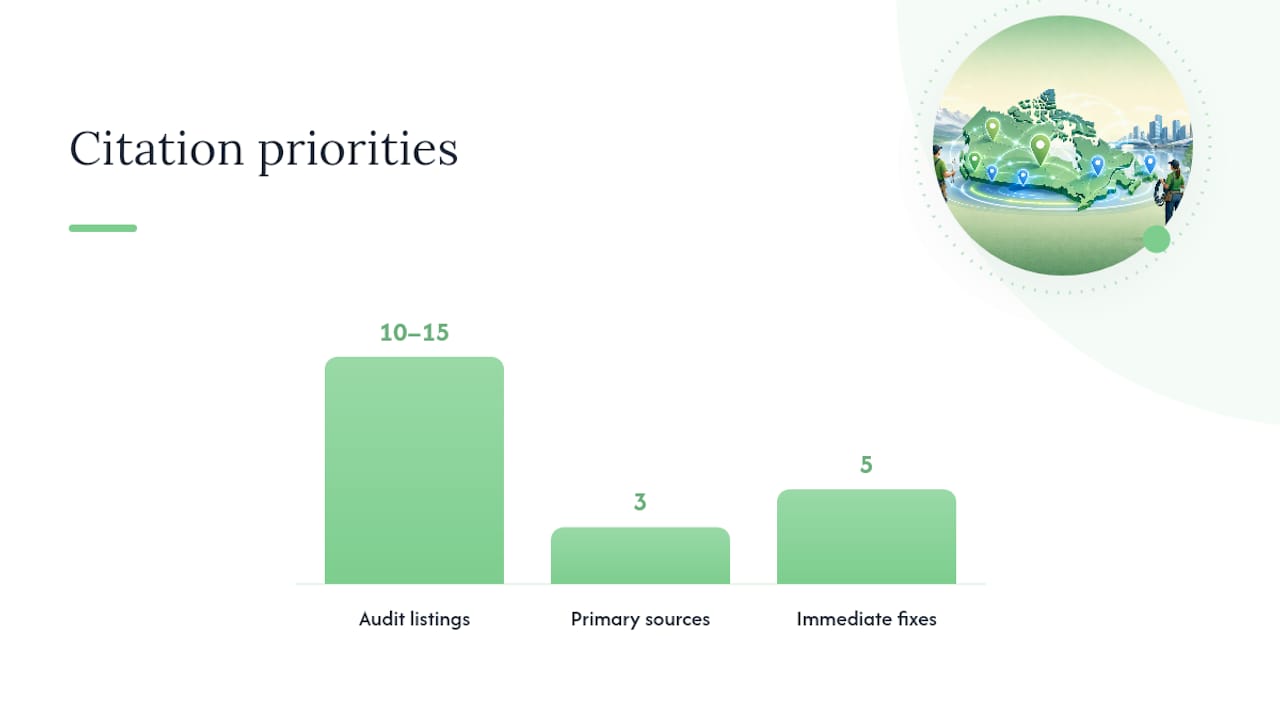
Run a quick NAP audit, checking that your business name, address, and phone number match exactly across your top 10 to 15 listings.
- Start with Google Business Profile, your website footer, and Facebook, since customers check those three most.
- Check supplier and manufacturer pages next, since those often get created once and never updated.
- Fix the top five mismatches within two hours; the rest can wait for a monthly cleanup pass.
- Sponsor a local Little League team or trade show booth for a natural backlink and community goodwill.
- Get listed in supplier “authorized dealer” directories if you carry brand certifications.
Citation consistency issues are one of the most common reasons a business plateaus in rankings after doing everything else right.
How Long Does Local SEO Take, and What Does It Cost?
Map Pack movement from GBP fixes alone often shows up within two to twelve weeks. Organic page rankings for service pages typically need three to nine months to mature, and a genuinely dominant local presence takes closer to nine to twelve months of consistent work.
| Metric to track | Tool to use | What it tells you |
|---|---|---|
| Calls and direction requests | GBP Insights | Real-world demand from your profile |
| Discovery vs. direct searches | GBP Insights | Whether new customers are finding you or looking you up by name |
| Website conversions and call quality | CallRail or similar call tracking | Which pages and campaigns produce real booked jobs |
| Keyword and Map Pack position | Rank grid tools, Google Search Console | Where you actually rank across your service area, not just at your shop |
Cost shapes vary widely and any number here is an example, not a guarantee. A DIY cleanup of GBP and citations might cost nothing but your own time. Ongoing managed local SEO for tradesmen through an agency commonly runs as a monthly retainer scaled to how competitive your city is. Treat any quote promising a guaranteed page-one ranking with suspicion. Nobody controls Google’s algorithm outright.
Common Local SEO Mistakes Trades Make (And Weekend Fixes)
- Showing a home address on a service-area business. Fix: switch to service-area mode and hide the address in your GBP settings, today.
- Mismatched business name or phone number across listings. Fix: audit your top five directories this weekend and correct any typo or old number immediately.
- One thin “services” page trying to cover everything. Fix: split it into two or three focused pages over the next month, starting with your highest-margin service.
- No visible phone number on mobile. Fix: add a sticky tap-to-call button before Monday. This alone can lift call volume noticeably.
- Photos that are two years old or missing entirely. Fix: take 15 photos on your next job and upload them the same day.
How Cristo and Cloudsprout Approach This Playbook for Trades
Most trade businesses lose leads to two things: a half-finished Google Business Profile and a website that loads slowly on a job-site phone. Some agencies build and manage both in-house, without outsourcing, for owner-operators across Ontario and Canada. Clients often see their first jump in GBP calls within the first month, once categories, services, and photos are cleaned up and a review cadence is running. The rest, service pages, schema, citations, compounds from there.
— Cristo
Get a Free Local SEO Audit Built for Trades
Some companies offer a practical alternative to hiring a traditional agency for local SEO for trades, providing no lock-in contracts, transparent month-to-month pricing, and a team that builds your website, Google Business Profile, and review system in-house instead of farming it out to subcontractors.
Every new client starts with a free SEO audit that checks your GBP setup, citation consistency, and mobile site speed against exactly the checklist above. If your site needs more than a tune-up, Cloudsprout also handles full website development built for tap-to-call conversion from day one.
| Route | What happens first | Typical first result |
|---|---|---|
| DIY quick fixes | You claim GBP, fix categories, start asking for reviews | Map Pack movement within weeks |
| Cloudsprout managed | Free audit, then GBP + site + review system setup | Measurable call increase within the first month |
Book the free audit and find out exactly which fix on this list will move your calls fastest.
Sources
This playbook draws on contractor-focused local SEO research from BKND Development and HearBack, Map Pack benchmark data from PipelineOn, and review-behavior research from Harvard Business School Working Knowledge. For UX auditing, Microsoft Clarity is free and worth running on any service page.
- Local SEO for Plumbers: How to Win the Map Pack in 2026
- The Yelp factor: are consumer reviews good for business
FAQ
How Much Should I Pay for Local SEO?
Costs vary by market competitiveness and scope, so treat any flat number as a rough guide rather than a rule. A basic DIY cleanup costs only your time, while ongoing managed local SEO services for tradesmen are typically billed as a monthly retainer scaled to your city’s competition.
How Do I Get Started With Local SEO?
Claim and fully complete your Google Business Profile first, since it’s free and often produces the earliest measurable leads. Then build a review-request habit at every job handover and create one strong service page for your top revenue service.
Is SEO Still Worth It in 2026?
Yes. The Local 3-Pack still captures the large majority of clicks on local-intent searches, and trades with complete, active profiles consistently out-earn competitors who ignore this. Paid ads can supplement it, but organic local visibility keeps working long after you stop paying for clicks.
What Is the 80/20 Rule in SEO?
For trades, the 80/20 rule means roughly 80% of your local visibility gains come from 20% of the work: completing your Google Business Profile, running a consistent review system, and publishing one focused service page. Everything else, deeper citations, backlinks, blog content, adds value but moves the needle far more slowly.
Do I Need a Different Page for Every City I Serve?
Only for towns you genuinely and regularly serve with real job history, not every town within driving distance. A thin page for a city you’ve worked in twice looks like a doorway page to both Google and customers, and it can drag down pages that are actually earning traffic.
Recommended
Less reading. More growing.
We build the systems these articles describe. Websites, AI follow-up, reviews, automation. And run them for you.
Keep reading

One Page Voice Chart: 8 Brand Voice Examples Small Businesses Can Use